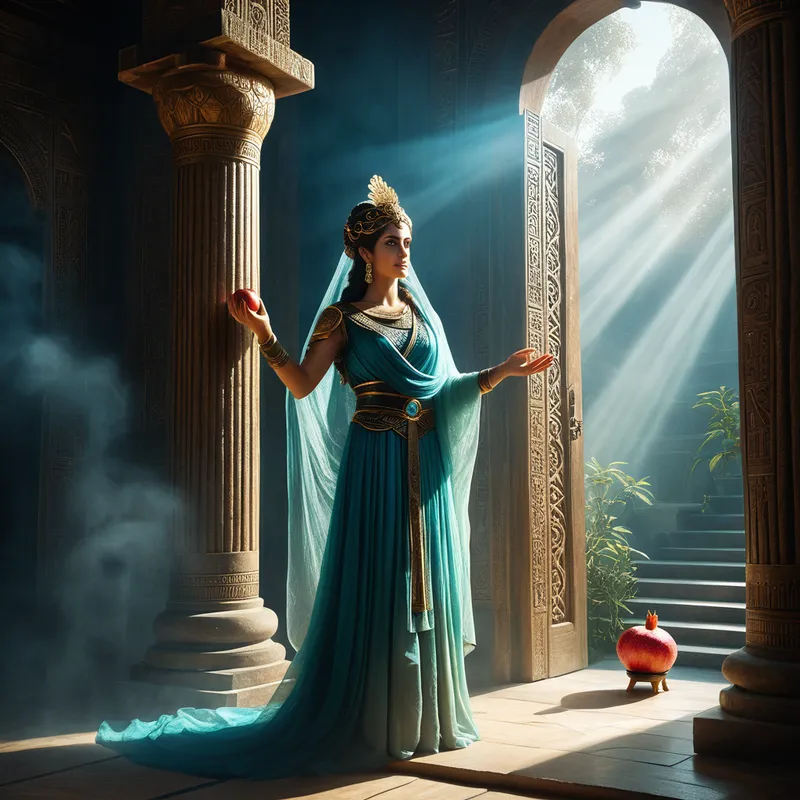
Hera's Chamber Myth Meaning & Symbolism
The myth of Hera's annual retreat to a hidden chamber, where she renews her sacred power and virginity, symbolizing the soul's need for cyclical regeneration.
The Tale of Hera's Chamber
Listen, and I will tell you of a mystery known only to the gods and the deepest roots of the world. It is not a tale of thunderous battle or desperate quest, but of a secret, sacred rhythm—the heartbeat of the Queen herself.
Each year, when the heat of high summer began to wane and the first hint of crispness touched the air on Olympus, a profound stillness would descend upon the halls of power. The laughter of the gods grew muted; the scheming of immortals paused. For it was time. Hera, the ox-eyed Queen, sovereign of the heavens and partner to the cloud-gatherer Zeus, would withdraw.
She did not announce her departure with fanfare. She simply ceased to be present in the glittering courts. Her formidable gaze, which could freeze the blood of a Titan, turned inward. With a dignity that silenced even the most brazen of suitors or complainants, she would leave the golden palaces behind. Her path was not charted on any map. It led to a place whispered of but never seen: her secret chamber.
This was no room of gold and ivory. It was a place of the earth’s first magic. Some say it was a grove so ancient the trees remembered when time began, their branches forming a living vault. Others say it was a cavern behind a waterfall whose mists held perpetual rainbows. There, in that hidden sanctum, was a couch—not a throne, but a simple resting place strewn with the most fragrant of herbs: myrtle for love, lotus for forgetfulness, and crocus for the light of dawn.
Here, alone, the Queen performed her most sacred rite. She would lay aside her regalia—the diadem, the scepter, the veils of state. Most significantly, she would untie the cestus, the girdle of allure and power. She would bathe in a spring that bubbled from the chamber’s heart, water so pure it could wash away not merely dust, but the very accumulation of the year—the strife of her tumultuous marriage, the burdens of sovereignty, the endless cycle of her husband’s infidelities and her own formidable wrath.
In that bathing, in that solitude, a miracle transpired. Hera renewed her parthenos, her sacred virginity. Not the virginity of inexperience, but the virginity of the absolute self—whole, unto herself, sovereign and renewed. The goddess of marriage returned to the primal source of her own being, separate from the union she presided over. She emerged not as Zeus's wife, but as Hera, complete. And only then, restored to her foundational power, would she return to Olympus, her majesty not merely intact, but deepened, ready to rule for another cycle of the world.

Cultural Origins & Context
This myth, primarily recounted in a few lines of the Iliad and elaborated in later cultic contexts, was not a popular epic for the masses. It was a mystery, closely guarded, likely central to the rites of Hera’s most important sanctuaries, such as those on the island of Samos and at Argos. Here, her priestesses would re-enact this Anados (ascent) and Kathodos (descent) in annual festivals.
The societal function was profound. In a culture where Hera was both the model of the married queen and a famously "jealous" and embattled wife, this myth provided a crucial counter-narrative. It asserted that her power was not derivative from her spouse, but intrinsic and self-renewing. It modeled a necessary rhythm for all forms of authority and partnership: the sacred withdrawal for regeneration. For the ancient Greek listener, especially women within the patriarchal structure of marriage, it offered a powerful symbolic truth—that identity could be periodically reclaimed in solitude, that one could return to the source of one’s own power.
Symbolic Architecture
The chamber is the ultimate symbol of the inviolable Self. It is not a place of hiding, but of encounter—with the core identity that exists before and beyond all relationships and roles.
The true throne is not the seat of visible power, but the inner sanctum where power is reborn from its own source.
Hera’s annual retreat represents the necessary cyclical death and rebirth of the personality. The marriage, with all its celebrated joys and legendary conflicts, represents the complex, often painful, engagements of the ego with the world (Zeus as the archetypal principle of expansive, often chaotic, consciousness). The chamber is where the psyche retreats from that engagement to remember its own essence. The bathing is a lustratio—a ritual purification of the accumulated psychic material of the year: resentments, compromises, projections, and fatigue. The renewal of parthenos is the reclaiming of psychic autonomy.
The pomegranate, often associated with Hera, is key here. It symbolizes the intact, seeded potential of the Self. The chamber is the pomegranate’s rind—the protective, defining boundary that contains the multitude of latent possibilities within a single, sovereign unity.
The Dreamer's Resonance
When this myth stirs in the modern unconscious, it often manifests as dreams of discovering a secret room in one’s house, finding a hidden garden, or arriving at a tranquil, enclosed natural space—a clearing, a secluded beach, a silent library wing. The somatic feeling is one of deep relief, expansion, and quiet awe. There is a palpable sense of "I am not supposed to be here, yet it is meant for me."
This dream pattern signals a psyche at the brink of burnout, over-identified with its external roles—the caregiver, the executive, the partner, the parent. The psyche is building its chamber, urging a withdrawal. The conflict in the dream is rarely about entering the space, but about leaving it or fearing its discovery by others (the demands of the outer world). To dream of Hera’s Chamber is to experience the Self’s non-negotiable demand for sacred solitude, for a period where you are not defined by your function in another’s story. It is the call to untie your own cestus—to lay down the tools of attraction, negotiation, and influence—and simply be in your own essence.
Alchemical Translation
The alchemical process mirrored here is solutio (dissolution) followed by coagulatio (re-coagulation). The engaged, hardened persona (the Queen in her courtly role) is dissolved in the waters of the unconscious (the sacred spring). This is not a destruction, but a return to the prima materia, the original soul-stuff.
Individuation is not a linear conquest, but a spiral return. We do not only become who we are by moving forward, but by periodically returning to the point of origin to remember who we have always been.
The modern individual’s "chamber work" is the practice of radical, defended self-retreat. It is the digital detox, the silent retreat, the solo journey, the creative sabbatical—any practice that severs the constant feedback loop of social and professional identity. In that space, we bathe in the aqua permanens, the everlasting water of the soul. We wash away the projections we’ve absorbed and the defenses we’ve erected.
Emerging, we undergo the coagulatio: we re-solidify, but in a new, more authentic form. The renewed "virginity" is the refreshed capacity to engage with the world from a place of choice, not compulsion; from abundance, not depletion. We return to our lives not to simply resume our duties, but to rule our own domain—be it a household, a project, or an inner kingdom—with the renewed authority that comes from self-knowledge. We complete the sacred cycle: from ruler (engaged), to virgin (autonomous), and back to ruler (engaged, but now from a centered self). This is Hera’s timeless wisdom: that true sovereignty is maintained not by holding on, but by letting go, and returning to the source.
Associated Symbols
Explore related symbols from the CaleaDream lexicon: