Heraclesand his Tw Myth Meaning & Symbolism
A hero confronts his cosmic twin, a being of pure shadow, in a battle that is also a sacred union, forging a new, integrated self.
The Tale of Heraclesand his Tw
Listen, and hear the tale that echoes in the space between heartbeats, the story sung by the oldest stars.
In the time before time was measured, when the Ur-Substance still dreamed of form, there walked a being named Heraclesand. He was not born of woman, but shaped from the first light that dared to define itself against the void. He was the Principle of Action, the Will that Moves. His strength could cradle galaxies and his sorrow could seed new suns. Yet, for all his might, a profound loneliness clung to him like a second shadow. He was complete, yet incomplete; a singer with only half a song.
The Whisperers of the Weave spoke to him from the fabric of spacetime itself. "Heraclesand," they murmured, a sound like rustling nebulae, "your power is but one note in the chord of being. To fulfill your nature, you must journey to the Nexus of Stillness, the place where all opposites touch."
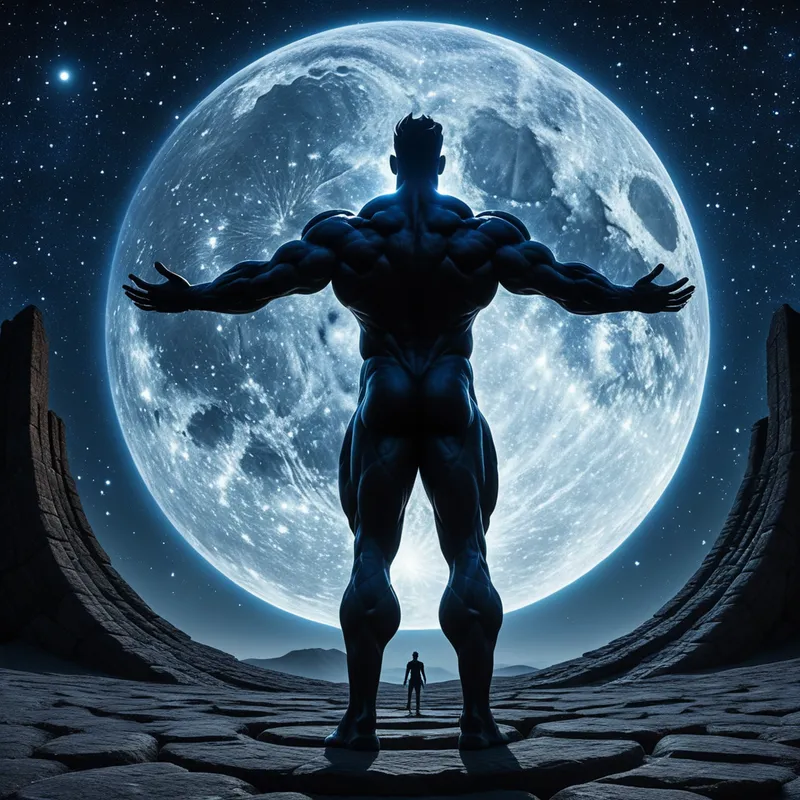
Driven by a yearning he could not name, Heraclesand traversed the singing realms of light and crossed the silent deserts of dark. He came at last to a plain under a sky of two moons—one silver, one absent, a hole of pure black. At the center stood a circle of monoliths older than memory. And there, in the exact center, stood his Tw.
It was him. Every line of the jaw, every curve of muscle, but wrought from living, breathing shadow. Where Heraclesand radiated purpose, the Tw absorbed all. It was the Principle of Rest, the Will that Receives. No words passed between them. The conflict was immediate, absolute, and silent. Heraclesand roared, charging with the force of a supernova. The Tw did not evade; it flowed, absorbing the impact, its form rippling like dark water. For eons that were also moments, they grappled—a dance of creation and negation. Heraclesand would land a shattering blow, only to feel his strength siphoned into the Tw's cool depths. The Tw would lash out with tendrils of cold void, which Heraclesand’s radiant form burned away.
It was not a battle either could win. Exhaustion, a new sensation for the eternal hero, began to seep in. In a final, desperate surge, Heraclesand lunged, not to strike, but to grasp. His hand of solid light closed around the Tw's wrist of fluid night. And in that touch, the revelation came. The struggle was not for dominance, but for recognition. The loneliness he carried was for this—the missing half of his own soul. The Tw was not an enemy, but his own unacknowledged depth, his capacity for stillness, his essential shadow.
With a sigh that stirred the dust of dead stars, Heraclesand ceased to resist. He pulled the Tw into an embrace. The Tw did the same. Light poured into shadow. Shadow seeped into light. There was a flash that was also a silence, a dissolution that was also a becoming. When the cosmic dust settled, the monoliths stood empty. Heraclesand and his Tw were gone. In their place stood a new, serene figure, whose eyes held both the fire of stars and the peace of the abyss. He was whole. The first chord of the universe was finally sung.

Cultural Origins & Context
The myth of Heraclesand and his Tw emerges not from a single earthly culture, but from the collective substratum of human storytelling, a ur-myth of duality. It is found in fragments: in the whispered dialogues of Siberian shamans describing their spirit-doubles; in the philosophical parables of ancient India concerning the Atman seeking the Brahman; in the Gnostic texts speaking of the divine spark trapped in matter yearning for its luminous counterpart.
It was a myth transmitted not in scrolls, but in rituals of initiation and in the trance-states of mystics. Its societal function was profound: to model the ultimate human journey from a state of perceived separation (from the divine, from the world, from parts of the self) to a state of sacred unity. It served as a metaphysical map for cultures that understood the cosmos as an interplay of complementary forces—Yang and Yin, Logos and Eros, Conscious and Unconscious. The story taught that wholeness is not achieved by annihilating one's opposite, but by undertaking the terrifying, sacred journey to embrace it.
Symbolic Architecture
At its heart, this myth is a masterful depiction of the psyche's fundamental structure. Heraclesand represents the conscious ego—the part of us that strives, acts, defines, and projects itself into the world. He is our identity, our willpower, our daylight self.
The Tw is the ultimate Shadow, but not merely as a repository of personal failings. It is the transpersonal Shadow—the vast, impersonal realm of the unconscious itself, the necessary counterweight to consciousness.
The Nexus of Stillness is the symbolic center of the Self, the point of equilibrium where all opposites are held in tension. The two-moon sky perfectly captures the state of duality that precedes integration. The battle, which seems like a failure of the hero's strength, is in fact the necessary process by which the ego exhausts its one-sidedness. The final embrace is the coniunctio oppositorum—the alchemical marriage of opposites. The new being that results is the individuated Self, where consciousness is informed by the depths, and the unconscious is illuminated by awareness.

The Dreamer's Resonance
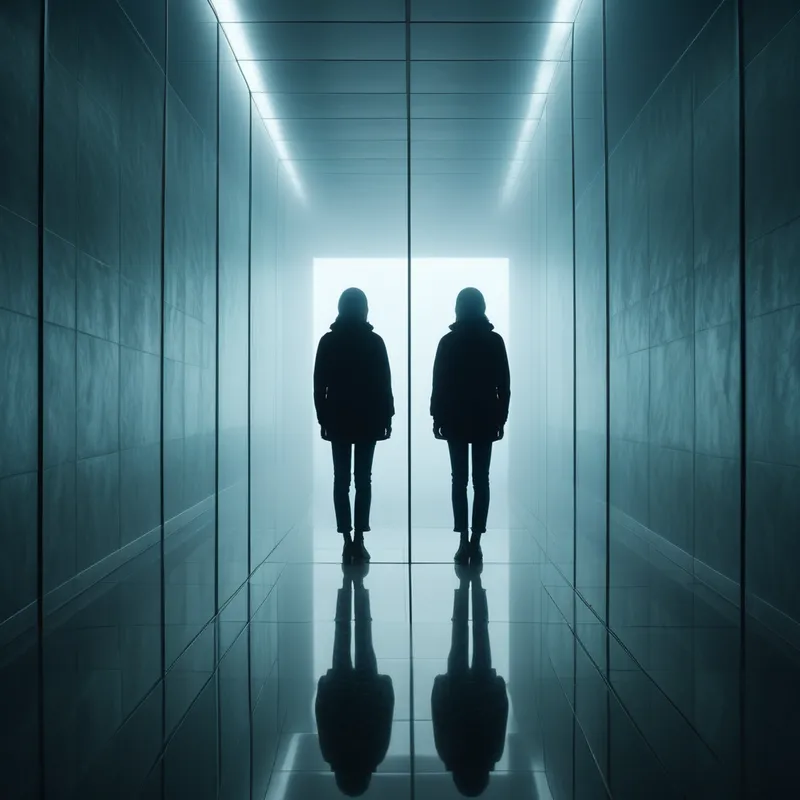
When this myth stirs in the modern dreamer, it often manifests as profound encounters with the "Other" who is also the self. You may dream of a mysterious stranger you feel inexplicably drawn to and repelled by, who mirrors your movements. You may find yourself in a mirrored room where your reflection steps out to confront you. There may be a recurring figure of immense power or profound silence that you are destined to either fight or unite with.
Somatically, this process can feel like a deep internal conflict that drains energy—a "civil war" in the psyche. The dreamer might wake feeling exhausted from a dream-battle, or conversely, with a strange sense of peace after a dream-embrace. These dreams signal that a major process of psychological integration is underway. The ego is being compelled, often through life crises or prolonged introspection, to acknowledge and engage with aspects of its own nature it has long disowned or feared—perhaps its own passivity, its rage, its creativity, or its spiritual depth.
Alchemical Translation
The journey of Heraclesand is the quintessential model of psychic alchemy, or individuation. The first stage, nigredo, is represented by his lonely journey and the black moon—a descent into melancholy and the recognition of one's fundamental incompleteness. The battle is the albedo and citrinitas—the washing and burning, where the ego's rigid identity is purified and tested against its shadow.
The embrace is the rubedo: the final, sacred marriage that produces the gold of wholeness.
For the modern individual, this translates directly to the therapeutic and spiritual journey. We spend our first half of life building our Heraclesand—our career, our persona, our conscious strengths. The call to the Nexus of Stillness often comes as a midlife crisis, a burnout, a depression, or a sudden awakening: the feeling that, despite all achievements, something essential is missing. The "battle" is the hard, inner work of shadow integration—facing our repressed emotions, our denied weaknesses, our latent potentials. We must "fight" these aspects to understand their power and their necessity. The triumph is not victory, but surrender—the conscious decision to stop repressing and to instead integrate. The new being forged is not a perfect, conflict-free person, but an individual who can hold their own contradictions, who possesses both agency and receptivity, who is both defined and boundless. One becomes, at last, the author and the subject of one's own complete story.
Associated Symbols
Explore related symbols from the CaleaDream lexicon: