Heracles' Burning Myth Meaning & Symbolism
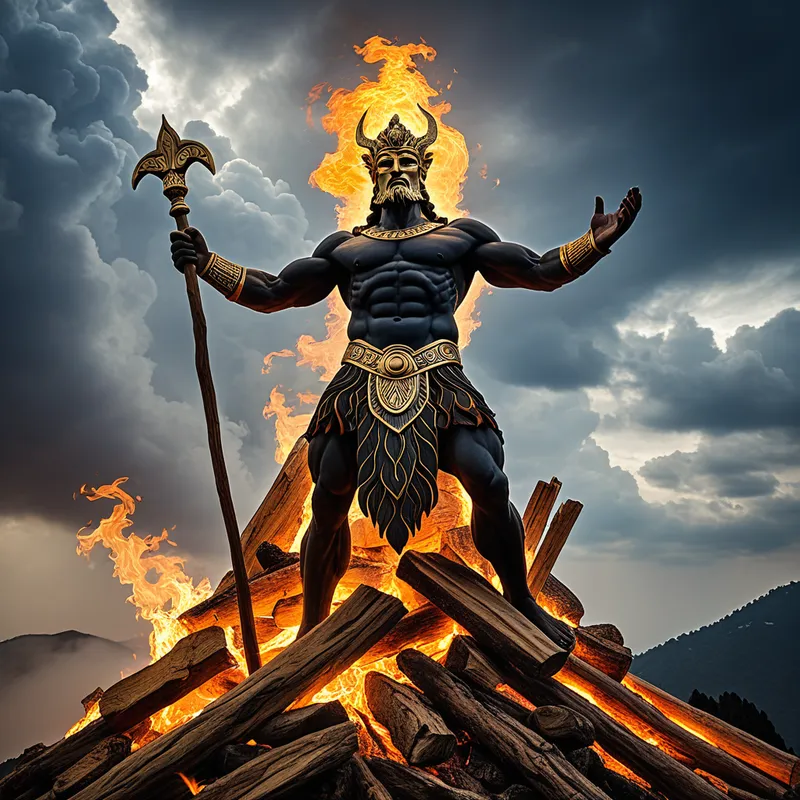
The demigod Heracles, poisoned by a tunic, builds his own pyre. As the flames consume his mortal flesh, his divine essence ascends to Olympus.
The Tale of Heracles’ Burning
The air on the slopes of Mount Oeta was thin and carried the scent of pine and impending fate. [Heracles](/myths/heracles “Myth from Greek culture.”/), the son of Zeus, was a colossus brought low. No monster, no titan, no labor had felled him. His ruin was woven into a gift—a tunic, dipped in the blood and venom of the centaur Nessus, given to him by his wife Deianeira in a desperate attempt to rekindle his love.
When he donned the robe, a different fire took hold. Not the fire of battle-rage, but a creeping, insidious burn that sank into his marrow. The great hero, who had strangled serpents in his cradle and held the heavens on his shoulders, screamed. The divine [ichor](/myths/ichor “Myth from Greek culture.”/) in his veins warred with the centaur’s poison, a civil war within his own flesh. He tore at the fabric, but it clung like a second skin, searing and melting into him. In his agony, he uprooted trees, shattered boulders, but the pain was unshakeable, a fire no river could quench.
An oracle’s cold truth was delivered: this was the end foretold, a death not by a living hand, but by one long dead. Heracles, understanding the cruel poetry of it, commanded his followers. With his own hands, still mighty though trembling, he helped heap the timber—oak, pine, and olive—into a great funeral pyre upon the mountain’s peak. He arranged his club and the famed Nemean Lion skin upon it, the trophies of a mortal life.
Then, he climbed. He lay upon the pyre, a king upon a bed of flame, and looked to the hard, blue sky. He asked for fire. His friend Philoctetes, tears cutting through the grime on his face, could not bear it. Heracles’ command was a roar that shook the mountain. At last, a torch was brought. The flame touched the dry tinder. It caught, crackled, and then roared to life, a hungry, orange-gold beast engulfing [the world](/myths/the-world “Myth from Tarot culture.”/)’s strongest man.
The smell was not of burning flesh alone, but of myrrh and sacrifice. The mortal shell of Heracles, the part born of the mortal woman Alcmene, writhed and was consumed. But as the flames reached their zenith, a great peal of thunder split the heavens. A cloud descended, wrapping the pyre in a divine mist. From the heart of the inferno, a figure was seen to rise—not in pain, but in [triumph](/myths/triumph “Myth from Roman culture.”/). The mortal dross burned away, leaving only [the immortal](/myths/the-immortal “Myth from Taoist culture.”/) essence, [the divine spark](/myths/the-divine-spark “Myth from Gnostic culture.”/) inherited from Zeus. The smoke carried him upward, past the realm of suffering, into the clear air of Olympus. There, reconciled with Hera, he was granted apotheosis. Heracles the suffering hero was no more. Herakles, the god, was born.
Cultural Origins & Context
The myth of Heracles’ burning death and apotheosis is primarily preserved in the later works of ancient authors like Ovid and the playwrights, but its roots dig deep into the complex soil of Greek hero cult. Heracles was unique—a pan-Hellenic hero whose worship blurred the line between mortal hero and god. His cult sites often featured rituals involving fire and purification.
This specific episode served a crucial narrative and religious function. It provided a fitting, paradoxically glorious end for a figure whose life was a tapestry of monumental achievement and profound tragedy. It resolved the inherent tension in his nature: the mortal son versus the divine son. The story was told not just as an epic conclusion, but as an aition—a myth explaining the origin of his divine worship. The pyre on Oeta was the ritual furnace that transformed a local strongman-turned-hero into a universal symbol of endurance and deification. It was a myth for those who believed that greatness is paid for in agony, and that true liberation often requires passing through an inescapable fire.
Symbolic Architecture
At its core, the burning is not a [punishment](/symbols/punishment “Symbol: A dream symbol representing consequences for actions, often tied to guilt, societal rules, or internal moral conflicts.”/), but the ultimate labor—the labor of being consumed by one’s own [destiny](/symbols/destiny “Symbol: A predetermined course of events or ultimate purpose, often linked to spiritual forces or cosmic order, representing life’s inherent direction.”/). The Nessus [tunic](/symbols/tunic “Symbol: A simple, ancient garment symbolizing identity, social role, and spiritual purity across cultures, often representing modesty, service, or ritual status.”/) represents the inescapable consequence of past actions, the “poisoned gift” of our own [history](/symbols/history “Symbol: History in dreams often represents the dreamer’s past experiences, lessons learned, or unresolved issues that continue to influence their present.”/), relationships, and choices that clings to us and causes [inward](/symbols/inward “Symbol: A journey toward self-awareness, introspection, and the exploration of one’s inner world, thoughts, and unconscious mind.”/) [torment](/symbols/torment “Symbol: A state of intense physical or mental suffering, often representing unresolved inner conflict, guilt, or psychological distress.”/). It is the embodiment of [karma](/myths/karma “Myth from Hindu culture.”/), of a [fate](/symbols/fate “Symbol: Fate represents the belief in predetermined outcomes, suggesting that some aspects of life are beyond human control.”/) woven from threads we ourselves helped spin.
The hero does not conquer the final monster; he becomes the sacrifice. His pyre is the altar where the mortal ego is offered up to a higher destiny.
The pyre, built by his own command, symbolizes conscious surrender. Heracles is not passively murdered; he actively participates in his [dissolution](/symbols/dissolution “Symbol: The process of breaking down, dispersing, or losing form, often representing transformation, release, or the end of a state of being.”/). This is the key: transformation requires our acquiescence to the process, even when it feels like annihilation. The fire itself is the archetypal [symbol](/symbols/symbol “Symbol: A symbol can represent an idea, concept, or belief, serving as a powerful tool for communication and understanding.”/) of alchemical change—destructive, purifying, and illuminating. It burns away the mortal [identity](/symbols/identity “Symbol: Identity represents the sense of self, encompassing personal beliefs, cultural background, and social roles.”/), the “Heracles” known for his [strength](/symbols/strength “Symbol: ‘Strength’ symbolizes resilience, courage, and the ability to overcome challenges.”/) and his sins, to liberate the immortal [pneuma](/myths/pneuma “Myth from Greek culture.”/) ([spirit](/symbols/spirit “Symbol: Spirit symbolizes the essence of life, vitality, and the spiritual journey of the individual.”/)) within.
The [apotheosis](/symbols/apotheosis “Symbol: The transformation of a mortal into a divine or godlike state, representing ultimate spiritual elevation and transcendence of human limitations.”/) is the [revelation](/symbols/revelation “Symbol: A sudden, profound disclosure of truth or insight, often through artistic or musical means, that transforms understanding.”/) that the true Self was always divine. The reconciliation with Hera, his lifelong persecutor, signifies the [integration](/symbols/integration “Symbol: The process of unifying disparate parts of the self or experience into a cohesive whole, often representing psychological wholeness or resolution of internal conflict.”/) of the antagonistic feminine principle—the transformative power of the unconscious that had hounded him, now accepted as part of the whole.
The Dreamer’s Resonance
When this myth stirs in the modern [psyche](/myths/psyche “Myth from Greek culture.”/), it may manifest in dreams of being trapped in burning clothing, of willingly walking into a fire, or of a profound, searing pain that feels cleansing. Somaticlly, this can mirror periods of intense psychological or physical purging—a devastating illness, the end of a defining relationship, a career collapse, or a dark night of the soul where everything we thought we were is called into question.
The dreamer is not dreaming of literal immolation, but of the psychic process of ego death. The “poisoned tunic” could be a toxic self-image, a suffocating role (the caregiver, the achiever, the strong one), or the accumulated pain of past trauma that has become part of one’s identity. The fire in the dream is the psyche’s own ruthless, curative intelligence, initiating a necessary disintegration. The dream may feel terrifying, but its underlying narrative is one of essential transformation, not meaningless destruction. It signals that a foundational part of the personality has outlived its usefulness and must be sacrificed for growth to continue.
Alchemical Translation
In the alchemical journey of individuation—the process of becoming one’s whole, unique Self—Heracles’ burning models the stage of [nigredo](/myths/nigredo “Myth from Alchemical culture.”/) and albedo compressed into one fiery ordeal. [The ego](/myths/the-ego “Myth from Jungian culture.”/), the conscious personality built on deeds, strengths, and wounds (the hero), must undergo a voluntary [solutio](/myths/solutio “Myth from Alchemical culture.”/) in the flames of suffering.
The crucible is not found; it is built from the ruins of our old life, and we must climb inside.
The modern individual encounters this when the strategies that once brought success—our “heroic labors” in career, family, or society—begin to poison us. The drive for external validation becomes the Nessus tunic, burning us from within. The alchemical work is to recognize this burning not as failure, but as the beginning of the [magnum opus](/myths/magnum-opus “Myth from Alchemical culture.”/). We must consciously consent to the death of an outmoded way of being. This is the building of our own pyre: ending the unsustainable job, leaving the hollow relationship, surrendering the cherished but limiting self-concept.
The apotheosis is the emergence of the Self, the central, guiding archetype of wholeness. It is the realization that our core identity is not the sum of our achievements or sufferings, but something transcendent that observes and contains them. We do not become gods on Olympus, but we achieve a kind of psychological divinity—a hard-won inner sovereignty where opposing forces (like Heracles and Hera) are reconciled, and we are no longer victims of our fate, but conscious participants in our own unfolding myth.
Associated Symbols
Explore related symbols from the CaleaDream lexicon: