Hephaestus's Workshop Myth Meaning & Symbolism
The myth of the divine smith who, cast out and wounded, forges beauty and power from the volcanic depths of his isolation.
The Tale of Hephaestus's Workshop
Hear now the tale of fire beneath the earth, of the god who walks with a halting gait but whose hands move with the certainty of stars. It begins not in the sunlit courts of Olympus, but in a fall from grace so profound it shook the heavens.
The queen, Hera, looked upon her newborn son and saw imperfection. His foot was twisted. In a moment of divine shame, she cast him from the gleaming peaks of Olympus. He tumbled, a falling star of flesh and potential, down, down through the breath of the world, to splash into the wine-dark sea. There, the ocean nymphs Thetis and Eurynome rescued him. They raised him in a secret, sub-aquatic grotto, where the first ember of his genius was kindled.
For nine years he labored in silence, his heart a furnace of rejection, his hands learning the language of coral, pearl, and sunken metal. He crafted jewels that held the memory of light and trinkets that whispered with the tides. This was his first, hidden workshop.
But a god’s destiny cannot be drowned. His craft called him home—not as a beloved son, but as a weapon. He returned to Olympus not on winged feet, but through cunning. He forged a magnificent, cunning throne of gold and sent it to Hera as a gift. When she sat upon it, invisible, unbreakable bonds snapped shut, holding the queen of heaven fast. No force in the cosmos could free her. The laughter of Olympus died. Only one being possessed the key to the trap’s design: the smith himself.
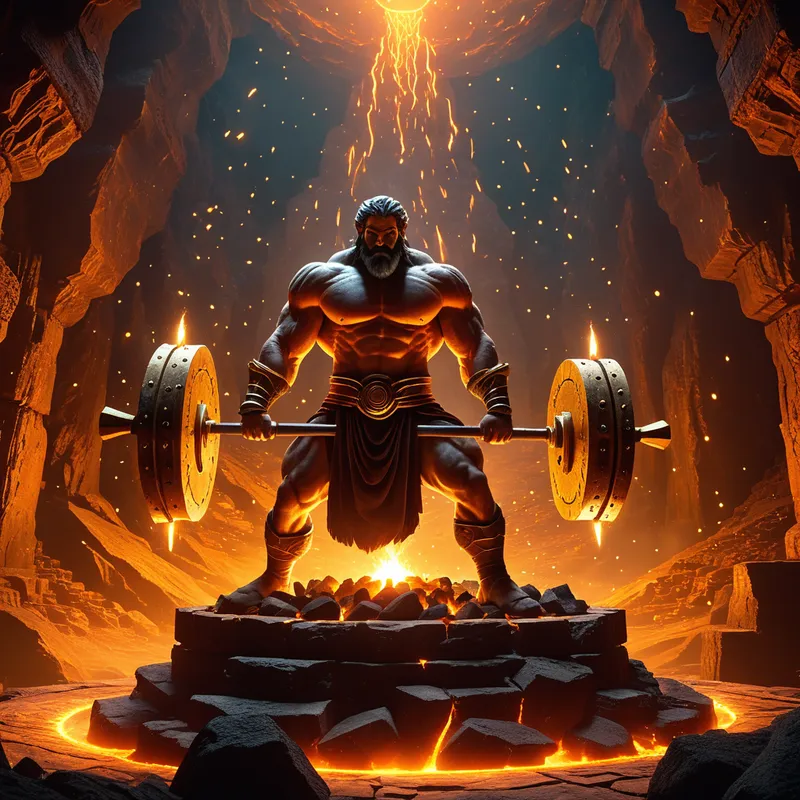
They bargained. Dionysus, the loosener, brought Hephaestus back, drunk and triumphant, upon a mule. His price for Hera’s release was not vengeance, but recognition: a seat among the gods and a workshop of his own. Thus, he was granted a forge greater than any mortal dream. He built it not on the mountain, but within it. His true workshop was the living heart of a volcano, Aetna or Lemnos, where earth’s blood met celestial will.
Here, in the roaring dark, the myth deepens. The air smells of ozone and hot iron. Cyclopes, giant sons of earth, pound the bellows, their single eyes reflecting the molten flows. Automatons of gold—living, serving maidens he crafted with his own hands—move with silent grace, bringing tools to their master. Here, the lame god creates the infrastructure of divinity: Zeus’s thunderbolts, Athena’s aegis, Helios’s chariot, the invisible net that would ensnare his unfaithful wife Aphrodite and her lover Ares. Each artifact is perfect, powerful, and often born from a place of personal wounding. His workshop is a place of sublime, painful making, where the raw chaos of fire and the precision of intellect marry to shape destiny itself.
Cultural Origins & Context
The figure of the divine artificer is a global archetype, but the specific mythos of Hephaestus (known to the Romans as Vulcan) is rooted in the complex societal fabric of ancient Greece. His stories are woven primarily through the epic poetry of Homer and the later hymns and collected myths of poets like Hesiod. These were not mere entertainments but sacred narratives performed at festivals, functioning as a cosmological map and a social mirror.
In a culture that prized physical perfection (arete) and martial glory, Hephaestus stood apart. He was the only Olympian who labored, who got dirty, who was physically "other." His myth served critical functions. For the artisan classes—potters, metalworkers, sculptors—he was a patron and a divine validation of their often-overlooked craft, elevating technical skill (techne) to a cosmic principle. For the broader society, his narrative explored profound themes: the integration of the outcast, the divine necessity of the imperfect, and the raw power that can be born from rejection. His workshop was not just a fantastical location; it was a symbolic anchor for the entire ancient technological imagination, a place where human craft intersected with, and was blessed by, divine purpose.
Symbolic Architecture
Psychologically, Hephaestus’s workshop represents the interior crucible of the creative Self. It is the deep, often hidden chamber of the psyche where raw experience—especially painful experience—is subjected to the transformative fires of consciousness and worked into meaningful form.
The workshop is not built in the light of approval, but in the volcanic depths of what has been rejected.
Hephaestus himself symbolizes the shadow aspect of the creator: wounded, limping, yet supremely potent. His lameness is not a weakness but the signature of his depth, the mark that forced his journey inward, away from the superficial glitter of the collective. His fall from Olympus is the necessary descent, the katabasis, that every true creative or individuation process requires. One must be cast out of the familiar "heaven" of the persona to discover one's authentic power.
The artifacts he forges are symbols of psychic integration. The thunderbolt is focused, transformative energy. The aegis is a protective boundary born of wisdom. The ensnaring net represents the inescapable consequences of unconscious actions, a cunning form of psychological truth. His workshop, therefore, is the locus where the fragmented self (the rejected child, the betrayed spouse) applies intense focus (the forge) to shape the materials of its own history into tools for wholeness and objects of beauty.
The Dreamer's Resonance
When this myth stirs in the modern dreamscape, it often heralds a profound somatic and psychological process of fabrication—in the original sense of making by hand. To dream of a subterranean workshop, a furnace, or a lone, focused figure crafting something essential is to receive a summons from the Hephaestian layer of the psyche.
Somatically, this may manifest as a felt sense of pressure, heat, or a creative "gestation" that feels physical—a tightness in the chest, a restless energy in the hands. Psychologically, the dreamer is likely in a phase where a deep, perhaps old wound (a sense of inadequacy, a betrayal, a rejection of one's "imperfect" nature) is becoming the raw material for a new creation. The dream says: you are in the workshop. The isolation you feel is not abandonment, but the necessary condition for this forging. The limp you carry is the very axis around which your unique power turns. The dream prompts the ego to stop seeking validation "up there" on Olympus and to instead descend into its own volcanic core, to pick up the hammer and begin the patient, fiery work of shaping meaning from pain.

Alchemical Translation
The myth of Hephaestus’s Workshop is a master narrative for the alchemical process of individuation. It maps the transmutation of prima materia—the leaden, rejected, and wounded parts of the self—into the gold of authentic identity and creative purpose.
The process begins with the calcinatio: the searing rejection and fall, which burns away false belonging and reduces the psyche to its essential, elemental state. The rescue by the sea nymphs represents the solutio—a dissolution in the unconscious, a period of hidden incubation where new patterns form away from the judging eye of the collective. The return and binding of Hera is the coagulatio: the act of giving solid, undeniable form to one's power, forcing the "parental" or authoritative complexes to acknowledge one's sovereignty.
The ultimate creation is not the artifact, but the artificer. The Self is forged in the act of forging.
The enduring work in the volcanic workshop is the coniunctio oppositorum—the sacred marriage of opposites. Here, fire (passion, rage, instinct) is wedded to form (discipline, intellect, design). Disability is married to supreme ability. Isolation becomes the space for profound connection to the anima mundi, the world soul, through craft. For the modern individual, this translates to the lifelong practice of taking the unprocessed ore of one's experiences—the shame, the anger, the loneliness—and committing to the workshop. It is the practice of daily, focused labor on the self, not to become "perfect" like the other Olympians, but to become uniquely, authentically wrought. One does not heal the wound to erase the limp; one learns to walk with it, and in that distinctive rhythm, finds the forge where one can build a world.
Associated Symbols
Explore related symbols from the CaleaDream lexicon: