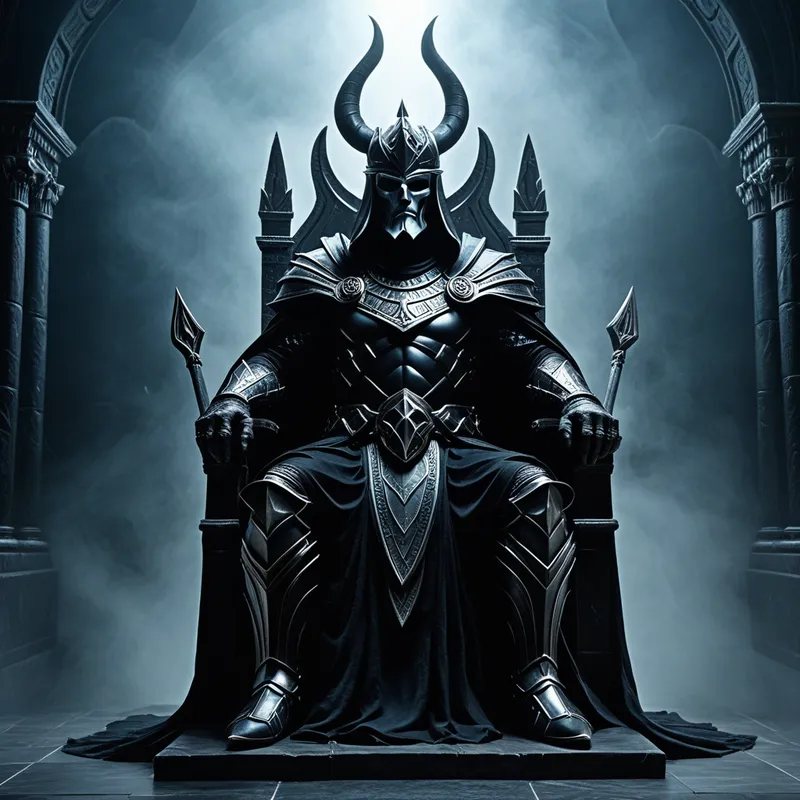
Helmet of Hades Myth Meaning & Symbolism
The magical cap of invisibility, forged by the Cyclopes, used by gods and heroes to navigate unseen through the underworld and the world of mortals.
The Tale of the Helmet of Hades
Listen, and hear the tale of [the shadow](/myths/the-shadow “Myth from Jungian culture.”/)-walker’s crown, the Helmet of [Hades](/myths/hades “Myth from Greek culture.”/). It was not born of mortal forge, but in the primeval fire of [the earth](/myths/the-earth “Myth from Hindu culture.”/)’s womb. When the great Cyclopes, sons of [Ouranos](/myths/ouranos “Myth from Global/Universal culture.”/) and Gaia, were freed from [the abyss](/myths/the-abyss “Myth from Kabbalistic culture.”/) of [Tartarus](/myths/tartarus “Myth from Greek culture.”/), they brought with them gratitude and terrible craft. For the gods who would rule the cosmos—Zeus, [Poseidon](/myths/poseidon “Myth from Greek culture.”/), and [Hades](/myths/hades “Myth from Greek culture.”/)—they fashioned weapons of ultimate dominion.
For Hades, the eldest, the silent, the lord of the countless dead, they did not make a weapon of flash and thunder. They made a weapon of absence. Upon their anvils of living stone, they worked a metal darker than a moonless midnight, shaping a helm that drank the light. When Hades placed it upon his brow, he did not vanish in a puff of smoke. He simply… ceased to be seen. The space he occupied became a pocket of profound non-being, a walking piece of [the underworld](/myths/the-underworld “Myth from Greek culture.”/) itself. With it, he claimed his somber kingdom, moving unseen among the shades, a sovereign of the unseen realms.
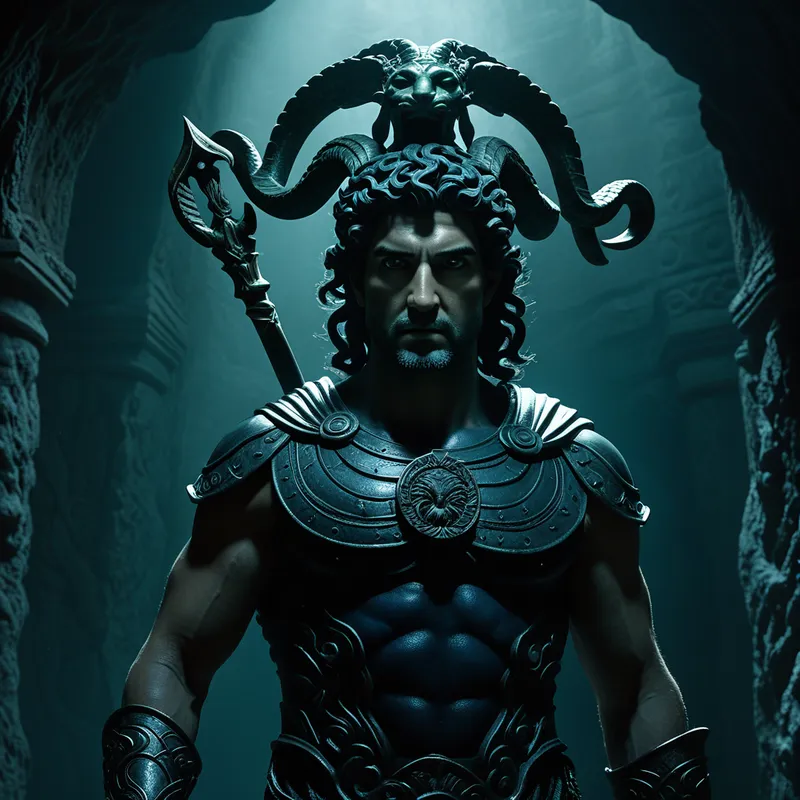
But the tale does not end with the god. The helmet’s power flowed into [the world](/myths/the-world “Myth from Tarot culture.”/) of heroes. Hear of [Perseus](/myths/perseus “Myth from Greek culture.”/), son of Zeus, tasked with an impossible murder: to bring back the head of the Gorgon [Medusa](/myths/medusa “Myth from Greek culture.”/). The gods, in their cryptic mercy, armed him. From the Graeae, the grey sisters who shared one eye, he stole the secret of his path. And from the [Hesperides](/myths/hesperides “Myth from Greek culture.”/), or perhaps from [Hephaestus](/myths/hephaestus “Myth from Global/Universal culture.”/)’s own treasury, he received the tools of his quest: a mirrored shield, a divine sword, winged sandals, and a sack. And lastly, the cap of darkness itself.
In the stony horror of the Gorgons’ lair, surrounded by the petrified statues of failed heroes, Perseus did not charge. He became a ghost. Slipping the helmet over his head, he dissolved into [the cave](/myths/the-cave “Myth from Platonic culture.”/)’s own shadows. Guided only by the reflection in his shield, he moved as a breath of night, an un-seen intention. The stroke that severed Medusa’s head came from nowhere, a cut from the invisible world. And when her immortal sisters awoke with shrieks that cracked stone, they found only empty air. Perseus, cloaked in Hades’ own power, was already gone, a secret carried on [the wind](/myths/the-wind “Myth from Various culture.”/).
Cultural Origins & Context
The Helmet of Hades, or the Kunee of Hades, finds its roots in the epic poetry that formed the bedrock of Greek cultural identity. It is mentioned in Hesiod’s Theogony, the foundational text of divine genealogy, and becomes a pivotal plot device in the later mythographic tradition surrounding Perseus. Its transmission was oral long before it was written, a detail recited by bards to illustrate not just a hero’s cleverness, but the nature of divine power itself.
In a culture that valued kleos (glory) and visible, heroic deeds, the helmet presents a profound paradox. It is the antithesis of the shining armor of Achilles. Its function was not for the battlefield’s open clash, but for the necessary, unseen tasks: the claiming of a kingdom that no living soul desired, the execution of a monster too terrible to behold directly. It served a societal function of acknowledging that which must be done in the shadows—governance of the dead, confrontation with ultimate terror—tasks that require a relinquishment of [the ego](/myths/the-ego “Myth from Jungian culture.”/)’s need to be witnessed. It was a narrative tool that allowed heroes to interact with the chthonic ([underworld](/myths/underworld “Myth from Greek culture.”/)) forces without being annihilated by them, symbolizing a temporary, sanctioned descent into the unconscious realms.
Symbolic Architecture
The [Helmet](/symbols/helmet “Symbol: A helmet in dreams typically symbolizes protection, security, and the mental frameworks we use to shield ourselves from emotional pain.”/) of [Hades](/symbols/hades “Symbol: Greek god of the underworld, representing death, the unconscious, and hidden aspects of existence.”/) is not merely a tool of stealth. It is a profound [symbol](/symbols/symbol “Symbol: A symbol can represent an idea, concept, or belief, serving as a powerful tool for communication and understanding.”/) of the [shadow](/symbols/shadow “Symbol: The ‘shadow’ embodies the unconscious, repressed aspects of the self and often represents fears or hidden emotions.”/), in the Jungian sense—the totality of the unconscious [personality](/symbols/personality “Symbol: Personality in dreams often symbolizes the traits and characteristics of the dreamer, reflecting how they perceive themselves and how they believe they are perceived by others.”/), the aspects of [the self](/myths/the-self “Myth from Jungian culture.”/) deemed unacceptable, fearsome, or hidden. To don the [helmet](/symbols/helmet “Symbol: A helmet in dreams typically symbolizes protection, security, and the mental frameworks we use to shield ourselves from emotional pain.”/) is to consciously enter the [shadow](/symbols/shadow “Symbol: The ‘shadow’ embodies the unconscious, repressed aspects of the self and often represents fears or hidden emotions.”/) [realm](/symbols/realm “Symbol: The symbol of ‘Realm’ often signifies the boundaries of one’s consciousness, experiences, or emotional states, suggesting aspects of reality that are either explored or ignored.”/), to become one with it.
To wear the helmet is to perform the ultimate act of introspection: to see the world while refusing to be seen by it, to observe the contents of one’s own psyche from a place of radical non-identification.
Its [material](/symbols/material “Symbol: Material signifies the tangible aspects of life, often representing physical resources, desires, and the physical world’s influence on our existence.”/), often described as the hide of a monstrous hound or forged from adamant, speaks to its function as a [boundary](/symbols/boundary “Symbol: A conceptual or physical limit defining separation, protection, or identity between entities, spaces, or states of being.”/). It creates a sacred, inviolable [space](/symbols/space “Symbol: Dreaming of ‘Space’ often symbolizes the vastness of potential, personal freedom, or feelings of isolation and exploration in one’s life.”/) around the wearer, a psychic [temenos](/myths/temenos “Myth from Greek culture.”/) where the ego can temporarily dissolve. This is not annihilation, but a shift in state. The [hero](/symbols/hero “Symbol: A hero embodies strength, courage, and the ability to overcome significant challenges.”/) does not cease to exist; he ceases to exist as a separate, visible object. He becomes context, [atmosphere](/symbols/atmosphere “Symbol: Atmosphere can signify the emotional and sensory environment surrounding an experience or situation.”/), [intention](/symbols/intention “Symbol: Intention represents the clarity of purpose and direction in one’s life and can symbolize motivation and commitment within a dream context.”/)—a pure subject moving through a world of objects.
The helmet’s primary users map a [symbolic journey](/symbols/symbolic-journey “Symbol: A symbolic journey represents the transformative process one undergoes, often mapping personal growth, challenges, and quests for truth.”/). Hades, its sovereign, represents the archetypal shadow, the [king](/symbols/king “Symbol: A symbol of ultimate authority, leadership, and societal order, often representing the dreamer’s inner power or external control figures.”/) of all that is repressed and unseen. Perseus represents the ego that must temporarily integrate this shadow-power to achieve a critical [task](/symbols/task “Symbol: A task represents responsibilities, duties, or challenges one faces.”/) (slaying the paralyzing Medusa, a symbol of petrifying [terror](/symbols/terror “Symbol: An overwhelming, primal fear that paralyzes and signals extreme threat, often linked to survival instincts or deep psychological trauma.”/)). The helmet, then, is the mediating symbol, the [ritual](/symbols/ritual “Symbol: Rituals signify structured, meaningful actions carried out regularly, reflecting cultural beliefs and emotional needs.”/) object that permits safe [passage](/symbols/passage “Symbol: A passage symbolizes transition, movement from one phase of life to another, or a journey towards personal growth.”/) between the conscious and unconscious worlds.
The Dreamer’s Resonance
When this mythic pattern stirs in the modern dreamer, it rarely manifests as a literal helmet. More often, it is the experience of becoming invisible. One might dream of walking through a crowded room entirely unnoticed, of one’s reflection disappearing from a mirror, or of being a silent, unseen witness to a dramatic scene.
Somatically, this can feel like a profound detachment, a chilling isolation, or conversely, a weightless, liberating freedom. Psychologically, this dream signals a process of withdrawal for the purpose of observation. The ego is undergoing a necessary retraction from its social [persona](/myths/persona “Myth from Greek culture.”/). The dreamer may be in a life situation where they feel their true self is not being seen, or where they must navigate a toxic environment (a familial “underworld” or a professional “Gorgon’s lair”) by making themselves psychologically small, unseen, or non-threatening.
The dream is an expression of the [psyche](/myths/psyche “Myth from Greek culture.”/)’s innate survival mechanism: the ability to don the “helmet” and retreat into the inner sanctum of the Self to avoid being “turned to stone” by external judgments, demands, or traumas. It asks the dreamer: What part of your life requires you to move unseen? What truth are you observing that you cannot yet openly confront?
Alchemical Translation
The myth models the alchemical stage of [nigredo](/myths/nigredo “Myth from Alchemical culture.”/)—the blackening, the descent into the dark matter of the soul. The hero’s journey with the helmet is a guided, purposeful nigredo. Perseus does not fall into the underworld; he chooses to wear its essence. This is the key to psychic transmutation.
Individuation is not about staying in the light, but about learning to carry the necessary darkness as a tool of perception, not as a burden of identity.
The modern individual’s “quest” often involves facing a personal Medusa—a frozen trauma, a paralyzing fear, a monstrous complex that turns one’s life to stagnant stone. The conscious ego, armed with the “reflective shield” of therapy, journaling, or mindful practice, cannot face this [thing](/myths/thing “Myth from Norse culture.”/) directly. It must first don the Helmet of Hades. This is the act of suspending identification. One must learn to observe the terrifying complex without being identified with it, to see one’s own rage, shame, or grief from a place of invisibility—that is, from a place where the ego’s defenses are not activated.
The [triumph](/myths/triumph “Myth from Roman culture.”/) is not in the invisibility itself, but in what it allows. One becomes invisible to the monster’s gaze (the paralyzing power of the complex), moves unseen through its territory (the associated memories and emotions), and performs the necessary surgery (integration, understanding, release). After the task is done, the helmet is returned. One does not stay invisible. The goal of alchemy is not to live in [the nigredo](/myths/the-nigredo “Myth from Alchemical culture.”/), but to emerge from it with the [lapis philosophorum](/myths/lapis-philosophorum “Myth from Alchemical culture.”/)—the philosopher’s stone. For Perseus, this was the head of Medusa, which retained its power even in death, a symbol of the integrated shadow now usable as a protective, albeit fearsome, force. The integrated individual returns from their descent not as a ghost, but as a whole person who has mastered the art of moving between worlds, who knows when to be seen and when to wield the profound, transformative power of the unseen.
Associated Symbols
Explore related symbols from the CaleaDream lexicon: