Helios and Selene Myth Meaning & Symbolism
The myth of the sun god Helios and moon goddess Selene, celestial siblings whose eternal dance embodies the fundamental rhythms of consciousness and the soul.
The Tale of Helios and Selene
Before history was written, when [the world](/myths/the-world “Myth from Tarot culture.”/) was young and [the sky](/myths/the-sky “Myth from Persian culture.”/) was a vault of living mystery, the cosmos was governed by a divine order. From [the womb](/myths/the-womb “Myth from Various culture.”/) of the primordial goddess Eos, two children were born who would become the very heartbeat of [the world](/myths/the-world “Myth from Tarot culture.”/): [Helios](/myths/helios “Myth from Greek culture.”/) and [Selene](/myths/selene “Myth from Global/Universal culture.”/).
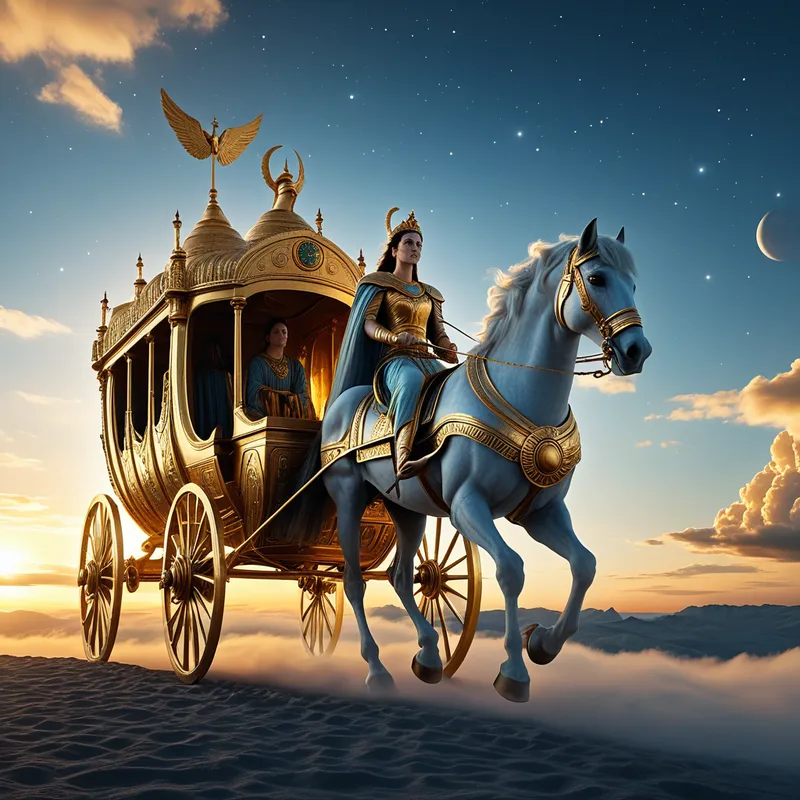
Each day began with a breath held in anticipation. From the far eastern palace where he rested, Helios would don his robes of blinding fire. With a command that shook the foundations of the heavens, he would yoke his four immortal, snorting steeds—Pyrois, Aeos, Aethon, and Phlegon—to his chariot of beaten gold. As he mounted the celestial ramp, the world below would stir. The first lance of his light would pierce [the veil](/myths/the-veil “Myth from Various culture.”/) of night, scattering the stars and painting [the horizon](/myths/the-horizon “Myth from Various culture.”/) in hues of saffron and rose. His journey was relentless, a sovereign’s procession across the dome of the sky. From his lofty perch, he saw everything—the foaming wrath of [Poseidon](/myths/poseidon “Myth from Greek culture.”/), the secret loves of the gods, the petty squabbles of mortals. Nothing was hidden from his all-revealing gaze.
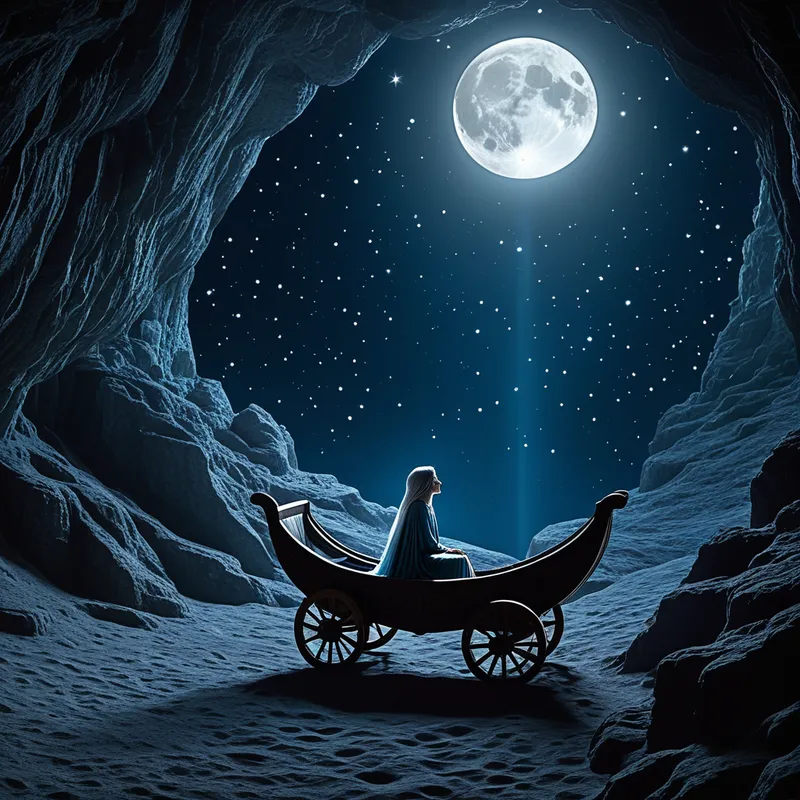
As Helios completed his arc, dipping his weary chariot into the western ocean, the realm was prepared for its other sovereign. Selene would emerge from the shadows, her arrival heralded not by fanfare, but by a profound, silver silence. Her chariot, drawn by a pair of dazzling white horses or, in older whispers, by a team of luminous oxen, was of polished silver and cool mother-of-[pearl](/myths/pearl “Myth from Chinese culture.”/). Where Helios declared, Selene suggested. Her light did not blaze; it seeped. It softened edges, cast long, dreaming shadows, and turned the mundane world into a realm of secret potential. She wore a crown of a glowing crescent, and a cloak of deepest indigo spangled with stars trailed behind her.
But her heart held a secret, a silent ache that pulsed in time with her phases. For she loved a mortal, the beautiful shepherd-king Endymion. She had found him sleeping in a cave on Mount Latmos, his form so perfect it seemed a sculpture of the night itself. Consumed by a love that could not exist in the waking world, Selene used her divine power to grant him his heart’s desire—eternal, ageless sleep. And so, night after night, she would abandon her course, descending to that silent cave to watch over him, to bask in the perfect, unchanging beauty of her slumbering love, her pale light the only kiss he would ever know.
Thus the great wheel turned. Helios, the unblinking eye of day, brought the world into sharp, rational focus. Selene, the gentle eye of night, drew the world into the soft, intuitive embrace of dreams and mysteries. They were two halves of a single, eternal breath: the exhale of revelation and the inhale of reflection, forever chasing, forever complementing, never meeting.
Cultural Origins & Context
The stories of Helios and Selene are not the polished tales of Olympian court drama found in later poets like Ovid. They are older, rooted in the pre-Olympian stratum of Greek belief, where natural forces were not merely governed by gods but were gods themselves. Helios and Selene were Titans, children of [the Titans](/myths/the-titans “Myth from Greek culture.”/) Hyperion and Theia, making them part of the primordial architecture of the cosmos.
Their worship was diffuse but profound. Helios was honored with oaths, for he saw all truths and falsehoods. While not possessing the vast cult centers of Apollo (with whom he was later syncretized), his presence was a constant, underlying assumption in daily life—the ultimate witness. Selene’s worship was more intimate, often linked with [Hecate](/myths/hecate “Myth from Greek culture.”/) and Artemis as a triad of lunar deities. She was invoked in charms and magic, in rites connected to the menstrual cycle and the hidden growth of things.
These myths were not just explanations for celestial mechanics; they were the poetic framework through which the ancient Greeks experienced time, order, and their own inner duality. The reliable journey of Helios was the promise of cosmic order (Dike). The changing face of Selene spoke to life’s cycles—of growth, fruition, decay, and renewal—and the powerful, often tragic, pull of irrational desire (Ate).
Symbolic Architecture
At its core, this myth maps the fundamental [structure](/symbols/structure “Symbol: Structure in dreams often symbolizes stability, organization, and the framework of one’s life, reflecting how one perceives their environment and personal life.”/) of the [psyche](/myths/psyche “Myth from Greek culture.”/). [Helios](/symbols/helios “Symbol: Helios symbolizes the sun, embodying light, life, and divine energy in various mythological traditions.”/) and Selene are not merely astronomical bodies; they are archetypal principles.
Helios represents [the principle](/symbols/the-principle “Symbol: A fundamental truth, law, or doctrine that serves as a foundation for a system of belief, behavior, or reasoning, often representing moral or ethical standards.”/) of [consciousness](/symbols/consciousness “Symbol: Consciousness represents the state of awareness and perception, encompassing thoughts, feelings, and experiences.”/). He is the light of [the ego](/myths/the-ego “Myth from Jungian culture.”/), of focused [attention](/symbols/attention “Symbol: Attention in dreams signifies focus, awareness, and the priorities in one’s life, often indicating where the dreamer’s energy is invested.”/), of [differentiation](/symbols/differentiation “Symbol: The process of distinguishing or separating parts of the self, emotions, or identity from a whole, often marking a developmental or psychological milestone.”/) and [clarity](/symbols/clarity “Symbol: A state of mental transparency and sharp focus, often representing resolution of confusion or attainment of insight.”/). His [chariot](/symbols/chariot “Symbol: The chariot signifies control, direction, and power in one’s journey through life.”/) ride is the daily [journey](/symbols/journey “Symbol: A journey in dreams typically signifies adventure, growth, or a significant life transition.”/) of the conscious mind across the [landscape](/symbols/landscape “Symbol: Landscapes in dreams are powerful symbols representing the dreamer’s emotional state, personal journey, and the broader context of life situations.”/) of [life](/symbols/life “Symbol: The symbol of ‘Life’ represents a journey of growth, interconnectedness, and existential meaning, encompassing both the joys and challenges that define human experience.”/), illuminating, categorizing, and asserting will. He is objective [truth](/symbols/truth “Symbol: Truth represents authenticity, honesty, and the quest for knowledge beyond mere appearances.”/), the [father](/symbols/father “Symbol: The father figure in dreams often symbolizes authority, protection, guidance, and the quest for approval or validation.”/) principle, and the relentless forward drive of time.
To see with the eye of Helios is to know the world as separate from oneself, defined by boundaries and illuminated by the intellect.
Selene embodies the principle of the unconscious. She is the light that does not clarify but deepens, revealing not surfaces but atmospheres. Her [realm](/symbols/realm “Symbol: The symbol of ‘Realm’ often signifies the boundaries of one’s consciousness, experiences, or emotional states, suggesting aspects of reality that are either explored or ignored.”/) is that of [intuition](/symbols/intuition “Symbol: The immediate, non-rational understanding of truth or insight, often described as a ‘gut feeling’ or inner knowing that bypasses conscious reasoning.”/), [emotion](/symbols/emotion “Symbol: Emotion symbolizes our inner feelings and responses to experiences, often guiding our actions and choices.”/), [memory](/symbols/memory “Symbol: Memory symbolizes the past, lessons learned, and the narratives we construct about our identities.”/), instinct, and the fertile dark of potential. Her love for the sleeping Endymion is the [archetypal image](/symbols/archetypal-image “Symbol: A universal, primordial symbol from the collective unconscious that transcends individual experience and carries profound spiritual or mythic meaning.”/) of the unconscious’s fascination with a [static](/symbols/static “Symbol: Static represents interference, disruption, and the breakdown of clear communication or signal, often evoking feelings of frustration and disconnection.”/), perfect, but lifeless state—the pull to retreat from the demands of conscious development into the [womb](/symbols/womb “Symbol: A symbol of origin, potential, and profound transformation, representing the beginning of life’s journey and the unconscious source of creation.”/) of eternal fantasy.
Together, they form an indissoluble pair. The day is defined by the [night](/symbols/night “Symbol: Night often symbolizes the unconscious, mystery, and the unknown, representing the realm of dreams and intuition.”/) that borders it; consciousness is shaped by the unconscious sea from which it emerges. The myth insists that a psyche ruled only by the Helian principle becomes harsh, barren, and exposed. A psyche ruled only by the Selene principle dissolves into passivity, melancholic [fixation](/symbols/fixation “Symbol: An obsessive focus on a single idea, object, or person, often representing a spiritual blockage or an unresolved archetypal pattern.”/), and sterile fantasy.
The Dreamer’s Resonance
When this myth stirs in the modern dreamer, it signals a profound rebalancing act within the soul. To dream of Helios—of a blinding light, a soaring chariot, or an all-seeing eye—often speaks to an over-inflation of the conscious attitude. The dreamer may be feeling exposed, scrutinized, or driven by a relentless, burning ambition that threatens to consume. It is a somatic call to cool the fires of the ego, to allow for shade and rest.
To dream of Selene—of moonlight on [water](/myths/water “Myth from Chinese culture.”/), of visiting a sleeping loved one, or of traveling in a silent, silver vehicle—points to a deep engagement with the unconscious. It may indicate a time of introspection, of processing hidden emotions, or of being “spellbound” by a memory, a person, or an unattainable ideal, much like her fixation on Endymion. The body may feel heavy, somnolent, or caught in a cyclical pattern.
The most potent dreams are those where both forces interact: a golden light merging with a silver mist, or two celestial bodies orbiting in a tense, beautiful dance. This is the psyche working to integrate its opposing forces, striving to bring the illuminating clarity of day into conversation with the intuitive wisdom of night.
Alchemical Translation
The individuation process, the alchemical journey of becoming whole, is modeled perfectly in the eternal dance of these Titan siblings. The goal is not for one to conquer the other, but for the conscious mind (Helios) and the unconscious (Selene) to recognize each other as sovereigns of their own domains and essential partners in governance.
The first step is often the recognition of the opposite. The rational, goal-oriented individual (Helios) must acknowledge the power of the irrational, the pull of mood, memory, and dream (Selene). Conversely, the person lost in feeling or fantasy must acknowledge the necessity of structure, action, and daylight clarity.
The core alchemical operation here is coniunctio oppositorum—[the sacred marriage](/myths/the-sacred-marriage “Myth from Various culture.”/) of opposites. This is not a literal union of Helios and Selene, for their separation defines the rhythm of life. Instead, it is the internal marriage where the ego learns to “see” by Selene’s light—to value intuition and shadow—and the unconscious learns to be structured by Helios’s discipline—to bring its contents forth into a form that can be integrated into life.
The triumph is not in eternal day or perpetual night, but in the conscious appreciation of the twilight—that liminal space where both lights are present, where knowing and feeling, seeing and dreaming, exist in a state of creative tension.
Endymion’s eternal sleep is the warning within the myth. It symbolizes the psychic danger of allowing the unconscious to enthrall consciousness completely, to choose perfect, static fantasy over the flawed, dynamic engagement with reality. Selene’s love is real, but it is sterile. True wholeness requires that the beautiful contents of the unconscious (Endymion) be awakened and brought into the light of day, where they can live, age, and contribute to the soul’s journey.
Thus, to live the myth of Helios and Selene is to become the charioteer of one’s own destiny, guided by the piercing sun of discernment and the gentle moon of compassion, riding the great arc between revelation and mystery, forever in pursuit of a wholeness that honors both.
Associated Symbols
Explore related symbols from the CaleaDream lexicon: