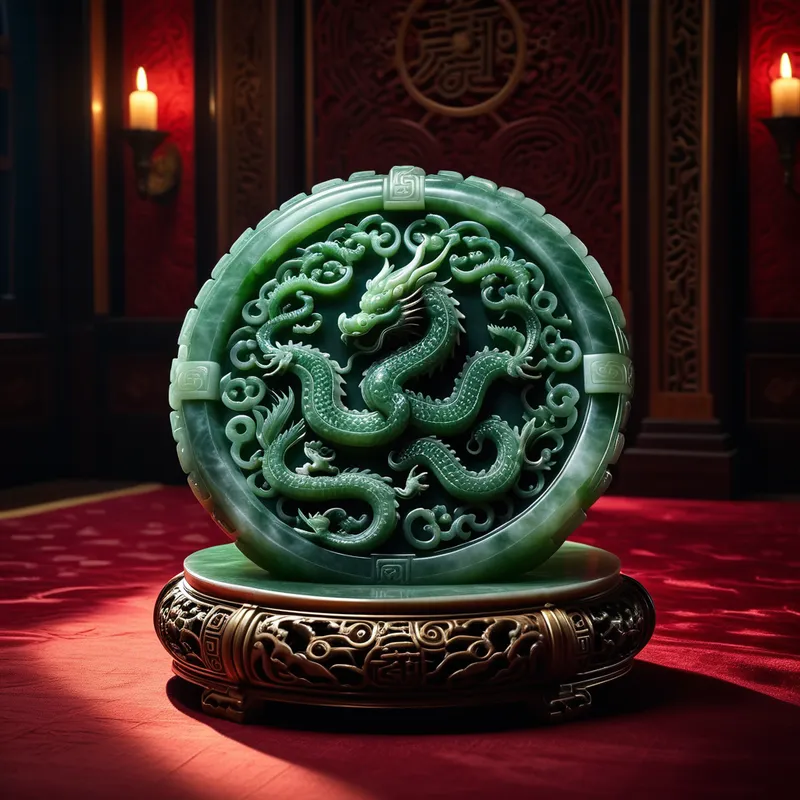
Heirloom Seal of the Realm Myth Meaning & Symbolism
The mythic quest for the lost Imperial Seal, a jade symbol of Heaven's Mandate, representing the eternal struggle for true legitimacy and sovereign identity.
The Tale of Heirloom Seal of the Realm
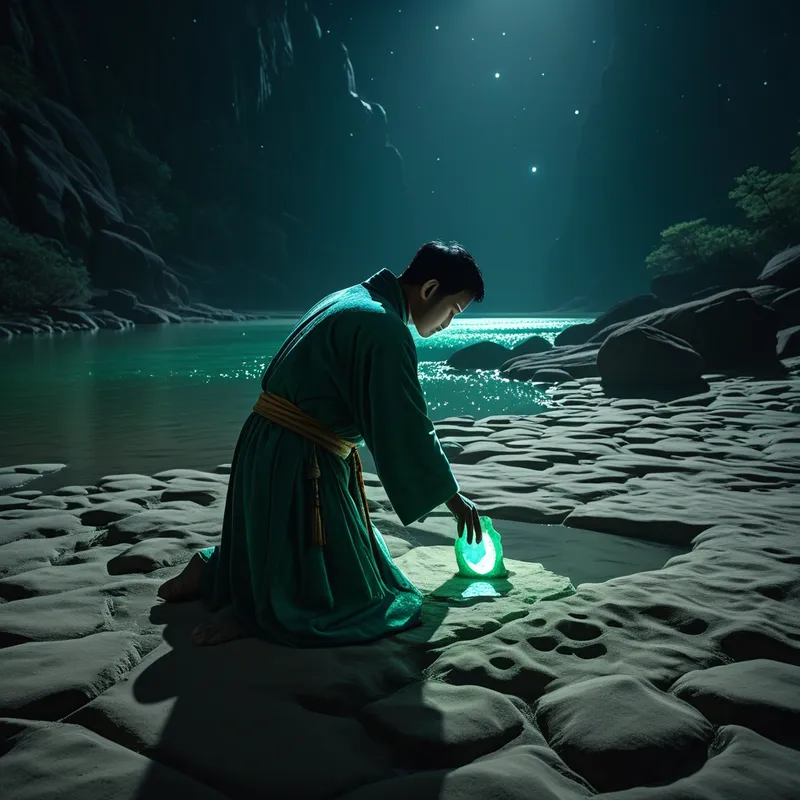
In the time when the world was young and the mandate of Heaven was a palpable force, a stone of heaven fell to earth. It was no ordinary stone, but a piece of the firmament itself, congealed from starlight and cosmic breath. It landed with a whisper, not a crash, in the lands of Chu, waiting in the riverbed for a hand worthy of its touch.
Centuries passed. Kings rose and fell, their claims to power echoing hollowly without a true symbol. Then came the First Emperor, Qin Shi Huang, a man of iron will who unified the warring lands. He heard the whispers of the stone. His most cunning artisan, a man who could hear the song within jade, was summoned. For three years and three days, the artisan labored. He did not carve the stone; he liberated the form sleeping within it. Under his tools, the Heshibi revealed itself as a square seal, its top crowned with five interwoven dragons, symbols of imperial power. Upon its face, eight characters were inscribed in ancient script: "Having received the Mandate from Heaven, may the Emperor lead a long and prosperous life."
The moment the last stroke was cut, the hall filled with a light that had no source. The seal became more than an object; it was a covenant. It was heavy, not with weight, but with consequence. To hold it was to feel the gaze of Heaven upon your soul. It passed from dynasty to dynasty—Han, Tang, Song—a silent witness to coronations and coups. Its presence on an edict made the paper thrum with authority; its absence left a void no proclamation could fill.
But power attracts shadows. The seal began its long, slow dance with loss. It was hidden in wells during rebellions, clutched by dying emperors, and stolen in the dead of night. With each transition, a little of its celestial light seemed to dim, absorbed by the blood and ambition of men. Finally, in the chaotic fires that consumed the Forbidden City, the seal vanished. Some say it was stolen by a desperate general. Others whisper it was swallowed by the earth, returning to the realm from whence it came, rejecting a world no longer able to bear its truth. The throne room fell silent. The mandate, now invisible, became a question etched into the heart of the empire itself.
Cultural Origins & Context
The Heirloom Seal of the Realm is a unique mytho-historical artifact. Unlike purely divine tales, its story is woven directly into the fabric of China's dynastic history. Its origin is traced to the Heshibi, a jade disc with its own pre-imperial lore, famously involved in the diplomatic struggles between the states of Qin and Zhao. The transformation of this jade into the Imperial Seal under the First Emperor cemented the concept of the Mandate of Heaven into a tangible, transferable object.
The myth was propagated and maintained by the state historiographers and scholar-officials of each successive dynasty. Its possession was a non-negotiable requirement for legitimate sovereignty. The story was not told around campfires but in court annals and official histories; its function was profoundly societal and political. It was the ultimate proof of legitimacy, a sacred relic that transformed might into right. Its final, ambiguous loss during the Ming-Qing transition (or later) transformed it from a physical object of power into a potent cultural and psychological symbol—a ghost limb of imperial authority, whose absence speaks louder than its presence ever did.
Symbolic Architecture
At its core, the seal symbolizes the concretization of transcendent legitimacy. It is the point where the abstract, moral will of Heaven touches the material plane of human rule. It is not merely a badge of office; it is the container for the soul of the state.
The true throne is not made of wood and gold, but of the consent between heaven, earth, and the human heart. The seal was its signature.
Psychologically, it represents the authentic Self in its sovereign aspect. It is the inner "seal" of one's own unique identity and right to exist with authority in the world. The dragons represent the raw, chaotic, and potent life force that must be integrated and mastered (the five directions, the five elements) to wield this self-authority. The obsessive quest for the seal by emperors and warlords mirrors the human psyche's desperate search for external validation to fill an internal void of illegitimacy. The seal’s loss symbolizes the terrifying, yet necessary, realization that ultimate authority cannot be permanently housed in any external object, person, or institution—it must be internally recognized and earned anew by each generation, and each individual.
The Dreamer's Resonance
When this myth stirs in the modern unconscious, it rarely appears as a literal jade seal. Instead, one dreams of losing a crucial document of identity—a passport, a diploma, a birth certificate. One dreams of searching for a key to a locked room that contains one's own name. There is a somatic quality of weightlessness in the hands, a feeling that one's actions lack gravitas or official sanction.
To dream of this pattern is to undergo a process of confronting the imposter syndrome of the soul. The dreamer is at a threshold where an old identity, once granted by an external system (family, job, society), has crumbled or been lost. The psychological process is one of grieving the lost "seal" of external validation and beginning the arduous, often terrifying, work of forging one's own. The anxiety in the dream is the anxiety of sovereignty—the terrifying freedom and profound responsibility of having no higher authority to blame or to bless one's choices.
Alchemical Translation
The myth models the alchemical journey of individuation—the process of becoming an integrated, self-governing individual—with stark clarity. The initial state is the unhewn Heshibi, the primal Self with immense potential but no defined form. The First Emperor's command represents the urgent, often tyrannical, impulse of the conscious ego to define and control this potential.
The crucible of individuation is not found in the light of possession, but in the darkness of loss. It is there the soul learns to stamp its own authority on the blank page of becoming.
The carving of the seal is the long, painful work of self-creation, giving form to one's innate authority (the dragons). Possession of the seal symbolizes a temporary stage of integrated Selfhood, where one feels legitimate and whole. But the myth insists this is not the end. The seal's inevitable loss—its theft, its hiding, its final disappearance—is the critical stage. This is the nigredo, the dark night of the soul, where all external symbols of identity and authority are stripped away. The ego is confronted with the abyss.
The triumph is not in the seal's recovery, but in the realization its pursuit demands. The true "Heirloom Seal of the Realm" is not an object to be found, but a state of being to be enacted. The alchemical gold is the individual who, having internalized the mandate, can act with authentic authority without needing the seal to prove it. They become the living seal, stamping their genuine essence onto the world through action and integrity, understanding that legitimacy flows from within, a mandate granted by one's own conscious engagement with life, not by a relic of the past.
Associated Symbols
Explore related symbols from the CaleaDream lexicon: