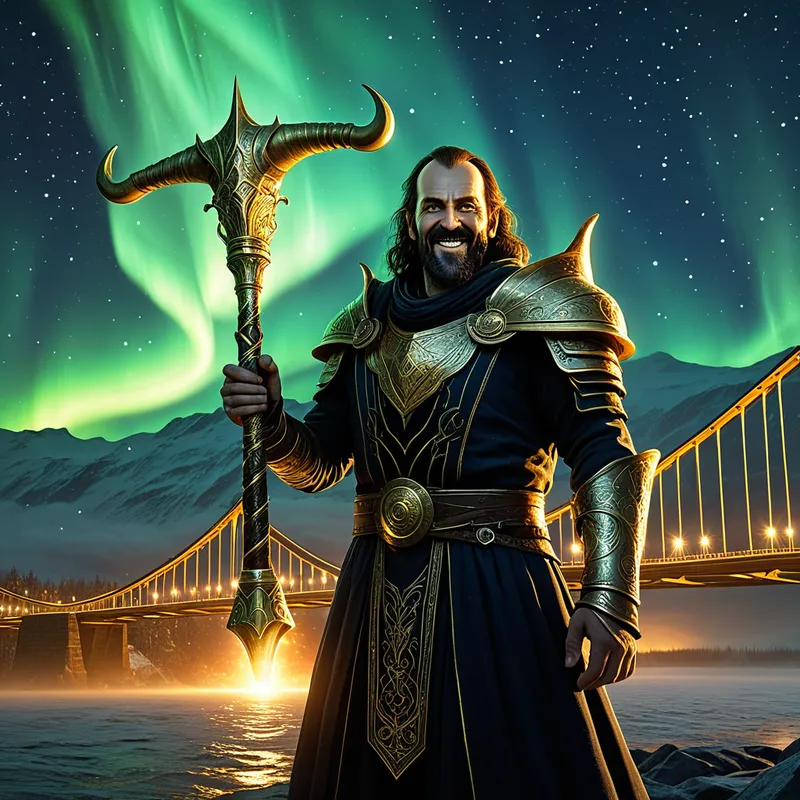
Heimdallr at Bifröst Myth Meaning & Symbolism
The story of the divine sentinel who guards the bridge between worlds, whose sight, hearing, and horn herald the twilight of the gods.
The Tale of Heimdallr at Bifröst
Listen. At the edge of all things, where the roots of the Yggdrasil drink from the well of memory and the branches scratch the cold belly of the void, there stands a bridge. It is not built of wood or stone, but of fire, ice, and the breath of the world itself—the Bifröst. It shimmers, a trembling arc of impossible colors, a road only the gods and the dead may walk.
And upon this bridge, there is a figure. He is Heimdallr, the Whitest of the Aesir. He was born of nine mothers, nine sea-giantesses, at the dawn of time, and from that moment, his purpose was forged. He needs no sleep. His eyes, brighter than the midday sun, see for a hundred leagues in every direction, by day or by deepest night. His ears are so keen he can hear the grass growing in Midgard, the wool thickening on the sheep’s back, and the whisper of malice in the heart of a jotun far in the frozen wastes of Jötunheimr.
His hall is Himinbjörg, the Heaven-Cliff, where the bridge’s burning root meets the soil of Asgard. Here, he waits. He watches the bridge, for it is the only path the giants could take to storm the golden gates of the gods’ home. He watches the worlds below, for he is the father of humankind, having once walked among them as Rig, seeding the classes of thrall, freeman, and lord. He is the boundary-keeper, the line between order and chaos, safety and annihilation.
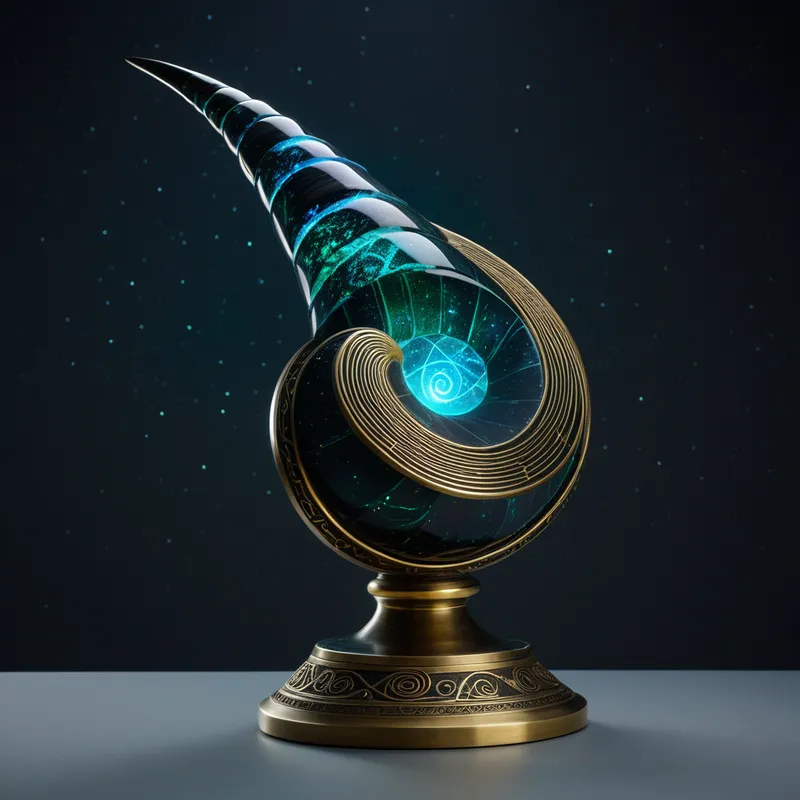
At his side rests Gjallarhorn, a horn of terrible power. Its voice is kept silent, a promise held in reserve. For Heimdallr knows—he sees it in the gathering storms over Jötunheimr, hears it in the restless churning of the Jörmungandr in the deep sea, feels it in the weakening of the bonds that hold the wolf Fenrir—that the long peace is a fraying thread. The final strife, Ragnarök, is coming.
And so he stands. The wind of the worlds howls around him, plucking at his cloak. The bridge thrums beneath his feet with the passage of gods and valkyries. He sees the mischief of Loki festering into true venom. He hears the distant, hungry panting of Fenrir. He watches, unblinking, until the day the sun and moon are swallowed, the stars fall from the sky, and the giants begin their march. On that day, he will raise the Gjallarhorn to his lips and blow a blast that will shatter the silence of the ages, a note so profound it will be heard in every corner of every world, waking every god and hero for the last battle. He, the watcher, will become the herald. And at the end of all things, it is foretold he will face Loki, his ancient foe, and they will slay each other, the guardian and the trickster falling together as the old world burns away.
Cultural Origins & Context
The figure of Heimdallr is woven into the fabric of Norse lore primarily through the Prose Edda of Snorri Sturluson and the older, poetic verses of the Poetic Edda. These texts are our primary windows, though stained and fragmented by time and Christianization, into the pre-Christian worldview of the Norse peoples. The myth of the watchman was not a mere bedtime story; it was a cosmological necessity. In a universe perceived as inherently unstable, surrounded by chaotic forces (the giants), the need for a perpetual guardian was absolute.
Heimdallr’s myth functioned on multiple societal levels. For the warrior aristocracy, he modeled the ideal of the steadfast sentry, the one who sacrifices personal comfort for the safety of the community—a virtue paramount in a culture of constant threat. For the common person, his role as the father of humanity’s social classes (as told in the poem Rígsþula) legitimized the social order, rooting it in divine action. Furthermore, his position at Bifröst, the bridge between the divine (Asgard) and the human (Midgard), positioned him as a liminal deity, a mediator. He was the god you might whisper a prayer to when standing at a literal threshold—a border, a doorway, the beginning of a journey—or at the ultimate threshold of life and death.
Symbolic Architecture
Heimdallr is the archetype of conscious awareness itself. He is the part of the psyche that stands sentinel at the boundary between the ordered ego (Asgard) and the vast, potentially overwhelming contents of the unconscious (Jötunheimr, the world of giants and primal forces).
The guardian does not create the bridge; he is the awareness that makes crossing it possible, or necessary.
His phenomenal senses symbolize hyper-vigilant consciousness. To “see a hundred leagues” and “hear the grass grow” is to possess a self-awareness so acute it perceives the subtlest movements in the inner landscape—the nascent emotion, the repressed memory, the first flicker of an intrusive thought. The Bifröst is the bridge of perception, the rainbow that appears only when light (consciousness) strikes the storm (the unconscious) at the correct angle. It is beautiful but perilous, a connection that is also a vulnerability.
The Gjallarhorn is the symbolic alarm of the psyche. It is the internal crisis point, the moment when ignored tensions, denied truths, or gathering shadows become so potent they can no longer be merely watched. They must be announced, confronted. The horn is the call to individuation, painful and catastrophic as it may seem.
The Dreamer’s Resonance
When the pattern of Heimdallr manifests in modern dreams, the dreamer is often in a state of heightened psychological vigilance or is approaching a critical inner threshold. Common motifs include: standing watch on a high wall or cliff edge; possessing a special item (a telescope, a listening device) that reveals hidden truths; feeling a profound responsibility to warn others of an unseen danger; or hearing a distant, compelling sound (a horn, a bell, an alarm) that signals a profound change.
Somatically, this can feel like a tightness in the chest or jaw (the body’s bracing for impact), restless sleep, or a hyper-awareness upon waking. Psychologically, it is the process of the ego strengthening its perimeter as unconscious material—a major life decision, a repressed trauma, a burgeoning creative impulse—begins to mobilize. The dream is the psyche’s way of mustering its resources of attention. The dreamer is, often uncomfortably, being made into their own watchman. The looming “Ragnarök” in the dream is not a literal end, but the necessary death of an old psychic structure to make way for a new, more conscious one.
Alchemical Translation
The alchemical process mirrored in Heimdallr’s myth is not the dramatic solve et coagula (dissolve and coagulate) of a hero’s journey, but the long, patient, and crucial stage of vigilia—the watch. In the work of individuation, we must first build our Himinbjörg: a stable point of observation in the psyche. From this vantage, we learn to observe the contents of our inner worlds—our personal giants of anger, fear, and desire—without immediately being overrun by them.
The ultimate test of the guardian is not to prevent the end, but to recognize its necessity and sound the call that initiates transformation.
Heimdallr’s final act is the alchemical key. His sounding of the Gjallarhorn is the conscious ego’s acceptance of its own limited reign. It is the moment we consciously choose to engage with the deep, transformative crisis (our personal Ragnarök) rather than continue a fragile, ignorant peace. The foretold mutual kill with Loki represents the integration of the opposites: the rigid, vigilant consciousness (Heimdallr) and the chaotic, shape-shifting trickster of the unconscious (Loki) must both “die” in their pure forms. From their conflict, a new, more resilient consciousness can be born in the world that emerges after the fire and flood.
To embody Heimdallr is to commit to the watch. It is to develop the inner sight and hearing to perceive the truths growing in the dark soil of the soul, and to find the courage, when the time is ripe, to raise the horn to your lips and blow—calling forth your own necessary ending, so a truer beginning may dawn.
Associated Symbols
Explore related symbols from the CaleaDream lexicon: