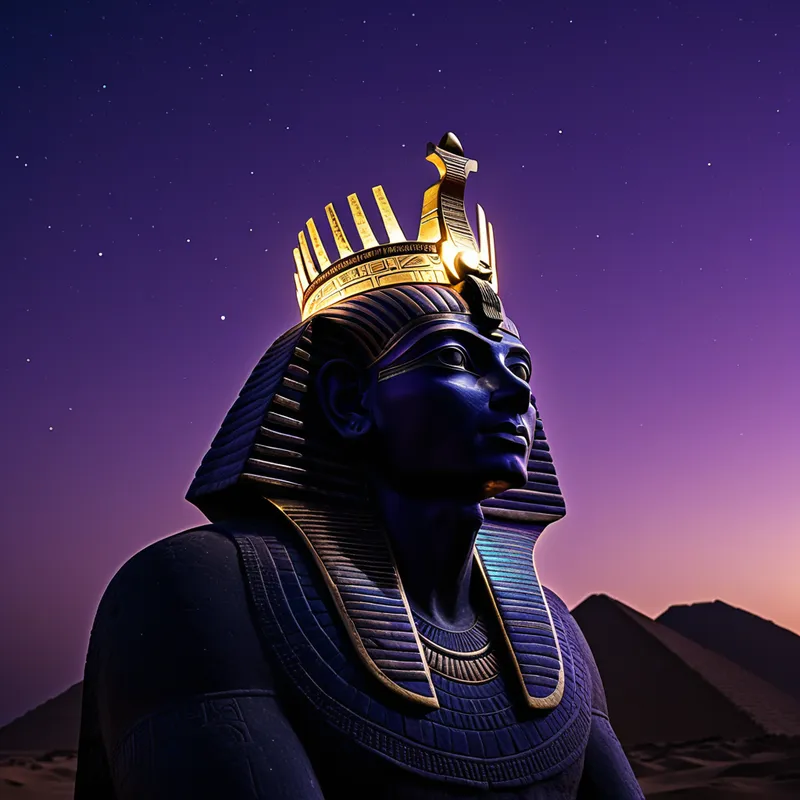
Hedjet Crown Myth Meaning & Symbolism
The luminous white crown of Upper Egypt, a symbol of divine authority and the radiant, unyielding consciousness that masters the inner chaos.
The Tale of the Hedjet Crown
Before the world knew the weight of a unified kingdom, when the sun was a young god and the Nile’s flood was a wild, untamed song, there was the South. They called it Upper Egypt, a land of stark cliffs and burning sun, where the air shimmered with heat and the horizon was a razor’s edge between gold and blue. And from this fierce, luminous land, a crown was born—not forged in fire, but woven from light itself. They named it Hedjet.
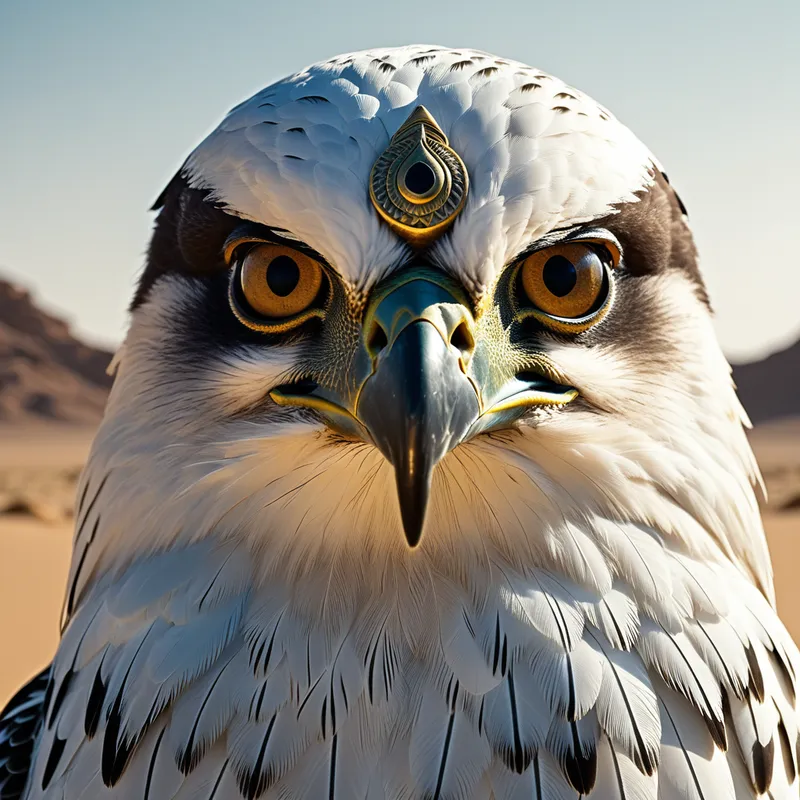
It did not rest upon the brow of a mortal king, not at first. It was the rightful helm of the Horus, the falcon whose wings were the vault of the day sky. His eye was the sun, a piercing, unblinking orb that saw truth in the deepest shadows. But a shadow had grown, festering in the red lands beyond the black soil. His name was Set, the lord of storms and screaming sands, of confusion and the fracturing of what is whole. Set coveted the luminous order the crown represented. He did not wish to wear it, for its light would burn him, but to shatter it, to see its pure white scattered into the blinding, meaningless dust of the desert.
The conflict was not a battle of armies, but a contest of essence. Where Horus brought the clarity of noon, Set brought the sandstorm that erased all paths. Where Horus offered the singular, focused vision of the raptor, Set offered the multiplying, disorienting visions of a mirage. The land suffered. The river grew uncertain. The people’s hearts wavered between the promise of stable light and the terrifying thrill of primal chaos.
The great tribunal of the gods, the Ennead, gathered. Their voices were like the rustle of stars and the deep rumble of the earth. They heard the claims of Horus, rightful and bright. They heard the furious, twisting arguments of Set. The debate swirled for eighty years—a lifetime of mortals—as the two powers strained against each other. Horus, in his youth and fury, sometimes lashed out, his anger giving Set a foothold. Set, in his cunning, would steal the very light from Horus’s eye, plunging moments into darkness.
The resolution came not from a final, crushing blow, but from a restoration of essence. The damaged eye of Horus was made whole—the Wedjat—its sight perfected, its light now tempered with the wisdom of suffering and healing. With this restored vision, Horus did not merely look at Set; he saw through him. He saw the chaos not as an equal power, but as a force that could only exist in opposition to order, having no true center, no crown of its own. In a final, silent confrontation under a sky emptied of stars, Horus did not strike Set down. He simply stood, wearing the Hedjet. Its white light did not attack the darkness; it defined it. It pushed the chaotic swirl of Set back to the edges of the realm, to the deserts where it belonged, contained but not annihilated. The crown was no longer just a symbol of the South; it became the manifest proof of a consciousness so integrated, so sovereign, that chaos could howl at its borders but could not touch its core. The first king of a unified Egypt would wear this crown, and in that moment, he was not a man, but the living vessel of that unyielding, luminous sight.
Cultural Origins & Context
The myth of the Hedjet Crown is not a single, codified story found in one papyrus. It is the narrative woven into the very fabric of kingship ideology in ancient Egypt, emerging from the Predynastic and Early Dynastic periods (c. 3100–2686 BCE). Its primary tellers were the state itself: through ritual, iconography, and monumental art. The crown was the definitive symbol of the ruler of Upper Egypt, and its mythology was enacted every time a king was crowned, every time he presided over Ma'at.
The myth functioned as the divine charter for pharaonic authority. By wearing the Hedjet, the king was directly channeling Horus, becoming the "Living Horus" on earth. The struggle with Set was not a relic of the past but an ongoing, eternal duty. The king’s role was to continuously re-enact Horus’s victory, using the authority of the crown to repel the constant encroachment of isfet (chaos) and uphold Ma'at. This story was passed down in the sacred space of temples and in the visual language of statues, reliefs, and the king’s own regalia, making it an ever-present, living truth for the civilization.
Symbolic Architecture
At its core, the Hedjet Crown symbolizes conscious sovereignty. It is not a crown of jewels or gold, but of whiteness—a color representing purity, but more critically, the undifferentiated, potent light of awareness before it is colored by emotion or bias.
The Hedjet is the psyche’s citadel, the inviolable seat of a consciousness that can observe chaos without being consumed by it.
The crown’s tall, bulbous shape is architecturally a pinnacle, a zenith. It represents the highest faculty of the mind: the integrated Self that can oversee the entire internal kingdom. Horus with the crown is the archetype of the ruling principle—the ego in its healthiest, most mature form, aligned with the Self. His falcon vision symbolizes focused, penetrating awareness that sees the whole field from a higher perspective.
Set, then, is not merely an external enemy. He is the personification of the unintegrated shadow, the psychic chaos of raw instinct, fragmentation, rage, and the ego’s own potential for tyranny. The myth wisely shows that Set is not destroyed, but contained. He is relegated to the necessary "desert" of the psyche—the place of potential, raw energy, and testing, but not the seat of government.
The Dreamer's Resonance
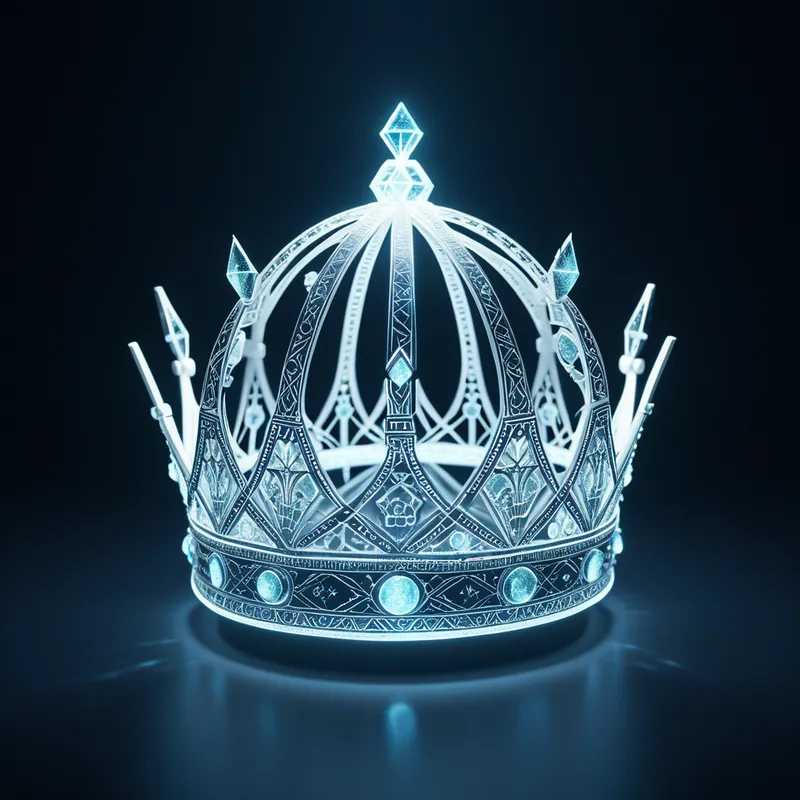
When the motif of the Hedjet Crown appears in a modern dream—perhaps as a blinding white light atop one’s head, an unshakable helmet, or a feeling of immense, calm authority—it signals a critical phase of psychological consolidation. The dreamer is likely in a period where internal or external chaos (Set) has been particularly aggressive: a life crisis, a surge of uncontrollable emotions, or a feeling of being pulled apart by conflicting demands.
The somatic sensation is one of elevated calm. There may be a feeling of pressure or weight on the crown of the head, not burdensome, but anchoring. It is the body registering the "crowning" of a new, more resilient psychic structure. The dream signifies that the dreamer is not just fighting chaos, but has successfully identified with a consciousness that transcends it. The struggle is moving from a battle on the ground to governance from a higher vantage point. It is the Self asserting its sovereignty over the riot of complexes.
Alchemical Translation
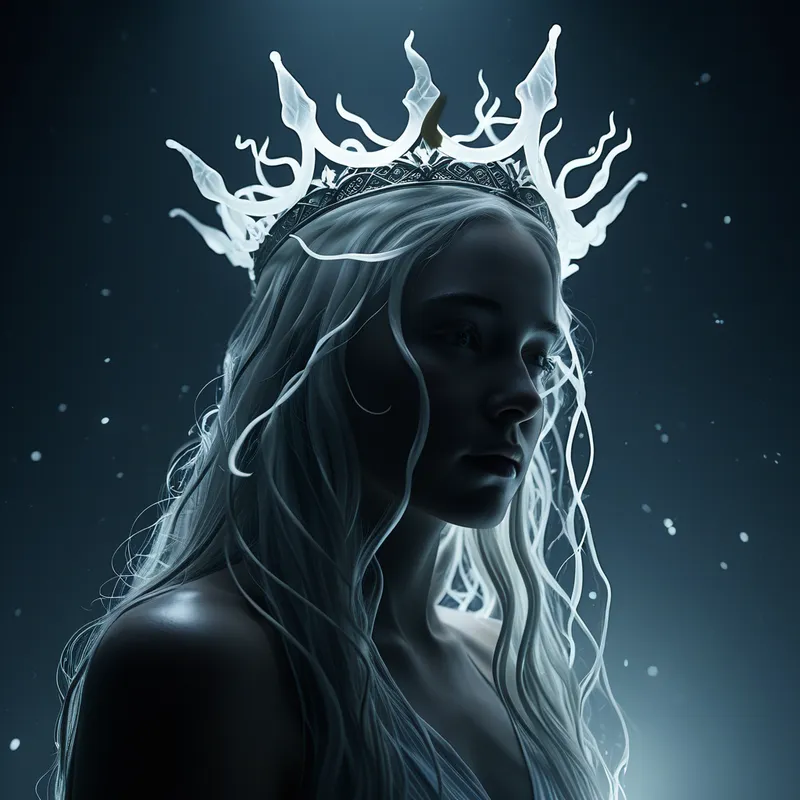
The alchemical process mirrored in this myth is the coagulatio—the solidification of spirit into a fixed, enduring form. The raw, volatile elements of the psyche (the chaotic forces of Set) are not discarded; they are the prima materia. The long conflict before the gods represents the nigredo, the blackening and putrefaction, where the old, less conscious ego (Horus in his unripe anger) is tested and broken down.
The restoration of the Wedjat eye is the albedo, the whitening. It is the purification of perception, the healing of insight. With this clarified vision, the final stage, the rubedo or reddening, is achieved not through violence, but through the radiant fixation of the Self.
Individuation is not the annihilation of one's darkness, but the development of a luminous structure capable of holding it in rightful relation.
The Hedjet Crown is the lapis philosophorum, the philosopher’s stone, of this inner process. It is the crystallized, permanent achievement of the ruling function. For the modern individual, the myth teaches that true power and order do not come from violently suppressing one’s inner chaos, passions, or shadow. It comes from the arduous work of developing an observing consciousness—a "crowned" awareness—so steadfast and clear that it can allow those forces to exist without being ruled by them. One becomes the sovereign of one’s own inner Upper Egypt, wearing the white crown of a hard-won, unassailable wholeness.
Associated Symbols
Explore related symbols from the CaleaDream lexicon: