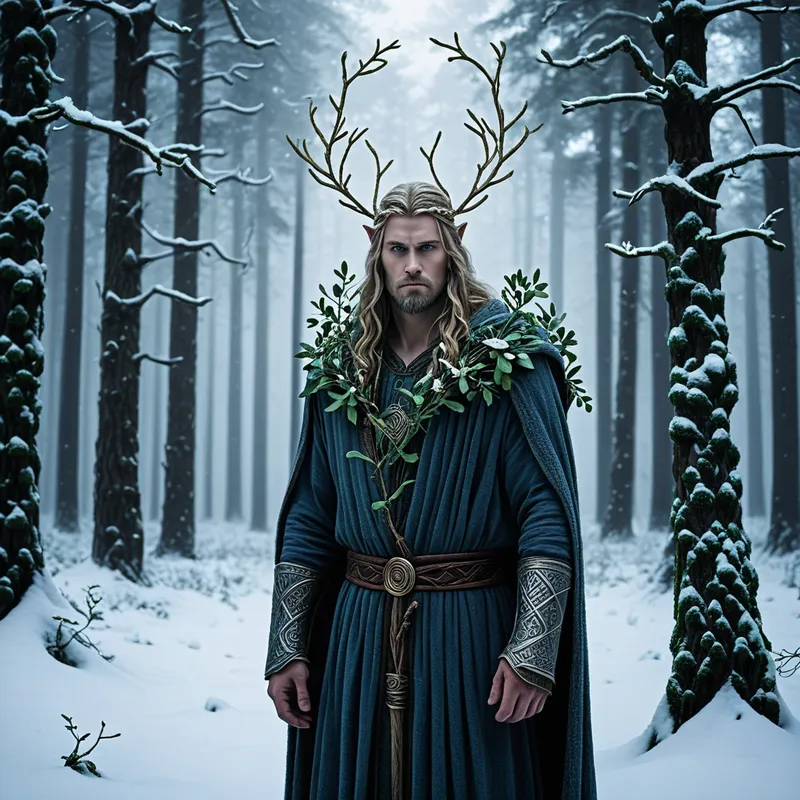
Höd Myth Meaning & Symbolism
The tragic tale of a blind god, Höd, manipulated into slaying his beloved brother Baldr, embodying fate, innocence, and the shadow's unwitting hand.
The Tale of Höd
Listen, and hear the tale that begins in laughter and ends in a silence that choked the worlds. It was a time of golden light in Asgard, for Baldr walked among them. His presence was like the sun on snow, so radiant that all things swore an oath not to harm him. All things, save one. A small, unassuming plant, the mistletoe, growing on the oak at the gate of Valhalla, was deemed too young to swear.
In their joy, the gods made a sport of it. They would gather in the great ring and hurl spears, strike with swords, cast great stones at Baldr. And each weapon would turn aside, or fall harmless at his feet, and laughter would ring through the halls. It was a celebration of his invulnerability, a dance of perfect safety.
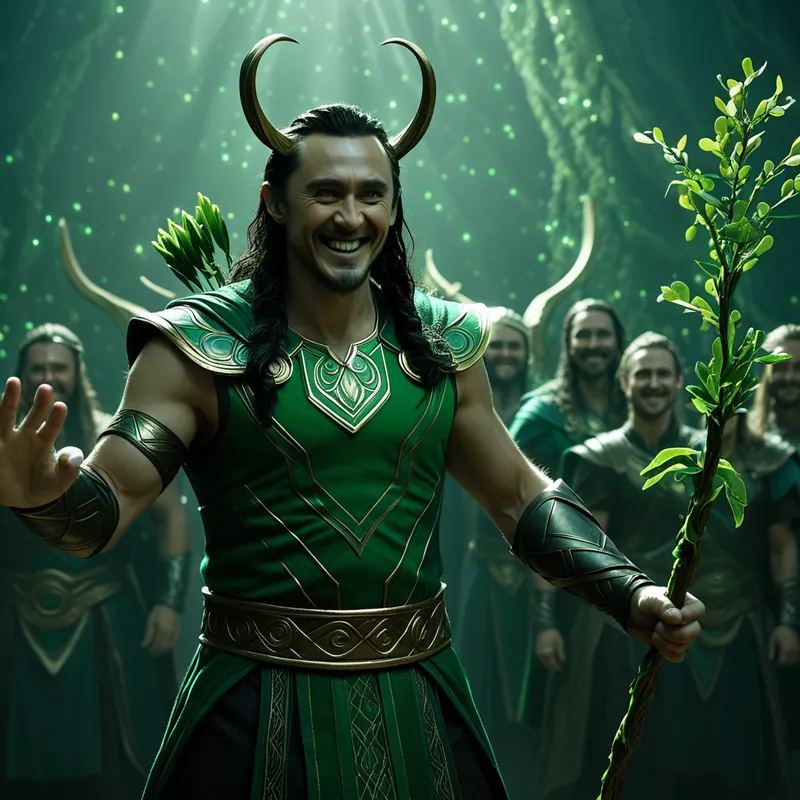
But one watched with a heart of cold stone. Loki, whose spirit curdled at such unblemished joy. He sought out the mistletoe, the one thing that had made no oath. With cunning hands, he fashioned it into a dart, slender and sharp, a needle of forgotten promise.
Now, there was another, Höd. A mighty god in strength, yet dwelling in a world of perpetual night. He heard the laughter, the clatter of harmless play, and felt the pang of exclusion. He stood apart, a solemn shadow in the revelry.
Then came a voice, warm and helpful, at his shoulder. It was Loki, the shapeshifter. "Why do you not join the game, noble Höd?" the voice asked. "Would you not honor your brother with a throw? Here, I will guide your hand." And Loki placed the dart of mistletoe into Höd's unknowing palm, positioned his arm, and aimed his blind strength toward the sound of Baldr's glad voice.
"Throw, Höd! Honor your brother!"
Höd, trusting, threw.
The laughter died. The sound that followed was not the familiar clatter of metal on stone, but a soft, terrible thud. Then a gasp, a cry that began in one throat and was taken up by every being in the nine worlds. The shining one fell. The light went out. And Höd, standing with empty hands, heard only the screaming silence and the wailing that now filled the place of joy. He did not see the dart. He did not see his brother fall. He only knew, in the sudden void where sound had been, that he had done a thing whose shape he could not fathom, whose consequence was the end of all light.
Cultural Origins & Context
This central tragedy is preserved primarily in the Poetic Edda, particularly in the Völuspá (The Prophecy of the Seeress) and Baldrs draumar (Baldr's Dreams), and is elaborated in the later Prose Edda by Snorri Sturluson. These texts are our fragile window into a worldview where myth was not mere story, but a resonant map of cosmic and human reality.
The myth was not simple entertainment. It was a foundational narrative explaining the inherent fragility of order, beauty, and innocence in a universe governed by implacable fate (ørlög). Told by skalds and around hearths, it served as a profound meditation on the themes of unintended consequence, the vulnerability of the good, and the inescapable nature of prophecy. The death of Baldr is the first domino in the cascade of events leading to Ragnarök. Höd’s role makes him not a villain, but an instrument—a crucial pivot upon which fate turns. In a culture that valued foresight, wisdom, and clear-sightedness, Höd’s blindness is the ultimate metaphor for the human condition: acting in profound ignorance within a predetermined script.
Symbolic Architecture
Höd is the archetype of the unwitting agent. He is not evil, but blind. His weapon is not a mighty sword, but the overlooked, the "too young," the exception. The mistletoe symbolizes that which is outside the covenant, the loophole in reality, the repressed element that inevitably returns. Loki represents the manipulative intellect, the shadow that identifies and exploits systemic weaknesses for chaos.
The greatest tragedies are not born from malice, but from blindness guided by cunning. The hand that acts is innocent; the will that directs it knows the darkness it unleashes.
Psychologically, Höd embodies the unconscious complex—a bundle of energy and potential within the psyche that operates autonomously, outside the light of ego-awareness. We all have a Höd within: aspects of ourselves that are powerful yet unseeing, capable of acting out destructive patterns engineered by our inner "Loki"—the trickster shadow that delights in sabotaging our wholeness. The death of Baldr is the shattering of the persona, the idealized self-image, or a state of naive innocence, by a truth we refused to see (the mistletoe) enacted by a part of ourselves we do not control (Höd).

The Dreamer's Resonance
When this myth stirs in the modern unconscious, it often manifests in dreams of profound, unwitting error. The dreamer may find themselves in a situation where they cause a catastrophic accident—pressing a button, saying a word, turning a key—without understanding its function. Upon the act, a terrible stillness falls, a beautiful object shatters, or a loved one looks at them with devastating sorrow. The overwhelming somatic feeling is one of cold dread and gut-wrenching guilt that arrives after the action, a retroactive understanding that floods the body.
This is the psyche working through a "Höd event." It indicates a process where an unconscious complex, perhaps a buried resentment, a neglected wound, or an unintegrated drive (the Loki-guided force), has used the dreamer's own energy and agency (Höd) to break something precious in their inner or outer life. The dream is not a prophecy, but a reflection. It shows the individual the architecture of a tragedy that has already occurred in their psychological landscape, making the unconscious manipulation conscious. The work lies in bringing light to that blind spot.

Alchemical Translation
The alchemical process modeled here is the mortificatio—the necessary death, the blackening. Baldr, the lumen naturae (light of nature), must die for the process of individuation to advance beyond naive unity. Höd is the reluctant agent of this dissolution. The psychic transmutation for the modern individual involves several agonizing steps.
First, one must cease identifying solely as the innocent victim (Baldr) or the purely malicious villain (Loki). One must courageously acknowledge the "Höd" within—the capable, strong, but unconscious part of oneself that has been an instrument of destruction. This is the "orphan" archetype, cast out from the garden of innocence by its own hand, bearing a guilt it did not consciously choose.
To integrate Höd is to open the eyes of the blind god. It is to take responsibility not for the cunning of the trickster, but for the strength that lent itself to the trickster's purpose.
The work is to bring consciousness to that blind strength. What in your life is a "mistletoe"—the small, overlooked, seemingly harmless exception that holds catastrophic power? What agreements have you failed to make with yourself? The alchemical goal is not to resurrect Baldr in his old, vulnerable form (though the myth holds that promise after Ragnarök), but to undergo the long night of the soul Höd initiates. In that darkness, stripped of false innocence, one forges a consciousness that can hold both light and shadow, seeing clearly the weapons in one's own hand before any voice, inner or outer, bids you throw. The rebirth that follows is not of innocence, but of hard-won integrity, where the seer and the actor become one.
Associated Symbols
Explore related symbols from the CaleaDream lexicon: