Hōchō Myth Meaning & Symbolism
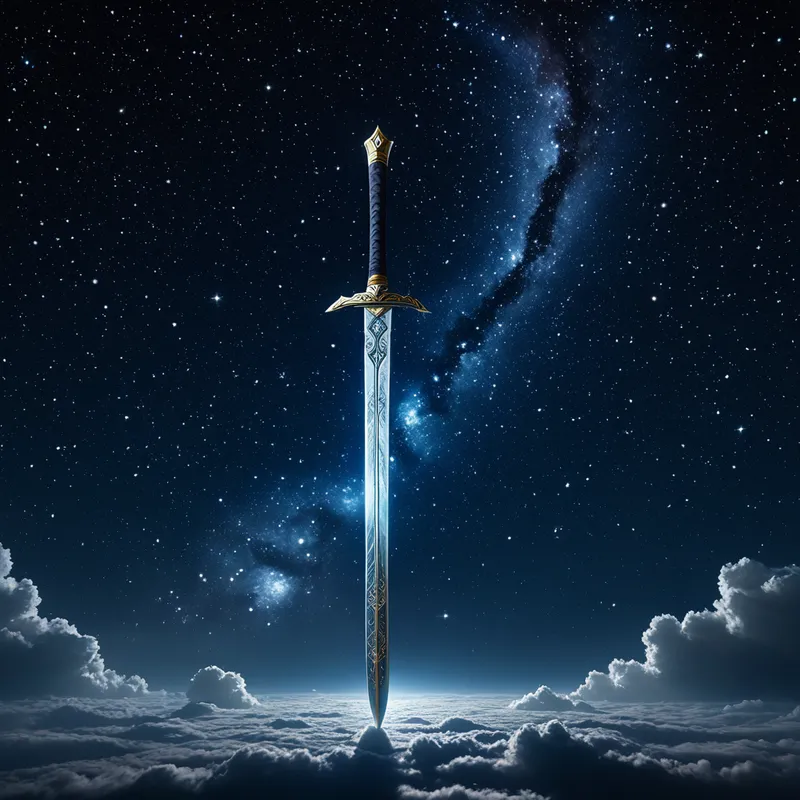
A myth of a divine blade that cleaves primordial unity, forging the world through a sacred act of separation and establishing order from chaos.
The Tale of Hōchō
In the time before time, when the heavens were a nameless expanse and the earth was a formless, drifting brine, there existed only the primeval unity. This was the Ame-no-Minakanushi, the solitary kami of the center of heaven—not a being as we know it, but the very condition of being, a silent, pregnant potential suspended in the void. No sun pierced the gloom, no wind stirred the waters, no line divided the sea from the sky. All was one, and the one was all, a profound and motionless egg of existence.
Then, from within that stillness, a stirring. A will, not yet a voice, formed from the longing of the potential to become manifest. It was the Kamiyonanayo, the Seven Generations of the Age of the Gods, coming into being as paired principles. And with them came a sound—not a clash, but a clear, singular tone that resonated through the formless ether. It was the sound of intent given edge.
For the paired kami saw the beautiful, terrible problem of the unity. To create a world, one must first create a space for a world. To allow for life, for growth, for story, one must first make a cut. And so, they summoned forth Hōchō. It did not appear in a forge of fire, but condensed from the very resolve of the deities, a blade of pure celestial principle. Its edge was not metal, but the absolute concept of distinction; its hilt was the unwavering will to act.
The kami grasped Hōchō, not with hands, but with the totality of their divine attention. There was no enemy to fight, only the infinite, soft resistance of the undifferentiated. With a motion that was both gentle and irrevocable, they drew the blade down through the heart of Ame-no-Minakanushi.
There was no scream, but a great, sighing exhalation as the one became two. The lighter, purer elements ascended, shimmering and bright, to become the Plain of High Heaven, Takamagahara. The heavier, denser elements coalesced and settled, becoming the floating bridge of earth, yet soft and unsteady. And between them now flowed space, distance, possibility—the arena where all things to come would play out. The first cut was not an act of violence, but the ultimate act of love: the separation that allows for relationship. Hōchō was then set aside, its primary duty complete, but its essence imbued into every boundary, every shoreline, every horizon that would ever be. The world was born not from a word, but from a cleaving.
Cultural Origins & Context
The myth of Hōchō finds its roots in Japan's oldest chronicles, the Kojiki (712 CE) and the Nihon Shoki (720 CE). These texts, commissioned by the imperial court to establish a divine lineage and a unified national cosmology, codified oral traditions that were far older. The story of the celestial blade is not a standalone tale but the critical, opening act of the Japanese cosmogonic narrative.
Its societal function was profoundly foundational. In a culture deeply connected to Shinto, where kami</ab title> are inherent in all things, the myth established the sacred origin of distinction and order. It provided a theological basis for the Japanese understanding of purity (kiyome) and pollution (kegare), where rituals often involve symbolic cutting or separation to restore proper boundaries. The act of Hōchō mirrored the agricultural and societal acts of division—clearing land for rice paddies, defining territories, establishing social roles—and sanctified them as participations in the original creative act. It was a myth told not merely to explain how the world began, but to instruct on how to live properly within it, respecting the sacred borders between human and divine, cultivated and wild, self and other.
Symbolic Architecture
The Hōchō is far more than a tool; it is the archetypal symbol of the necessary, sacred cut. It represents the principle that creation is always preceded by separation. Unity, while perfect, is static and unconscious. For life and consciousness to emerge, a differentiation must occur.
The first act of consciousness is to draw a line where none existed, to say "this" is not "that." This is the painful, glorious birth of meaning.
Psychologically, Hōchō symbolizes the faculty of discrimination—the ability to make judgments, set boundaries, and define the self apart from the undifferentiated mass of the unconscious or the collective. The primordial unity (Ame-no-Minakanushi) represents the primal, unconscious state of the psyche, full of potential but without form or direction. The wielders of the blade, the Kamiyonanayo, symbolize the emerging conscious mind, which must perform the difficult task of analysis and separation to create an inner structure (heaven and earth within the psyche). The cut is not a destruction of wholeness, but the establishment of the tension of opposites (light/dark, heaven/earth) between which creative energy can flow—the very basis of psychic life.
The Dreamer's Resonance
When the motif of Hōchō appears in modern dreams, it rarely manifests as a literal Japanese blade. Instead, one may dream of a surgeon's scalpel poised over a healthy body, a gardener's shears about to deadhead a beautiful flower, or a simple, profound line being drawn in the sand of a vast beach. The somatic experience is often one of acute tension, a mixture of dread and necessity in the dreamer's body.
This dream pattern signals that the psyche is undergoing a critical process of differentiation. The dreamer may be facing a life decision that requires a clean break—leaving a job, ending a relationship, or decisively choosing one path over another. The "primordial unity" in the dream could be an enmeshed family system, a stagnant but comfortable identity, or a tangled mass of unresolved emotions and ideas. The dream of Hōchō is the Self's imperative to cut, to separate, to define. The anxiety present is the natural fear of losing the safety of the undifferentiated, of the womb-like state. The dream confirms that while the cut feels like a loss, it is the essential precondition for the next stage of growth and conscious order.

Alchemical Translation
The alchemical journey of individuation mirrors the myth of Hōchō precisely. It begins in the massa confusa, the chaotic, unified prima materia of the unconscious personality. The seeker feels a longing for meaning and selfhood, but is trapped in a formless state where potentials conflict and cancel each other out.
The alchemical separatio is not about discarding parts of the self, but about giving each part its proper domain, its heaven and its earth, so the whole person can function.
The individual must then forge and wield their own psychic Hōchō. This is the development of conscious discernment and moral courage. It is the painful but necessary act of distinguishing the ego from the parental complexes (the first cut creating psychic space), the persona from the shadow, and the values of the Self from the expectations of the collective. Each act of clear-eyed judgment, each enforced personal boundary, each difficult truth acknowledged is a stroke of this inner blade.
The triumph is not in the cutting itself, but in what the cutting makes possible. By separating the elements of the psyche, one does not achieve a sterile isolation. Rather, one establishes the distinct territories—the "heaven" of spirit, ideals, and consciousness, and the "earth" of body, instinct, and grounded reality—between which a dynamic, creative relationship can now occur. The once-static unity becomes a living cosmos. The modern individual, through this alchemical translation of the myth, learns that true wholeness (individuation) is not a return to unconscious oneness, but a consciously achieved integration of clearly differentiated parts. The blade that divides is, paradoxically, the instrument that ultimately allows for a more profound and conscious connection.
Associated Symbols
Explore related symbols from the CaleaDream lexicon: