Hathor's Solar Crown Myth Meaning & Symbolism
A myth where the goddess Hathor, as the Eye of Ra, is pacified with a solar crown, transforming her destructive fury into life-giving, ecstatic power.
The Tale of Hathor’s Solar Crown
Listen, and hear the tale of the day the sun’s own daughter turned her face away.
In the time when gods walked [the earth](/myths/the-earth “Myth from Hindu culture.”/) and the Nun was held at bay by Ma’at’s feather, the aging sun god Ra sat upon his throne of lapis and gold. A whisper, thin and sharp as a shard of flint, reached his ear. It was the sound of rebellion. Humanity, the children he had fashioned from his own tears, now plotted in the shadows, mocking his age, questioning his rule. A cold fury, older than [the pyramids](/myths/the-pyramids “Myth from Egyptian culture.”/), stirred in Ra’s heart. He did not call for his warriors. He did not summon storms. He turned his gaze inward, to the most terrible aspect of his own power—his Eye.
And his Eye was [Hathor](/myths/hathor “Myth from Egyptian culture.”/).
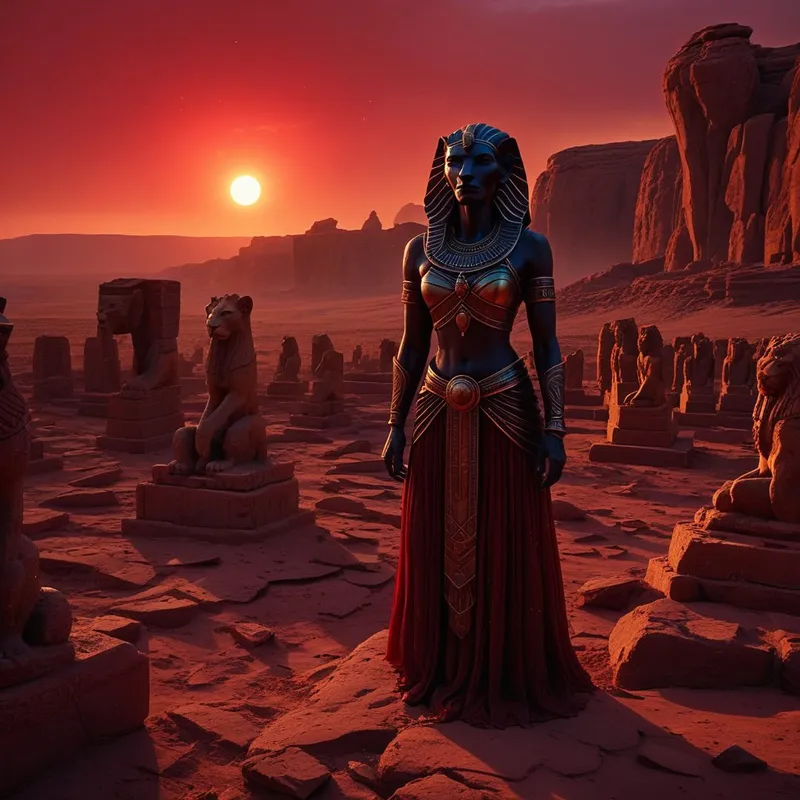
But not the Hathor of the sweet sistrum and the welcoming embrace. This was Hathor Unbound. At Ra’s silent command, her form shimmered and melted, reshaping itself into something sleek, muscled, and furious. Where there was softness, there was now taut sinew; where there was a gentle cow’s ear, there now stood a pointed lion’s ear, twitching at the sound of treachery. Her skin burned the color of [the desert](/myths/the-desert “Myth from Biblical culture.”/) at high noon, her eyes held the ferocity of the untamed hunt. She was [Sekhmet](/myths/sekhmet “Myth from Egyptian culture.”/), the Powerful One. Ra spoke a single word: “Cleanse.”
With a roar that split [the sky](/myths/the-sky “Myth from Persian culture.”/), Sekhmet leapt from the heavens onto the green ribbon of the Nile valley. She became a sandstorm of teeth and claws. She did not fight armies; she became the plague itself. Her breath was fever, her touch was pustule and blood. The laughter of rebellion turned to screams, then to whimpers, then to a terrible, spreading silence. She waded in a red tide of her own making, and her rage, once ignited, became a self-feeding fire. The land was dying. The balance was shattered.
High in his barque, Ra watched. His anger had cooled, replaced by a dawning horror. This was not [justice](/myths/justice “Myth from Tarot culture.”/); this was the end of his creation. He had unleashed a force that would not, could not, stop. He called the council of gods. Their faces were ashen. “We must make her drunk,” one whispered. “We must divert her fury.”
Under the command of the wise [Thoth](/myths/thoth “Myth from Global/Universal culture.”/), the gods acted with desperate speed. From the fertile silt of Elephantine, they commanded the servant girls to grind barley. They stained seven thousand jars of beer with red ochre, until the liquid shone like blood in the last light of Ra’s barque. Under the cover of Sekhmet’s roaring rampage, they poured this crimson flood across the fields where she was next to tread.
At dawn, the lion-goddess paused, her muzzle dripping. She sniffed the air. Before her, the land shimmered with a vast, red pool. She saw her reflection in it—a sea of blood. A final, triumphant roar tore from her throat, and she bent to drink deeply, lapping up the “blood” of her enemies.
She drank, and drank, and drank. The fermented barley worked its ancient magic. The fire in her veins softened, cooled. The lion’s snout blurred, the taut muscles relaxed. The burning red of her skin faded to a warm gold. Her furious pacing slowed to a sway, then a stumble. She lay down in the field, not in death, but in a deep, satiated sleep.
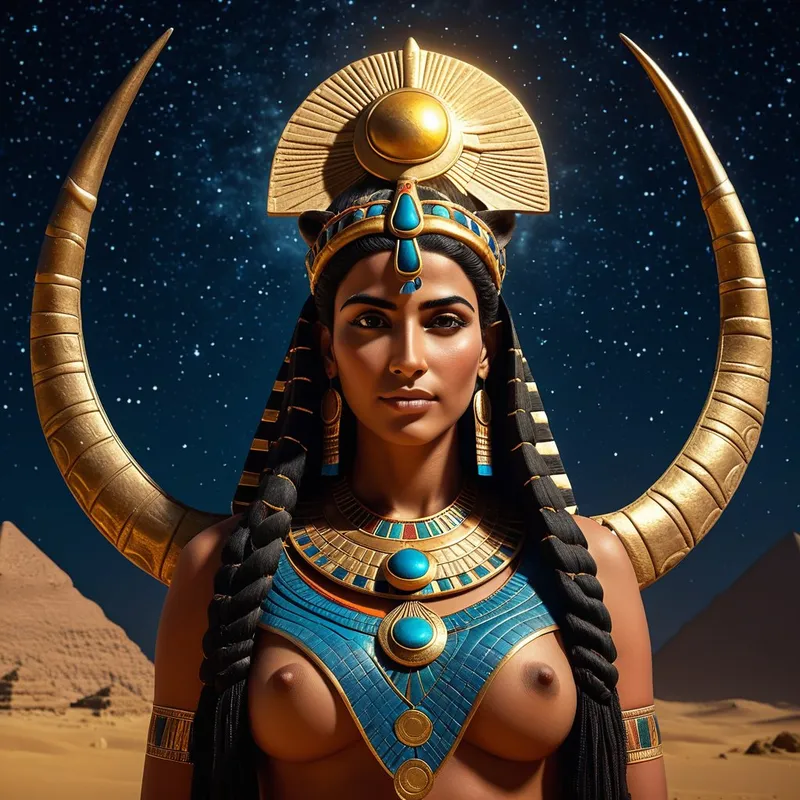
When she awoke, [the world](/myths/the-world “Myth from Tarot culture.”/) was quiet. The taste of copper was gone from her tongue, replaced by a sweet, earthy aftertaste. The hunger for destruction had vanished. She rose, and she was Hathor once more—but changed. The gods approached, not in fear, but in reverence. From the hands of Nut herself, they offered her a crown. It was not a crown of dominion, but of integration. A radiant sun disk, the very essence of her father Ra, was placed between the elegant, sweeping horns of the celestial cow.
As [the crown](/myths/the-crown “Myth from Various culture.”/) settled upon her brow, a final alchemy occurred. The searing, destructive power of the Eye was not removed, but transformed. It fused with her nurturing, joyous nature. She was no longer Sekhmet or Hathor, but Hathor-Sekhmet, the complete one. Her rage had been alchemized into a protective, ecstatic power. She returned to the heavens, and where her crown shone, music was born, love flourished, and the people danced, knowing that the goddess who brought the dance also held the knife that kept chaos at bay.
Cultural Origins & Context
This myth, often called “The Destruction of Mankind,” is preserved in fragments on the walls of royal tombs, such as that of Seti I, and in later Coffin Texts. It was not a folktale for the masses, but a sacred, cosmological narrative recited in temple liturgies and royal rituals. Its primary function was explanatory and regulatory. It explained the inherent duality of the divine—the terrifying, necessary violence that protects cosmic order (Ma’at) and the benevolent joy that makes life worth living.
Priests of Hathor and Sekhmet would have invoked this story during festivals, perhaps even during the “Drunkenness of Hathor” celebrations, where ritualized intoxication mirrored the myth. It served as a divine precedent for [the pharaoh](/myths/the-pharaoh “Myth from Egyptian culture.”/)’s role: like Ra, he must wield terrible power to protect Egypt, but he must also master and temper that power, lest it destroy what it seeks to preserve. The myth is a masterclass in divine statecraft and psychological integration, presented as cosmic drama.
Symbolic Architecture
At its core, the myth is about the peril and necessity of reintegrating the repressed, destructive [aspect](/symbols/aspect “Symbol: A distinct feature, quality, or perspective of something, often representing a partial view of a larger whole.”/) of [the Self](/myths/the-self “Myth from Jungian culture.”/). Ra’s initial act is a psychological [projection](/symbols/projection “Symbol: The unconscious act of attributing one’s own internal qualities, emotions, or shadow aspects onto external entities, people, or situations.”/): his own unresolved rage at his perceived weakness (aging) is externalized onto humanity and then embodied in Sekhmet. She is his unleashed [shadow](/symbols/shadow “Symbol: The ‘shadow’ embodies the unconscious, repressed aspects of the self and often represents fears or hidden emotions.”/), the raw, amoral [life](/symbols/life “Symbol: The symbol of ‘Life’ represents a journey of growth, interconnectedness, and existential meaning, encompassing both the joys and challenges that define human experience.”/)-force that knows only consumption.
The crown is not a reward, but a symbol of the completed circuit. The solar disk (consciousness, spirit, father) is held stable by the lunar horns (the unconscious, body, mother). The violent energy is contained, focused, and made sacred.
The red [beer](/symbols/beer “Symbol: Beer often symbolizes social connection, celebration, and relaxation, reflecting both enjoyment and excess.”/) is the pivotal [symbol](/symbols/symbol “Symbol: A symbol can represent an idea, concept, or belief, serving as a powerful tool for communication and understanding.”/) of [trickster](/symbols/trickster “Symbol: A boundary-crossing archetype representing chaos, transformation, and the subversion of norms through cunning and humor.”/)-[alchemy](/symbols/alchemy “Symbol: A transformative process of purification and creation, often symbolizing personal or spiritual evolution through difficult stages.”/). It meets Sekhmet on her own terms—as [blood](/symbols/blood “Symbol: Blood often symbolizes life force, vitality, and deep emotional connections, but it can also evoke themes of sacrifice, trauma, and mortality.”/)—but secretly introduces a transforming agent (intoxication, sleep, the unconscious). It does not defeat her through force, but disarms her through subterfuge and [assimilation](/symbols/assimilation “Symbol: The process of integrating new experiences, identities, or knowledge into one’s existing self, often involving adaptation and transformation.”/). This is the profound Egyptian [insight](/symbols/insight “Symbol: A sudden, deep understanding of a complex situation or truth, often arriving unexpectedly and illuminating hidden connections.”/): transformation often requires a ruse, a symbolic bait-and-switch that the literal-minded, raging aspect of the [psyche](/myths/psyche “Myth from Greek culture.”/) will accept.
Hathor, wearing the [crown](/symbols/crown “Symbol: A crown symbolizes authority, power, and achievement, often representing an individual’s aspirations, leadership, or societal role.”/), becomes the [archetype](/symbols/archetype “Symbol: A universal, primordial pattern or prototype in the collective unconscious that shapes human experience, behavior, and creative expression.”/) of the coincidentia oppositorum—the coincidence of opposites. She holds the ecstatic dance and the slaughterous claw in perfect, fearsome balance. She is the full [spectrum](/symbols/spectrum “Symbol: A continuum of possibilities, representing diversity, transition, and the full range of existence from one extreme to another.”/) of feminine power, from devastating [wrath](/symbols/wrath “Symbol: Intense, often destructive anger representing repressed emotions, moral outrage, or survival instincts.”/) to life-giving nurturance, now under the governance of the solar principle of conscious recognition.
The Dreamer’s Resonance
When this myth stirs in the modern dreamer, it often manifests as dreams of uncontrollable rage or terrifying, predatory feminine figures. One might dream of being chased by a lioness, of a house filling with blood-red liquid, or of wielding destructive power with a mix of horror and exhilaration. Somatic sensations accompany this—a heat in the chest, a clenched jaw during sleep, a feeling of being “possessed” by a fury that feels both alien and intimately personal.
This is the Sekhmet-phase active in the psyche. It signals that a long-suppressed anger, a vital but untamed force, has been triggered and is on a rampage, often in reaction to perceived betrayal, injustice, or helplessness (Ra’s hearing the “whispers” of rebellion). The psyche is in the midst of its own bloody purification, which feels apocalyptic. The dreamer is not dreaming of Sekhmet; they are in the field with her, experiencing the chaotic, self-destructive fallout of shadow-[projection](/myths/projection “Myth from Alchemical culture.”/).
Alchemical Translation
The individuation process modeled here is the alchemy of sacred rage. The first step is the painful recognition that the “monster” destroying our inner landscape (relationships, self-worth, peace) is not an external enemy, but a disowned part of our own divine authority, sent on a misguided mission of protection.
The red beer is the symbol of the creative trick we must play on ourselves. We must offer our raging Sekhmet an alternative container that honors its intensity but changes its nature.
This is the “creative intoxication.” For the modern seeker, this could be channeling fury into passionate art, transformative activism, or intense physical discipline. It is finding a vessel that can “hold” the red energy without letting it spill as literal destruction. It requires the cunning of Thoth—the intellectual and symbolic reframing of our own experience.
The final stage is the donning of the Solar Crown. This is the conscious, willed integration. It is the moment we can say, “This destructive power is mine. I will not exile it again, for it is my strength. But I will place it under the sovereignty of my greater Self (the sun disk).” The crown represents a new, stable identity that acknowledges [the shadow](/myths/the-shadow “Myth from Jungian culture.”/) without being ruled by it. The individual becomes like Hathor: capable of profound joy, creativity, and love precisely because they have faced and transformed their capacity for holy terror. The power that once sought to destroy the world now becomes the fierce, ecstatic force that protects and enlivens their authentic life.
Associated Symbols
Explore related symbols from the CaleaDream lexicon: