Hasan and Husayn at Karbala Myth Meaning & Symbolism
A tale of ultimate sacrifice at Karbala, where Husayn ibn Ali's stand against tyranny became an eternal symbol of conscience over power.
The Tale of Hasan and Husayn at Karbala
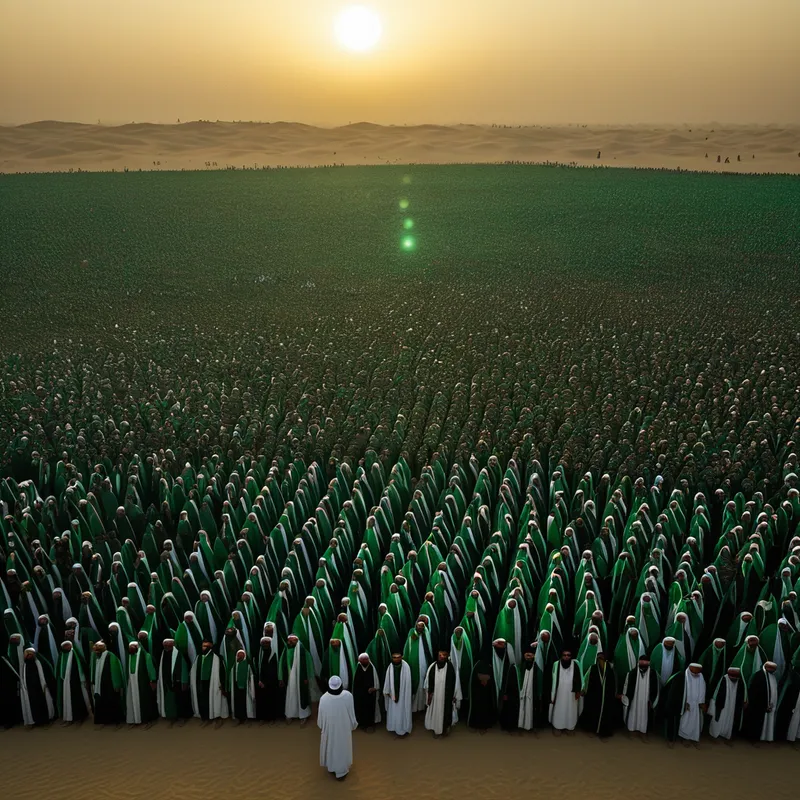
Listen. The wind that blows across the plain of Karbala carries more than sand. It carries a cry that has never died. It is the year 61 after the Hijra. The sun is a merciless eye over a land parched for justice.
Husayn ibn Ali, a man whose lineage is a thread of light back to the Prophet himself, travels with his family and a small band of the faithful. They are not an army. They are a conscience. They move toward Kufa, where voices called for him, pledging allegiance to truth over the throne. But the promises were ash. The governor, Ibn Ziyad, has filled the roads with soldiers, and the voices have fallen silent, choked by fear.
Husayn’s elder brother, Hasan, is not with them in body. His spirit is a silent witness. Years before, Hasan had made a peace, a treaty with the Umayyad ruler Mu'awiya, to prevent bloodshed. He swallowed the bitterness of compromise to preserve the community. Now, Mu'awiya is dead, and his son Yazid demands an oath of allegiance that would sanctify tyranny. Husayn cannot give it. To do so would be to extinguish the light of truth itself.
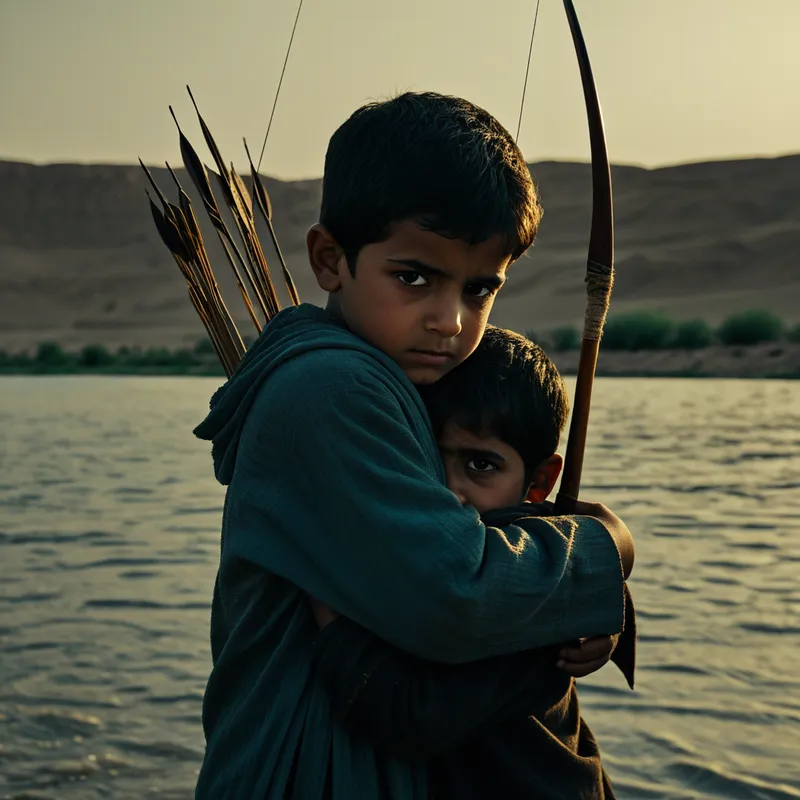
So they arrive at Karbala, a desolate place by the Euphrates. The vast army of Umar ibn Sa'd surrounds them, a sea of spears and banners blocking access to the life-giving water. The siege begins under a baking sky. Thirst becomes a tangible enemy. Husayn’s infant son, Ali al-Asghar, cries for a drop of water. Husayn carries him before the army, a silent plea to their humanity. The answer is an arrow that finds its mark. The cradle is empty.
The day of Ashura dawns. One by one, Husayn’s companions—his brothers, his sons, his nephews—go forth. They fight not for victory, for that is impossible, but for witness. They fall, each death a separate chapter of valor, until the plain is strewn with the bodies of the chosen. Finally, Husayn stands alone, wounded, weary, his garments stained. He lifts his face to the sky, a final prayer on his lips. Then the blows fall. He is struck down. His head is severed. The army descends upon the tents, plundering, trampling all that remains.
Silence returns to the plain, but it is a silence that screams. The women and children, including Husayn’s sister Zaynab, are taken captive, paraded through the streets of Kufa and Damascus. But from Zaynab’s mouth does not come wailing; it comes prophecy. In the court of Yazid himself, she unveils the crime, transforming captivity into a pulpit. The victory of the sword is unmasked as the defeat of the soul. The story does not end with death at Karbala; it is born there, carried on the breath of the survivors, an eternal, burning testimony.
Cultural Origins & Context
This is not merely a historical account of 680 CE. It is the foundational narrative of Shi'a Islam, experienced as a living, bleeding reality. Passed down not as cold history, but as raw elegy (marsiya), passionate oration (majlis), and physical theatre (ta'ziyeh), the story is relived annually during the month of Muharram.
Its societal function is multifaceted. It is a myth of origin, defining a community through shared sacred suffering and resistance to illegitimate authority. It is a moral compass, establishing the absolute imperative of standing for truth (haqq) even in the face of annihilation. It transforms grief from a passive state into an active, unifying force—a "revolution of tears" that nurtures resilience, social cohesion, and a perpetual critique of worldly power. The narrators were first the survivors like Zaynab, then the Imams that followed, and finally a whole tradition of poets, preachers, and devotees who became the keepers of this sacred memory.
Symbolic Architecture
At its heart, Karbala is an archetypal collision between two irreconcilable principles: the raw, coercive power of the state (dunya) and the sovereign, uncompromising authority of the spirit (din). Husayn is not a conventional hero seeking conquest; he is the shahid—the witness-martyr. His victory lies in his defeat, for he exposes the hollow core of tyranny by refusing to grant it legitimacy.
The most profound rebellion is not to overthrow a throne, but to deny it your soul.
Hasan represents the path of pragmatic wisdom and preservation, while Husayn embodies the ultimate sacrifice when compromise becomes corruption. The severed head of Husayn, paraded yet speaking through Zaynab, symbolizes the ultimate paradox: the voice of truth is most powerful when the body of power has been destroyed. The thirst of Karbala is not merely physical; it is the soul's thirst for justice in a spiritual desert. The empty cradle of Ali al-Asghar is the murder of innocence and future, making the tragedy unbearably intimate and universal.

The Dreamer's Resonance
When this myth stirs in the modern dreamer, it often signals a profound interior crisis of integrity. To dream of being besieged, of being denied life-giving Water, speaks to a soul feeling parched by a life of inauthenticity or moral compromise. The vast, faceless army may manifest as the collective pressures of society, corporate demands, or familial expectations—forces demanding an "oath of allegiance" to a value system the dreamer's essence rejects.
Dreams of making a stand alone, or of witnessing the fall of beloved figures (the Hero within), indicate a somatic recognition: a part of the psyche is ready to die rather than continue a falsehood. This is not a desire for physical death, but the necessary death of a former way of being. The captive journey of the women in the dream may represent the feeling of being forced to carry and display one's grief or vulnerability in hostile environments. The dream is the psyche's Ritual of Ashura, preparing the dreamer for a conscious, waking choice between comfort and conscience.

Alchemical Translation
The alchemy of Karbala is the transmutation of utter defeat into incorruptible spiritual authority. For the individual on the path of individuation, this myth models the most difficult transition: from the ego's desire for worldly success and validation to the Self's demand for authentic existence.
The first operation is the separatio: the conscious, painful separation from the collective stream. This is Husayn leaving Medina, refusing the oath. It is saying "no" to the collective lie, knowing isolation will follow. The second is the calcinatio: the burning away of all support and hope on the desert plain. This is the destruction of the persona and all external crutches. The thirst is the agony of the emerging Self, stripped bare.
The gold of the soul is forged not in the fire of ambition, but in the crucible of principled refusal.
The final, crucial transmutation is the solutio and coagulatio: the dissolution of the physical form and the coagulation of meaning. The beheading is the ultimate dissolution of ego-identity. Yet, from this, a new substance coalesces—the legacy, the teaching, the unwavering voice (Zaynab's). In psychological terms, the ego is sacrificed to the larger reality of the Self. The individual no longer acts for personal gain but becomes a vessel for a transpersonal truth. The power that was sought outwardly is found to have been within all along, but it can only be claimed through total vulnerability and acceptance of the cost. The dreamer learns that true power is not domination, but the ability to hold truth intact, even as the world falls apart.
Associated Symbols
Explore related symbols from the CaleaDream lexicon:
- Water — The denied Euphrates represents life, truth, and spiritual sustenance; the thirst at Karbala symbolizes the soul's agony when cut off from its source of meaning.
- Sacrifice — The core action of the myth, representing the voluntary surrender of life, comfort, and security for the sake of a higher, incorruptible principle.
- Blood — Spilled on the desert sand, it is not a sign of defeat but the sacred ink with which the covenant of resistance and truth is written for eternity.
- Hero — Husayn redefines the archetype, where heroism is not measured by victory in battle, but by the unwavering stance of conscience against impossible odds.
- Shadow — Represented by the army of Yazid, it is the collective, tyrannical force of conformity, oppression, and legitimized injustice that the conscious self must confront.
- Temple — The family and camp of Husayn become a moving temple of truth, a sacred space besieged by profane power, representing the inner sanctum of conscience.
- Cup — The empty cup of Ali al-Asghar, symbolizing the ultimate deprivation and the shattered vessel of future hope, which becomes a sacred relic of grief.
- Dawn — The morning of Ashura, a time of impending violence and final prayers, representing the twilight moment of choice before a world-altering act of witness.
- Journey — The road from Medina to Mecca to Karbala, and the captive journey to Damascus, mapping the physical and spiritual odyssey from safety to sacrifice to testimony.
- Islamic Crescent — A symbol often associated with the faith, here cast under the shadow of the tragedy, representing the community tested and defined by this foundational memory.
- Voice — Embodied in Zaynab's speeches after the battle, it represents the truth that survives the body, the prophecy that rises from the ashes of silence.
- Stone — The hard, unyielding ground of Karbala, representing the harsh, unforgiving reality of the world upon which the soft power of principle must make its stand.