
Harmonia's Necklace Myth Meaning & Symbolism
A divine wedding gift, a cursed necklace of beauty and ruin, passed through generations, binding fate to the very essence of harmony and discord.
The Tale of Harmonia's Necklace
Hear now the tale not of a blade or a shield, but of a jeweled whisper that coiled through generations, a gift that was a geas, a beauty that was a blight. It begins in the scent of ambrosia and the shimmer of divine light, at the wedding that was to unite heaven and earth.
The great hall of Cadmus in Thebes thrummed with a presence never before felt in the mortal realm. The Olympians themselves had descended, not as distant watchers, but as guests, honoring the union of the mortal king and his bride, Harmonia. She, born of the most unlikely union—Ares, the storm of strife, and Aphrodite, the sea of desire—was a living poem of reconciliation. Her very name was the hope of the age.
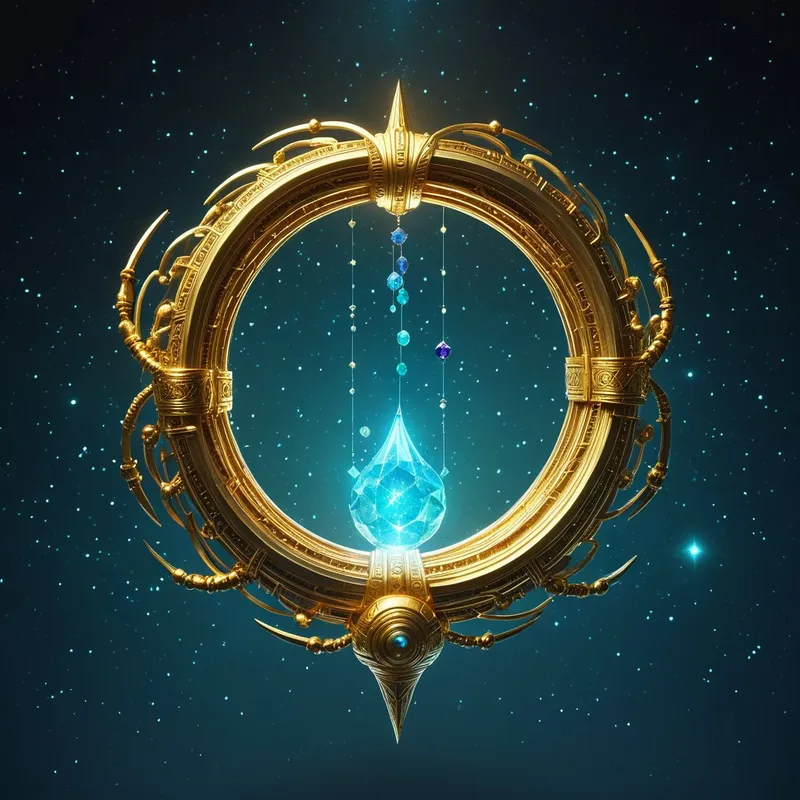
The air was thick with the perfume of divine favor. Then, as the hymns reached their peak, the mother of the bride stepped forward. Aphrodite, in her unbearable radiance, presented her daughter with a wedding gift. It was a peplos, a robe woven from starlight and twilight, and a necklace. Oh, the necklace! Forged not by mortal hands, but by the divine smith Hephaestus himself, it was a masterpiece of gold, more fluid than metal, set with gems that held the captured fire of distant stars. It was beauty incarnate.
But a chill entered the hall, a shadow in the golden light. For the gift was not born of love alone. Hephaestus, the cuckolded husband, had crafted it with a secret art, imbuing the gold with a silent, relentless curse. It was a seed of the future, a glittering prison for the fate of a line. As the cool, impossibly heavy links settled around Harmonia’s neck, she felt not just adornment, but a destiny clicking into place.
The golden shadow followed them. From Thebes, Cadmus and Harmonia were driven, their city turning against them as the curse took its first, subtle root. They wandered, royal beggars, until they were transformed—not into gods, but into serpents, sliding into the forest’s embrace, their human forms shed but their bond, and the memory of the necklace, eternal. The artifact passed to their daughter, Semele, and then to her sister, Jocasta. In each royal chamber it rested, a silent guest at every tragedy. It gleamed in the torchlight as brothers warred for a throne, as a son unknowingly slew his father, as a queen discovered an unbearable truth. It was there, a passive, brilliant witness to the fall of the House of Cadmus, its beauty a cruel counterpoint to the blood staining the stones of Thebes. The necklace, the beautiful, cursed heirloom, outlasted them all, a chain of gold linking one ruin to the next, until it was finally dedicated to the gods, its mortal saga ended, its legendary poison sleeping in a temple’s gloom.

Cultural Origins & Context
This haunting narrative comes to us primarily from the later mythographic traditions, most notably in the works of poets like Apollonius of Rhodes and the travel-writer Pausanias. It is not a myth of the high Classical age of Athens, but one that flourishes in the Hellenistic and Roman periods, a time of greater psychological complexity and interest in fate, inherited guilt, and the darker facets of divine interaction.
The myth functioned as a powerful etiological story—an explanation for why. It explained the profound and repeated suffering of the Theban royal house, the Cadmeans, providing a tangible, symbolic cause for the intangible concept of a "family curse." The necklace became the physical vessel for the ate (divine infatuation, ruin) that plagued them. It was told not just as entertainment, but as a moral and cosmological lesson: that the gifts of the gods are never simple, that beauty and catastrophe can be forged from the same divine fire, and that the consequences of divine discord (here, between Hephaestus, Aphrodite, and Ares) ripple through generations of mortals. It served as a warning about the dangerous allure of divine artifacts and the inescapable weight of legacy.
Symbolic Architecture
At its core, Harmonia’s Necklace is an archetypal symbol of the poisoned gift and the beauty that binds. It represents the paradoxical nature of inheritance—all that is passed down is not merely wealth or status, but also the unseen psychological patterns, the unresolved conflicts, and the latent curses of our lineage.
The necklace is the embodied paradox: that which makes us radiant also makes us vulnerable; our greatest adornment is our heaviest chain.
Harmonia herself is the symbol of a fragile, achieved unity. Born of opposites (Love and War), her very existence is a miracle of reconciliation. The necklace, given at her wedding—the ritual of union—immediately begins to unravel that unity. This speaks to a profound psychological truth: the moment we achieve a state of inner or outer harmony, the shadow elements, the unresolved tensions (here, Hephaestus’s rage and betrayal), often activate to test and potentially dismantle it. The necklace is the return of the repressed, gifted in a golden box.
The curse is not a sudden blast of evil, but a slow, generational poison. It works through the very structures of life: family, loyalty, love, and power. It turns brothers against each other (Polynices and Eteocles), unravels the sacred order of parent and child (Oedipus and Laius). The necklace symbolizes how unconscious, inherited trauma—the "family secret," the unspoken wound—can dictate the script of our lives in beautiful, tragic repetition.
The Dreamer's Resonance
When this myth stirs in the modern unconscious, it rarely appears as a literal necklace. The dreamer may find themselves in a family home, receiving a beautiful but unsettling heirloom—a clock that ticks backwards, a painting whose eyes follow them, a deed to a magnificent but crumbling estate. The somatic feeling is one of simultaneous attraction and dread; the object is gorgeous but feels cold, heavy, or electrically charged.
Psychologically, this dream pattern signals an encounter with the generational shadow. The dreamer is becoming conscious of a pattern, a "curse," that has moved through their family line: perhaps a pattern of failed relationships, financial ruin following success, or a specific type of betrayal. The dream marks the moment this inherited complex is being handed to them. They are now the "Harmonia" of their line, the one in whom the conflict between the beautiful legacy (the family's strengths, gifts, love) and the cursed legacy (its dysfunctions, secrets, traumas) becomes conscious and must be held.
The process is one of painful awakening. The dreamer is no longer just living out the pattern; they are beginning to see it as a pattern. This brings a profound sense of burden and isolation, but also the first, fragile potential for a different outcome.
Alchemical Translation
The individuation process modeled by this myth is not one of heroic conquest, but of conscious embodiment and transmutation. The goal is not to reject the "necklace"—the inherited complex—for it is part of the Self, part of the family soul. Nor is it to be destroyed by it. The alchemical work is to wear it consciously, to take its weight upon oneself with full awareness, and in doing so, begin to change its nature.
The curse is transmuted not by being broken, but by being fully understood and borne with conscious suffering. The lead of fate becomes the gold of meaning only in the crucible of acknowledged experience.
The first step is Recognition: seeing the pattern in one's own life and tracing its lineage (Cadmus and Harmonia being driven out). The second is Containment: holding the tension between the beauty and the poison without acting out the old script (the necklace passing through generations, witnessed but not always understood). The final, most difficult step is Sacred Dedication.
This is symbolized by the necklace's final fate: being placed in a temple. For the modern individual, this means taking the complex—the inherited trauma, the family shadow—and "dedicating" it to something greater than the personal or familial drama. This could be through art, through deep psychological work, through service, or through a spiritual practice. It is to say, "This curse is real, it has shaped me, but I will not pass it on as a curse. I will transform its energy by making it part of my offering to life." One does not become free of the pattern; one becomes its conscious, responsible steward, breaking the cycle of unconscious repetition. The necklace, once an engine of ruin, becomes a relic of a completed journey, its beauty finally purified of its poison, its story a testament to transformation.
Associated Symbols
Explore related symbols from the CaleaDream lexicon: