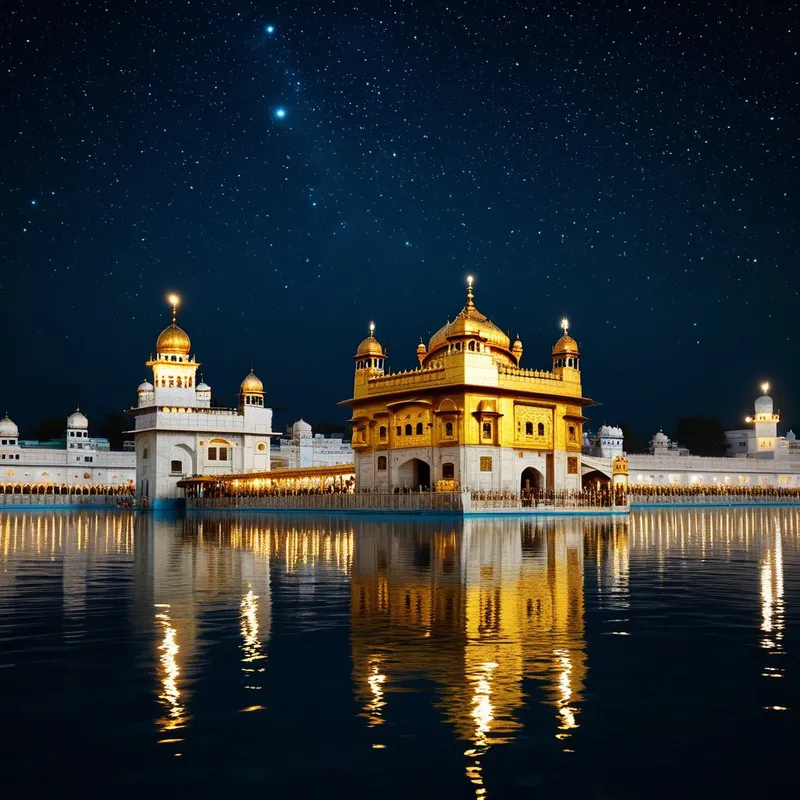
Harmandir Sahib Myth Meaning & Symbolism
A sacred sanctuary built not on high ground but in a humble pool, embodying divine invitation, universal equality, and the alchemy of turning the heart into a temple.
The Tale of Harmandir Sahib
Listen, and hear a tale not of a mountain peak, but of a sacred dip in the land. In the heart of the Punjab, where the earth remembers the tread of sages, there was a place of stillness—a pool of water known as Amrit Sarovar. It was said this was no ordinary water, but a place where the Waheguru’s own light first touched the soil, where saints and seers had come to meditate and dissolve their separateness into the One.
But for generations, the pool lay in a low place, overlooked, a silent mirror for the sky. Then came the Guru, a beacon of the Timeless One. The fourth Guru, Guru Ram Das, saw not a swamp, but a promise. He envisioned a city of the Divine here, and he began to dig the pool wider, deeper, calling it the Pool of Nectar. The work was an act of devotion, each scoop of earth a prayer.
Yet, the central mystery remained empty, a question mark upon the water. It was his son, the fifth Guru, Guru Arjan Dev, who received the divine instruction. The voice of the Gurbani within him spoke a revolutionary truth: The house of God shall not be upon a hill, looking down upon creation. It shall be built lower than the earth around it. The architects of spirit were confounded. Every temple of man sought the high place, the vantage point of power and exclusivity.
But the Guru was unwavering. "We shall build the Harmandir Sahib in the very center of the pool," he declared. "And we shall not face it with one grand door, but with four—one open to each corner of the world." The builders descended into the humble place. The foundation stone was laid not by a priest or a king, but by a Muslim saint, Mian Mir, at the Guru's own invitation. The stone was set lower than the surrounding land, a deliberate bow to all of humanity.
As the marble walls rose from the water, a miracle of intention took shape. It was not a fortress, but a refuge. Not a throne, but a seat. When the structure was complete, Guru Arjan placed within its heart the living word—the newly compiled Adi Granth Sahib. He declared this book the eternal Guru, the light within the temple. And so, the Harmandir Sahib was born: a jewel rising from the water, accessible only by a causeway, its golden dome not piercing the heavens arrogantly, but gathering the sky's light and casting it gently back upon the earth, a beacon calling all, from every direction, to come and drink from the pool of unity.
Cultural Origins & Context
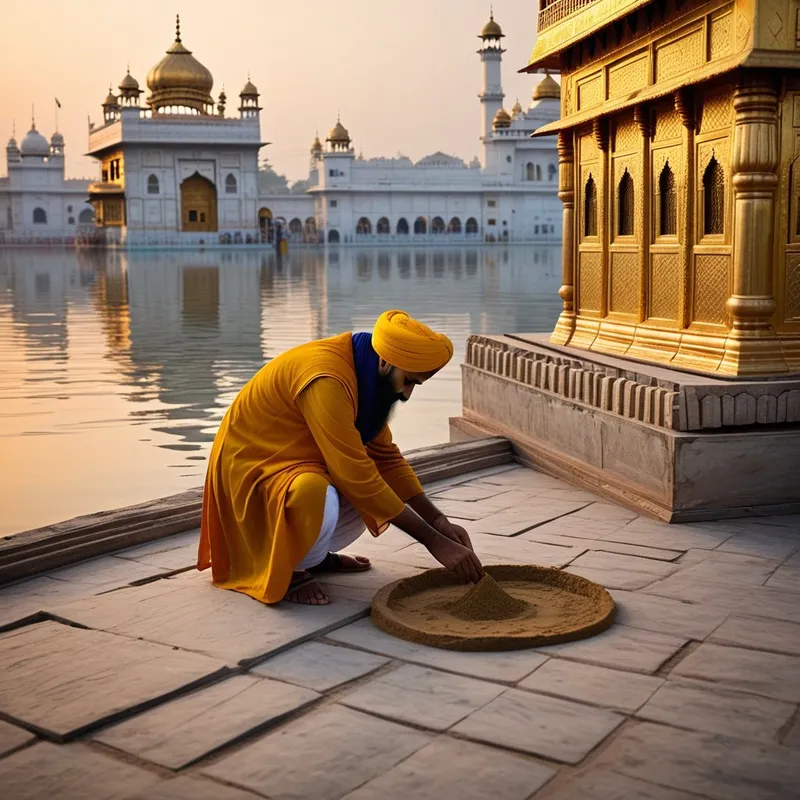
This is not a myth lost in antiquity, but a living narrative rooted in the 16th and early 17th centuries of North India. It originates from the very foundation of Ramdaspur, the city that grew around the Harmandir Sahib. The story was passed down through the Khalsa and the Sangat, not as a fable of gods and monsters, but as a recorded history of divine principle made manifest in architecture and community action.
Its tellers were the Gurus themselves, through their hymns and directives, and later the Gianis and Ragis who recited the history in the courtyards of the temple. Its societal function was revolutionary: to physically embody the core Sikh tenets of Ik Onkar and the rejection of caste, creed, and gender as barriers to the Divine. The temple's design was its doctrine, a silent, permanent sermon against spiritual hierarchy and exclusion.
Symbolic Architecture
The myth of Harmandir Sahib is a masterclass in symbolic inversion, where every conventional religious symbol is turned inside out to reveal a deeper, psychological truth.
The most profound temple is built not where you look up to the divine, but where the divine looks level into your eyes.
The low-lying foundation is the ultimate symbol of humility (Nimrata). Psychologically, it represents the dissolution of the ego, the conscious descent from the hilltop of superiority and isolation into the common pool of shared human experience. It is the death of spiritual arrogance.
The four doors are the arms of the psyche stretched open in radical inclusivity. They represent the conscious orientation towards all psychological types, all backgrounds, all shadows and lights of the human condition. There is no "back door" for the unworthy; every approach is a front door.
The surrounding water (Amrit Sarovar) is the unconscious itself—primal, reflective, and purifying. The temple rises from it, meaning the organized, conscious self (the structure of the personality) must be founded in and reflected by the depths of the unconscious. One must walk through the waters of the unknown to reach the center.
Finally, the central shrine housing the Adi Granth Sahib symbolizes the true "inner sanctum." It is not an idol, but the Living Word, the compiled wisdom of ages. This represents the individuated Self, the central, guiding principle of the psyche that is not the personal ego, but a transpersonal authority (the "eternal Guru") composed of integrated wisdom, seated at the heart of one's being.
The Dreamer's Resonance
When this myth stirs in the modern dreamer, it often manifests as dreams of finding or building a sanctuary. One may dream of a beautiful, luminous structure in the middle of a lake or a swamp, feeling a compelling urge to reach it. Alternatively, one might dream of a crowded, exclusive temple on a hill and feel a profound sense of alienation, followed by the discovery of a simpler, open door below.
Somatically, this can feel like a release of tension in the chest and shoulders—the dropping of a burden of having to be "above" others, or the anxiety of exclusion. Psychologically, this dream pattern signals a process of inclusive integration. The psyche is working to bring exiled parts of the self—the "lower" or shameful aspects, the identities from the "four directions" of one's experience that have been kept out—into a central, sacred space within. The conflict is between the old, hierarchical ego-structure (the hilltop fortress) and the emerging, humble, and holistic Self (the island temple).
Alchemical Translation
The alchemical journey modeled by Harmandir Sahib is the transmutation of the heart from a fortified citadel into a reflective sanctuary. The prima materia, the base matter, is the soul languishing in the "low place"—feelings of inadequacy, common suffering, and spiritual confusion (the neglected pool).
The alchemical gold is not mined from a mountain of achievement, but crystallized from the humble waters of accepted humanity.
The first stage, Nigredo, is the conscious acceptance of this low place. It is Guru Ram Das digging into the earth, the willingness to engage with the mud of one's own shadow and history. The Albedo is the cleansing action of the pool—the reflective work of self-examination and the purifying repetition of one's core truth (the Simran).
The critical fire of Citrinitas is the revolutionary insight: to build the center lower. This is the death of the spiritual ego. The foundation stone laid by the "other" (Mian Mir) represents the integration of what the ego perceived as foreign or opposing.
Finally, Rubedo is the golden temple itself—the fully realized Self. The structure is stable (marble), radiant (gold), and open (four doors). The eternal Guru, the Adi Granth, is installed within. This signifies that the center of one's being is no longer a fragile ego, but is governed by a timeless, compassionate wisdom accessible to all aspects of the self. The individual becomes a causeway, a bridge between the divine and the human, the self and the other, inviting the world to find its reflection and its peace within their own now-sanctified depths.
Associated Symbols
Explore related symbols from the CaleaDream lexicon: