Harbinger of Spring Myth Meaning & Symbolism
A timeless myth of a luminous spirit who shatters winter's prison through selfless sacrifice, heralding the world's rebirth from icy despair.
The Tale of Harbinger of Spring
Listen. There was a time when the world forgot how to turn.
The great wheel of the seasons seized. A king of cold, whose name was whispered only by the howling wind, had woven a spell of forgetting. He cast a net of silence over the birds and a blanket of leaden sleep over the seeds. The sun became a pale, distant coin, and the rivers were shackled in glass. The world was trapped in a single, endless moment of hibernal stasis, a breath held until the lungs burned. Life did not die, but it ceased to live. It waited, buried in a despair so deep it felt like truth.
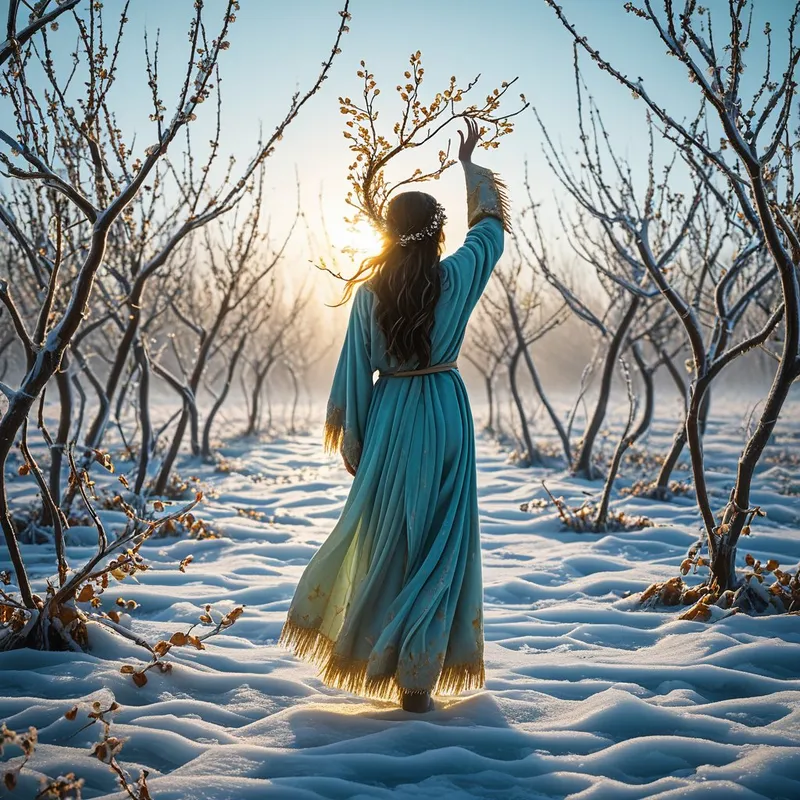
In the heart of this frozen silence, where even memory grew brittle, a spirit stirred. It was not a spirit of great power, but of profound essence. Some tales say it was the last dream of the autumn earth, given form. Others whisper it was a fragment of the sun’s compassion, fallen to the ice. It had no name that could be spoken, but its presence was a soft, persistent light, like the ghost of a forgotten color. It was the Harbinger.
This Harbinger walked the iron-hard ground. It saw the trees as skeletal hands clawing at a grey sky, the flowers as tiny, frozen screams in the soil. It felt the world’s longing not as a thought, but as a physical ache in its own luminous core. The spell of the cold king was a perfect, seamless prison—there was no lock to pick, no wall to scale. It was the absence of the very idea of change.
The Harbinger knew a terrible truth. The prison was not around the world, but within it. The forgetting had seeped into the root of things. To remind the world of turning, something must turn first. To shatter the silence, a sound must be made that cost everything.
It climbed to the highest, coldest peak, where the air itself shattered like glass. There, it did not raise a weapon or chant a spell. It opened its essence. It began to remember, aloud. It sang of the scent of wet soil after rain, of the unbearable green shout of a new leaf, of the chaotic, joyful riot of a bee in a blossom. With each memory sung, its own light dimmed, its form becoming more translucent, for it was pouring its very substance into the words.
The cold king’s wind slashed at it, not with cold, but with the ultimate argument: It is easier to sleep. Why suffer for a tomorrow that may never come? The Harbinger’s song grew fainter, a mere thread of sound. At the climax of its remembering, it offered not a shout, but a whisper—the memory of warmth on skin. And then, it ceased.
Its form dissolved, not into nothing, but into a final, silent exhalation. A mist of golden particles, like a sigh made visible, drifted down from the peak. It fell upon the ice. And where each particle touched, a sound returned: the faintest crack. Then another. A symphony of fracturing silence spread across the land. The spell, perfect in its stillness, could not withstand the introduction of a new note—the note of sacrifice for a future one would never see.
The ice did not simply melt; it remembered it was water. The seeds did not just grow; they remembered they were life. The world drew in a breath it had forgotten it possessed. The wheel, oiled by a spirit’s essence, gave a great, shuddering turn. Spring did not arrive as a conquest, but as a recollection.
Cultural Origins & Context
The myth of the Harbinger of Spring is not the property of a single tribe or nation, but a story that has crystallized independently in the cold margins and temperate hearts of countless cultures. It is a folktale born from the most fundamental human observation: the annual death and rebirth of the natural world. In pre-literate, agrarian societies, the failure of spring was not a metaphor but an existential threat. This story emerged as a psychic container for that profound anxiety.
It was told in the deep winter, often around a dwindling fire. The teller was not merely an entertainer but a shaman of the hearth, using narrative to enact a symbolic ritual of encouragement. The story served a vital societal function: to model hope as an active, costly principle. It taught that the return of life was not automatic or guaranteed, but might require a profound exchange. It framed the harsh winter not just as an enemy, but as a necessary state of contraction against which the expansion of spring could be measured—and earned.
Symbolic Architecture
At its core, the myth is a map of a specific kind of transformation: one that cannot be forced, only invited through self-expenditure. The Harbinger is not a warrior-hero who defeats winter in battle. It is a prima materia of consciousness itself.
The true winter is not the ice without, but the stagnation within. The Harbinger’s journey is the psyche’s decision to feel the collective despair as its own, and to act from that identification.
The Frozen Stasis represents psychological inertia, depression, or a life lived by rote, where potential is locked in perpetual latency. The Cold King is the psychic complex that enforces this stagnation—the inner critic, the voice of nihilism, the comfort of familiar despair. The Harbinger embodies the nascent, fragile impulse toward life—the first flicker of feeling in a numbed heart, the inexplicable urge to create when all seems pointless.
Its Dissolution is the critical symbol. It does not “win” in a conventional sense. It succeeds by ceasing to be a separate entity and becoming a catalyst. Its sacrifice is the ultimate act of faith: investing one’s entire current being into a pattern (spring) whose reality one will not experience as the same “self.”
The catalyst does not remain to enjoy the reaction it initiates. Its purpose is entirely in the transmutation it makes possible.
The Dreamer's Resonance
When this myth stirs in the modern dreamscape, it rarely appears as a literal figure. Instead, one dreams of being trapped in ice or glass, able to see the world but utterly unable to move or influence it. One may dream of a small, precious, living thing (a bird, a plant, a child) freezing to death, and the dream-ego’s frantic, often futile attempts to warm it with their own body heat.
Somatically, this can correlate with feelings of constriction in the chest, a literal coldness in the limbs, or sleep paralysis. Psychologically, the dreamer is at the precipice of a psychic death. They are encountering the “cold king” within—the part of them that believes change is impossible, that their vitality is permanently lost. The dream is not a warning, but a depiction of the current, agonizing state of transition. The suffering felt in the dream is the “singing”—the costly acknowledgment of one’s own longing and the depth of the freeze.

Alchemical Translation
For the individual on the path of individuation, the Harbinger’s myth models the solve stage of alchemy—the dissolution of the current ego-structure. We are not called to heroically “fix” our winter. We are called to become the Harbinger for our own spring.
This means identifying the one small, true thing within us that has not consented to the freeze. It might be a forgotten creativity, a stifled compassion, or a genuine grief we have been avoiding. The “climb to the peak” is the act of bringing this fragment into full, conscious focus, regardless of the inner criticism (“the wind”). The “singing” is the commitment to live from that truth, to express it, even if—especially if—it feels like it is costing us our former, familiar identity.
The ego, like the Harbinger, must consent to its own partial dissolution. It must invest its energy into a pattern of wholeness (the Self) that it cannot yet fully comprehend or inhabit.
The rebirth that follows is not the old self warmed up. It is a new configuration of the psyche, seeded by that initial, sacrificial act of authenticity. The ice cracks not because we fought it, but because we finally resonated at a frequency different from stagnation. We become, in our own lives, both the sacrifice and the subsequent, greening world. The myth teaches that our deepest transformations are not achievements, but awakenings purchased by the courageous expenditure of who we were.
Associated Symbols
Explore related symbols from the CaleaDream lexicon: