
Haoma Myth Meaning & Symbolism
The myth of Haoma, the divine plant pressed for its sacred juice, embodies the sacrifice required to distill immortality from the raw substance of life.
The Tale of Haoma
Listen, and let the winds from the high Hara Berezaiti carry the tale. In the time before time, when the world was raw and the gods walked closer to the earth, a great longing stirred in the heart of creation. The world was divided, light from dark, truth from the lie, the mortal from the eternal. A bridge was needed, a sacrament to heal the rift.
From the heart of the primeval mountains, where the first waters sprang and the first trees took root, he emerged. He was not born, but manifested. They called him Haoma. His body was the succulent stem, his hair the fragrant blossoms, his blood the sap that held the secret of life itself. He appeared not as a plant to be harvested, but as a radiant youth, beautiful and terrible, his eyes holding the stillness of the mountains and the fire of the stars.
The great god Ahura Mazda beheld him and knew his purpose. But the gift was not to be given freely. It had to be earned, pressed from the very flesh of the divine. The first to seek him was the shining Vivanhvant, father of the legendary king Yima. Guided by a vision, Vivanhvant climbed the treacherous slopes at the breaking of dawn. There, in a high meadow kissed by the first light, he found Haoma, glowing with an inner luminescence.
"Who are you, O most beautiful of beings?" Vivanhvant whispered, his voice trembling with awe.
And Haoma answered, his voice like the rustling of a thousand leaves and the clear chime of water on stone. "I am Haoma. Press me. For only through pressure am I revealed. Only through sacrifice am I given. Those who drink of my essence shall have strength to fight weariness, clarity to see through falsehood, and a tongue that speaks only truth. They shall touch immortality."
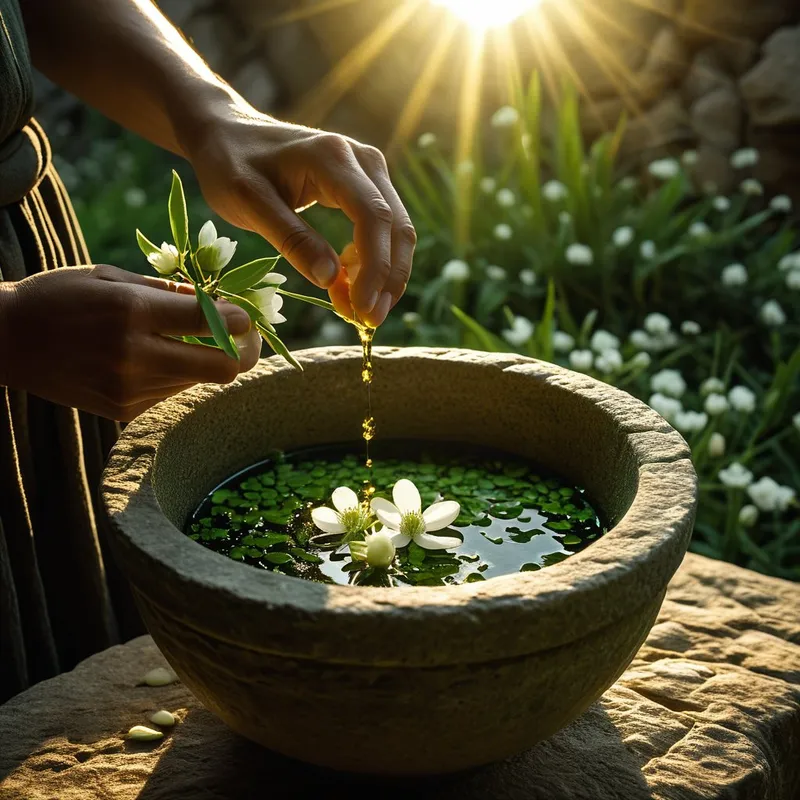
Terror and reverence warred in Vivanhvant's heart. To press this divine being was an act of violence, a sacred violation. Yet the command was clear. With hands that shook, he gathered the radiant stems. He placed them in the stone hawan, took up the pestle, and with a prayer that was also a plea for forgiveness, he pressed down.
A sigh, not of pain, but of profound release, echoed through the valley. From the crushed stems flowed not sap, but liquid light, a golden stream that filled the cup. The air thickened with a scent that was at once earthy and celestial—the smell of rain on dry soil, of crushed herbs, of ozone. Vivanhvant drank. And in that moment, the boundary between him and the mountain, between his mortal breath and the eternal wind, grew thin. He saw the weave of the world, and his place within it. The pact was sealed. The sacrament was born.
Cultural Origins & Context
The myth of Haoma is the sacred heart of the ritual that sustained ancient Persian spirituality for millennia, central to the Mazdayasnian tradition and its later Zoroastrian expression. This was not merely a story to be told, but a process to be performed. It was passed down not only by priests, the Magi, but enacted in the Yasna ceremony, the core act of worship.
The societal function was multifaceted: it was a cosmological act, a re-enactment of the original sacrifice that maintained order (Asha) against chaos (Druj). It was a communal offering to the divine, a means of seeking healing, strength, and wisdom. The plant itself, likely a species of ephedra or a similar psychoactive herb, was the tangible link between the earthly and divine realms. The myth provided the sacred narrative that transformed a botanical preparation into a theophany—a direct encounter with the divine. It was the story that made the ritual potent, embedding the act of pressing and drinking within a framework of primordial meaning.
Symbolic Architecture
At its core, Haoma represents the paradox of the sacred: the divine that must be broken to be shared, the wholeness that must be fragmented to become accessible. He is the spirit of the plant, the animating intelligence within nature that offers itself for humanity's transcendence.
The ultimate wisdom is not found in pristine isolation, but in the courageous act of pressing the raw substance of existence until it yields its golden essence.
Psychologically, Haoma symbolizes the sap of life itself—the undifferentiated libido, vitality, or psychic energy in its raw, unconscious state. The myth dramatizes the crucial process of cultivation and sacrifice. The unprocessed psyche, like the wild plant, contains immense potential but is not yet useful for conscious life. It must be "pressed"—confronted, engaged with, and consciously processed through the vessel of ritual (the hawan, symbolizing the disciplined container of the ego or conscious mind).
The resulting juice is the distilled essence of experience: insight, vitality, and spiritual connection. It is consciousness earned through effort. The deities who seek Haoma—Vivanhvant, then later Thraetaona, and others—represent different facets of the human psyche (the seeker, the hero, the healer) engaging with this inner process. The "immortality" granted is not literal physical eternity, but the experience of transcending one's limited, mortal perspective and participating in something timeless and ordered.
The Dreamer's Resonance
When this myth stirs in the modern unconscious, it often manifests in dreams of pressing, extracting, or brewing. One might dream of crushing herbs in a mortar, squeezing juice from a fruit that glows, or distilling a strange liquid in an alchemical lab. The somatic sensation is often one of pressure, effort, and then release—a tangible feeling of extracting something precious from a resistant source.
Psychologically, this signals a process of essentialization. The dreamer is in a phase where life feels overwhelming, cluttered, or full of undigested experiences (the "raw plant"). The psyche is initiating a ritual of its own: it is pressing these experiences to extract their core meaning, their nutritional "juice." The conflict in the dream—the reluctance to crush something beautiful, the fear of wasting the substance, the awe at the resulting liquid—mirrors the inner resistance to this necessary, sometimes painful, process of introspection and simplification. It is the Self urging the ego to engage in the sacred work of finding what is truly nourishing amidst the bulk of daily life.

Alchemical Translation
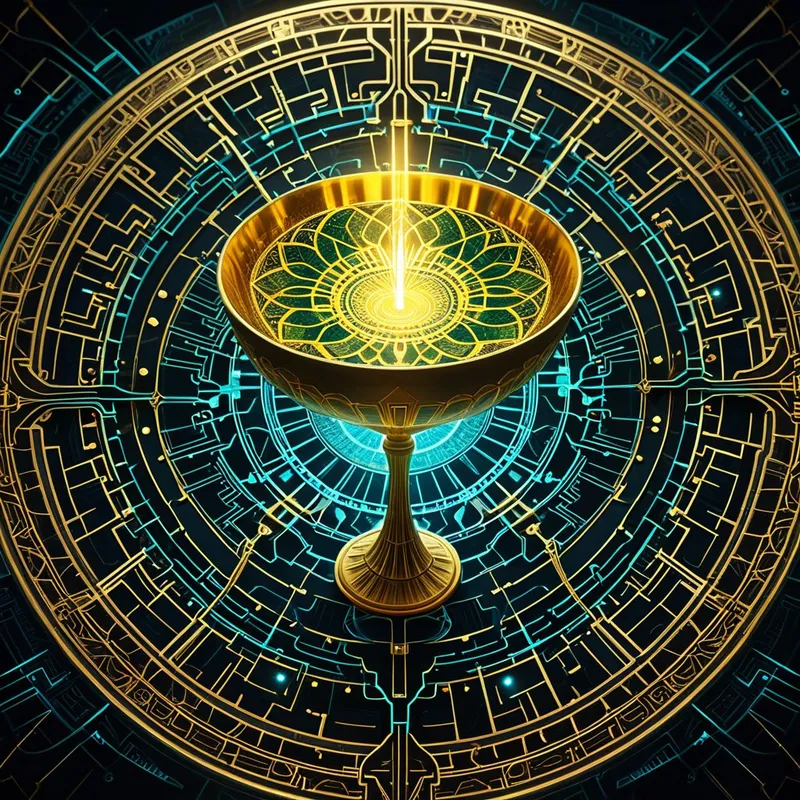
The Haoma myth is a perfect map for the alchemical and Jungian process of individuation—the journey toward psychic wholeness. The prima materia, the worthless starting substance of the alchemists, is our own unexamined, unconscious life. Like the wild Haoma plant on the mountain, it holds divine potential but is latent, unactivated.
The ritual pressing is the opus, the hard work of analysis, introspection, and conscious living. It involves "crushing" our identifications, our complexes, and our naive perceptions in the vessel of self-reflection. This is the sacrifice: the giving up of our comfortable, unconscious state.
Individuation is the sacrament where the self is both the priest and the offering, the mortar and the divine plant, distilling the elixir of meaning from the flesh of experience.
The golden juice that flows forth is the aqua vitae, the "water of life"—the integrated insight, the liberated energy, and the connection to the transpersonal Self (symbolized by Ahura Mazda's cosmic order). This is the "immortality" offered: not an escape from death, but the achievement of a perspective that is no longer solely identified with the mortal ego. One becomes, in a psychological sense, a vessel for the sacred. The modern individual's "triumph" is not in avoiding pressure or suffering, but in learning to perform the inner Yasna ceremony—to consciously press their experiences, extract their meaning, and in doing so, transform mundane existence into a continuous, living sacrament. The goal is to become both the Vivanhvant who courageously performs the act and the Haoma that willingly yields its essence, achieving a sacred unity within oneself.
Associated Symbols
Explore related symbols from the CaleaDream lexicon: