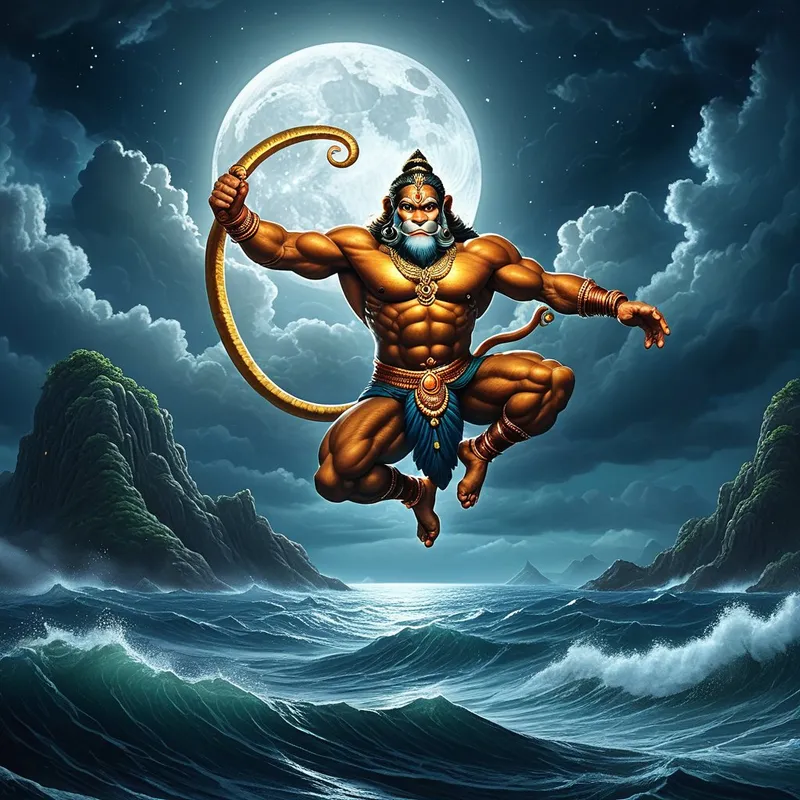
Hanuman's Leap Myth Meaning & Symbolism
The story of the divine monkey's impossible leap across the ocean to find a lost goddess, embodying the power of devotion to overcome all obstacles.
The Tale of Hanuman's Leap
Hear now the tale of the impossible leap, the story that sings of a devotion so vast it could drink the ocean dry.
The air in Lanka was thick with sorrow. Sita, beloved of Rama, was held captive in a grove of ashoka trees, a jewel trapped in a cage of gold and fear. Across the roaring, endless sea, on the shores of southern Bharat, an army of despair stood frozen. The mighty Sugriva and his vanara hosts had scoured the world, but the southern ocean was a barrier of mythic proportion, a liquid wall of time and space. Who could cross it?
Then, a figure stepped forward. Not the largest, nor the loudest, but one whose stillness spoke of contained tempests. It was Hanuman. The son of the wind. In his heart, a single thought burned with the heat of a thousand suns: Rama. The name was his breath, his blood, his very bones. The elder Jambavan reminded him of his latent divinity, the boons of his birth—strength, size, speed, wisdom—all lying dormant, waiting for the key of purpose.
And so, on the peak of Mahendragiri, Hanuman began his prayer. He focused his mind, his life-force, his entire being on the form of Lord Rama. As he did, a miracle of will unfolded. His body began to grow. He expanded, a mountain of fur and muscle and intent, until his head brushed the clouds and his shadow swallowed the coast. The very earth groaned beneath his feet. The vanaras cheered, their cries lost in the gathering wind.
With a deep inhalation that drew the sky into his lungs, Hanuman coiled his immense power. Then, he pushed. Not just with his legs, but with his soul.
The leap was not a jump; it was a rewriting of reality. He tore himself from the mountain, and the world became a blur of sea and sky. Monstrous serpents rose from the deep to challenge him—Surasa demanded a meal, and he expanded his mouth to dwarf her own before shrinking to pass through. The demoness Simhika lunged from the depths, and he pierced her heart with a focused strike. He was not merely flying; he was enacting a principle, a line of devotion drawn straight from the heart of the world to the heart of its lost harmony.
Finally, the golden spires of Lanka pierced the horizon. With the grace of a falling leaf and the impact of a meteor, Hanuman landed, shrinking to a humble size. He had crossed the uncrossable. The search, and the hope, had found their shore.

Cultural Origins & Context
The myth of Hanuman's Leap is a central episode of the Ramayana, attributed to the sage Valmiki. For millennia, it has been transmitted not as a dry historical record, but as a living, breathing entity through oral recitation, theatrical performance (like Ramleela), devotional singing (bhajans), and intricate visual art. Its primary societal function is pedagogical and inspirational. It is a master-text on the nature of bhakti—not as passive adoration, but as active, world-altering power.
The story serves as a cultural anchor for values of duty (dharma), selfless service (seva), and the potential within the seemingly "small" or humble to achieve the divine. Hanuman, though a divine being, is often depicted as a devoted servant, making his feats accessible models for human aspiration. His leap is recited to instill courage, to break mental barriers, and to illustrate that the most formidable obstacles yield not to brute force alone, but to force concentrated by unwavering faith and a clear, righteous purpose.
Symbolic Architecture
The Leap is a perfect symbolic diagram of the psyche mobilizing its latent totality toward a singular, meaningful objective.
The Shore represents the known world, the conscious ego with its limitations and despair. The Ocean is the vast, terrifying, and unknown unconscious—the realm of monsters (complexes, fears, repressed memories) and profound depth. Lanka is the distant goal, the Self, the integrated psyche, or the sacred object of desire that feels impossibly out of reach. Sita within it symbolizes the anima, the soul-value, that which gives life meaning and which has been captured by the shadowy, demonic aspects of the psyche (Ravana).
The true obstacle is never the ocean; it is the belief that the ocean cannot be crossed.
Hanuman himself is the symbol of the activated connection between the ego and the Self. His divine parentage (son of Vayu, the wind/wind-god) signifies the psychic energy (prana) that animates all things. His forgetting and subsequent remembrance of his powers, catalyzed by Jambavan (the wise old king, the inner guide or Self), mirrors the process of discovering one's own innate capacities. His expansion is the ego's temporary dissolution into a state of psychic inflation—necessary for the great task, but which must be relinquished (he shrinks) to perform the delicate work of reconnaissance and integration upon landing.

The Dreamer's Resonance
When this myth stirs in the modern dreamer, it often manifests not as a literal monkey-god, but as a profound somatic and psychological event. One may dream of:
- Making an impossible jump across a chasm, feeling both terror and a surge of unexpected power.
- Growing or shrinking in size to navigate a challenging landscape.
- Flying over a terrifying but beautiful body of water toward a luminous city or a waiting figure.
- Being given a crucial object or piece of information by a wise, often animal-like, figure before a pivotal journey.
These dreams signal a psychic mobilization. The dream-ego is confronting a seemingly insurmountable life obstacle—a career transition, the healing of a deep wound, a creative endeavor. The "ocean" is the anxiety, the depression, the sheer unknown of the process. The dream is the psyche's declaration that the resources for the crossing are present, but dormant. The feeling of expansion is the unconscious affirming, "You are bigger than your current self-conception." The monsters encountered are the specific fears and resistances that must be consciously faced and navigated, not avoided.

Alchemical Translation
For the individual, Hanuman's Leap is a map for the alchemical opus, the great work of individuation. It models psychic transmutation in clear stages:
The Despair on the Shore (Nigredo): This is the initial confrontation with the shadow, the recognition of a painful split (Sita's abduction). The conscious attitude is stuck, faced with its own limitation. This dark night is necessary; it creates the tremendous tension that will fuel the leap.
The Remembrance of Power (Albedo): Jambavan's counsel represents the first flash of insight from the Self. It is the recollection of one's own history, talents, and innate divinity buried under layers of conditioning and forgetfulness. This is the purification, the clarifying of purpose: "Your life is for this."
The Expansion and the Leap (Citrinitas): This is the surrender of the small ego to a greater pattern. The individual, focused wholly on their central, meaningful value (Rama), allows their identity to temporarily expand. They tap into transpersonal energies—creativity, fierce compassion, boundless resolve. They act with a courage that surprises even them.
The Navigation and the Landing (Rubedo): The leap is only the beginning of the work. Confronting Surasa and Simhika is the ongoing process of integrating the shadow material that arises during any great endeavor (inflation, distraction, old wounds). Landing and shrinking in Lanka is the critical return to groundedness, to perform the careful, detailed work of retrieval and integration in the new, once-distant territory of the achieved goal or transformed self.
The ultimate goal is not to remain a giant, but to have the giant's power available to the humble servant who does the work on the ground.
Thus, the myth teaches that our greatest leaps—psychological, spiritual, creative—are made possible not by eradicating the self, but by dedicating the self entirely to something beyond its petty concerns. In that total dedication, the boundaries of the possible are rewritten, and the soul finds its way home.
Associated Symbols
Explore related symbols from the CaleaDream lexicon: