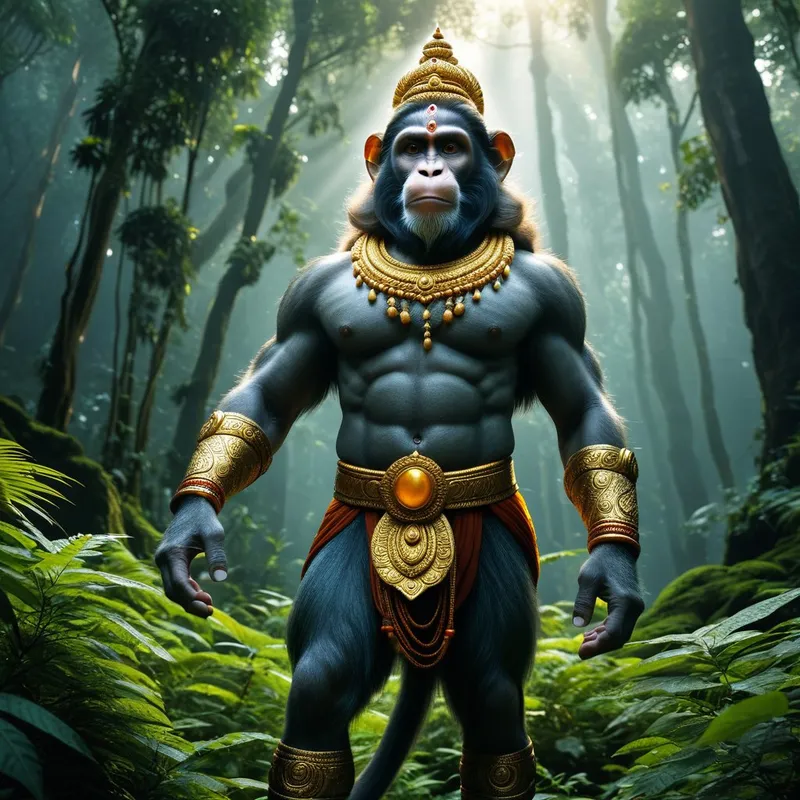
Hanuman Myth Meaning & Symbolism
The myth of the divine monkey Hanuman, whose boundless devotion and immense power serve the divine order, embodying the alchemy of raw energy into sacred service.
The Tale of Hanuman
Listen. Before time hardened into history, when the world was still a story whispered by the gods, there was a wind. Not the gentle breeze that stirs the leaves, but the primal breath of the storm, Vayu. And from this union of wind and an earthly queen, Anjana, a child was born. He was not like other children. His body was covered in russet fur, his tail was long and powerful, and in his infant eyes burned a curiosity as vast as the sky. They named him Hanuman.
As a babe, seeing the rising sun like a ripe, red fruit, he leapt into the heavens to devour it. The king of gods, Indra, struck him down with a thunderbolt, marking his jaw. In his rage, the wind god Vayu withdrew all air from the world. To appease him, the gods blessed the child with immortality, invincibility, and strength greater than any weapon. Yet, a sage’s curse lay upon him: he would forget his own divinity until reminded by another.
Years flowed like a river. Hanuman grew into a minister of the monkey-king Sugriva, living in the deep, green forests of Kishkindha. His power was a slumbering volcano. Then, into his forest came a prince in exile, Rama, whose wife Sita had been stolen by the demon-king Ravana. When Hanuman’s gaze met Rama’s, a forgotten chord within him resonated. The curse shattered. In that moment, he knew his purpose was not for his own glory, but for service to this embodiment of divine principle.
His devotion became the engine of the epic. He leapt across the ocean to find Sita in the golden city of Lanka, his form growing to blot out the sun. He found her in a grove of Ashoka trees, her spirit unbroken, and gave her Rama’s ring—a token of hope. Captured, he allowed himself to be bound in burning ropes, only to set the city aflame with his blazing tail, a signal fire of impending justice.
But his greatest feat was born of desperation. In a terrible battle, Rama’s brother Lakshmana lay mortally wounded. Only a herb from a mountain far to the north could save him. Time was a slipping noose. Hanuman leapt again. Reaching the mountain, he could not identify the single herb. So, he did the impossible. He uprooted the entire mountain, cradling its forests, waterfalls, and peaks in his hands, and carried it back across the skies. The medicine was found, the life was saved.
The war was won. Sita was freed. And when Rama offered him any reward in all the cosmos, Hanuman asked for only one thing: to live as long as Rama’s name was spoken, so he could forever sing the glories of his lord. He tore open his own chest, and there, beating within his heart, was the living image of Rama and Sita. His devotion was not external; it was the very architecture of his soul.

Cultural Origins & Context
The myth of Hanuman is woven into the vast tapestry of the Ramayana, attributed to the sage Valmiki. For millennia, it has been transmitted not merely as scripture, but as living performance—through recitation, dance-drama like Kathakali, folk theatre, and nightly readings. He is a pan-Indian deity, transcending sectarian lines, revered by devotees of both Vishnu (as Rama’s servant) and Shiva (as an incarnation of Rudra).
Societally, Hanuman functions as the ultimate bhakta, modeling the path of devotion (bhakti yoga). He makes the divine accessible. He is the bridge between the immense power of the gods and the heartfelt yearning of humanity. His temples are often simple, his worship direct—through chanting, physical endurance, and service. He represents the ideal of strength completely surrendered to a righteous cause, making him a patron of wrestlers, soldiers, and anyone seeking to channel raw energy into disciplined purpose.
Symbolic Architecture
Hanuman is the archetype of the instinctual self, the immense psychic and physical energy latent within the human body-mind, often symbolized by the monkey—restless, clever, powerful, but scattered. His journey is the alchemical process of taming and directing this raw prana toward a conscious, sacred aim.
The greatest strength is not that which conquers others, but that which conquers its own nature in service of a truth greater than itself.
His forgotten powers represent the amnesia of our own divine potential, lost under the "curse" of socialization and ego-identification. Meeting Rama is the moment of guru-disciple recognition, where the soul encounters its own higher principle (Atman). The leap across the ocean is the transcendent function of consciousness bridging the vast, unconscious depths (the ocean) to reach the captured anima (Sita), held prisoner by the inflated, ten-headed ego (Ravana).
Carrying the mountain is the ultimate symbol of holistic healing. When precise knowledge fails, the integrated psyche must bring the entirety of its resources—conscious and unconscious, instinctual and spiritual—to bear on the crisis. It is the act of wholeness saving the fragmented self.

The Dreamer's Resonance
When the pattern of Hanuman stirs in the modern dreamscape, it signals a profound somatic and psychological mobilization. Dreaming of immense leaps, of discovering hidden strength, or of a powerful, guiding simian figure points to a surge of latent life-force energy seeking direction.
Somatically, one may feel a restless, almost electric energy in the body—a need for intense physical release or a sense of boundless, unfocused power. Psychologically, it is the process of the ego encountering its own forgotten capacities. The dreamer may be in a situation that feels impossible (the ocean), requiring a "leap of faith" or the marshaling of resources they did not know they possessed. The figure of Hanuman in a dream does not symbolize brute force, but devoted force—the critical turning point where raw ambition, anger, or desire is being courted by a higher value, asking to be put into service of something beyond the personal.
Alchemical Translation
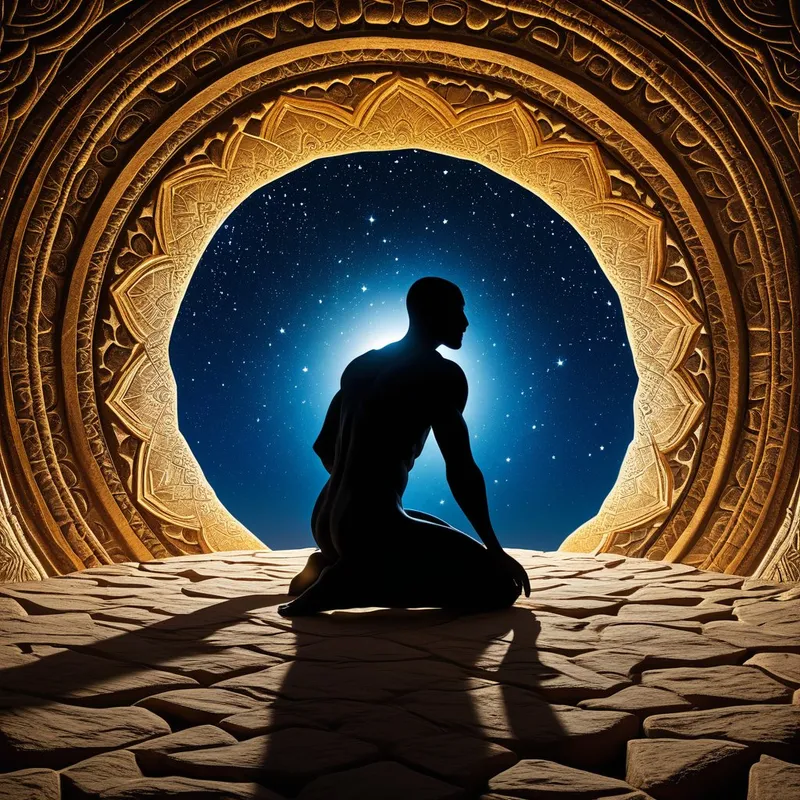
The individuation process modeled by Hanuman is the transmutation of the "monkey mind"—the chaotic, desirous, and powerful id-like energy—into the disciplined instrument of the Self. It is the hero's journey turned inward, where the quest is not to slay a dragon in the world, but to harness the dragon's fire within.
Individuation is the act of tearing open the chest of the personal ego to reveal that the image of the divine was the heart's true structure all along.
The first alchemical stage is nigredo: the forgetting, the curse, the latent potential buried under complexes. Meeting Rama is the albedo: the awakening, the purification of purpose. The leap and the trials are the citrinitas: the application of this purified energy in the world, the testing and proving of devotion through action. The final revelation—the image in the heart—is the rubedo: the culmination where the servant and the served, the devotee and the divine, are revealed as inseparable. The ego does not vanish; it becomes a perfect vessel. The immense power of instinct, emotion, and body is not denied but sanctified, becoming the very vehicle for realizing one's deepest connection to the cosmic order (dharma). For the modern individual, the myth asks: To what higher principle can you devote your boundless, restless energy? What mountain of your own wholeness must you carry to heal what is broken?
Associated Symbols
Explore related symbols from the CaleaDream lexicon: