Hansel and Gretel's Cottage Myth Meaning & Symbolism
Two children, abandoned in a deep wood, find a cottage of candy that conceals a devouring witch, forcing them to find cunning and courage to survive.
The Tale of Hansel and Gretel's Cottage
Listen, and hear a tale spun from the deep, dark loam of the world. It begins not with light, but with a creeping shadow in the human heart. In a time of great hunger, when the belly’s gnawing echo drowned out the whispers of conscience, a woodcutter and his wife dwelt at the forest’s edge. They had two children: Hansel, clear-eyed and quick, and Gretel, whose heart was a quiet well of feeling.
The famine grew teeth. And in the desperate silence of their hut, a terrible thought was born. “The forest will provide,” the stepmother whispered, her voice the rustle of dead leaves. “We will lead them deep, and leave them. It is the only way.” The woodcutter’s soul cracked, but hunger is a powerful god. At dawn, they walked into the Great Wood. Hansel, cunning as a jay, had filled his pockets with white pebbles that gleamed like captive moons. As they walked, he let them fall, one by one, a trail of cold light on the dark earth.
Abandoned, the children waited for the moon to rise. It silvered the pebbles, and they followed that star-road on the ground back to their father’s door. But hunger is patient. The stepmother’s resolve hardened like old frost. The next journey, the door was locked. Hansel had only a crust of bread. This trail, he scattered in crumbs. But the birds of the air came, and ate every last one.
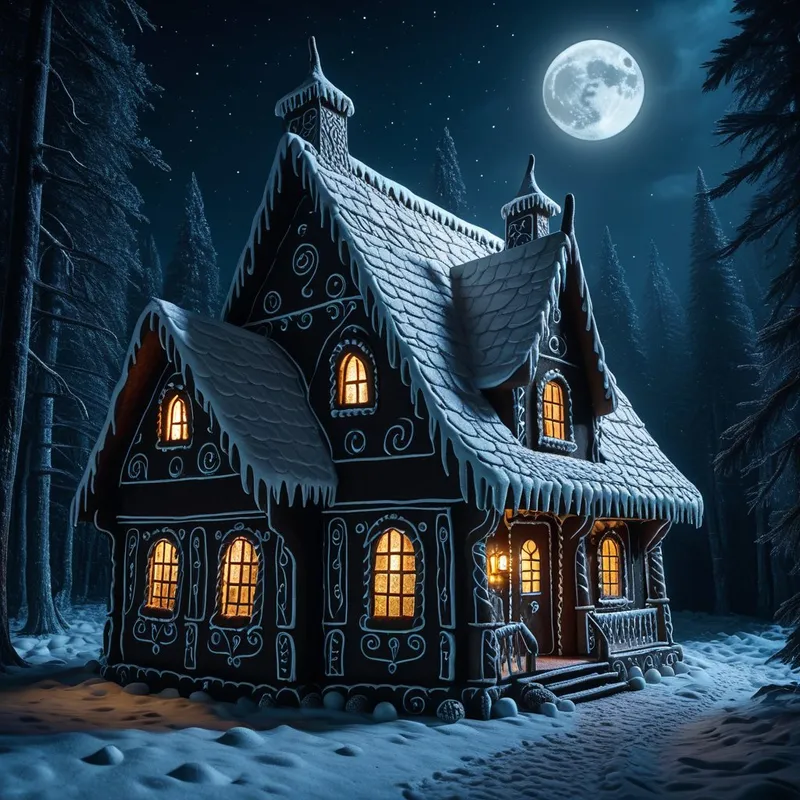
Now truly lost, they wandered for three days. Despair was a cold stone in their throats. Then, through the skeletal trees, a scent: of honeycake and spun sugar, of ginger and warm marzipan. They stumbled into a clearing, and there it stood—a cottage, but no ordinary dwelling. Its walls were built of sweet, dark gingerbread, its roof was thatched with shingles of frosting, its windows were clear, hard candy that glowed from within. It was a feast for the starving, a blasphemy of nourishment. They fell upon it, breaking pieces of the roof, the walls, stuffing their mouths with sweetness.
A creak, like old bones. The door opened. Out stepped not a monster of fang and claw, but an old woman, leaning on a crutch. “Nibble, nibble, little mouse,” she crooned, her voice sticky as syrup. “Who is nibbling at my house?” She smiled, and her eyes were like black currants, depthless. She ushered them inside, to a warm hearth, a soft bed. They thought themselves saved.
But with the dawn, the truth was revealed. The old woman was a Hag-Witch, and her candy house was a larder. She seized Hansel, thrust him into a cage of iron, and fed him rich food to fatten him for her oven. Gretel she made a slave. Each day, the witch, whose eyes were weak, would make Hansel stick out a finger so she might feel his plumpness. But the boy, ever cunning, held out a thin bone instead. “Still too thin,” the witch would grumble, her patience thinning like old milk.
Finally, her hunger could wait no longer. “Heat the oven, girl!” she commanded Gretel. “We shall bake bread today.” Gretel, her heart a drum of terror, obeyed. As the flames roared, the witch bent to peer into the inferno’s heart. “Is it hot enough, child?” In that moment, a fierce and desperate courage, born of love for her brother, flared in Gretel. “I cannot tell, grandmother. You must look yourself.” With a strength she did not know she possessed, she shoved the bent figure into the glowing maw and slammed the iron door shut.
The witch’s shriek was the sound of sugar burning. Silence fell. Gretel freed Hansel from his cage. Within the witch’s house, they found chests of pearls and jewels, the ossified treasures of countless lost children. They filled their pockets, and together, hand in hand, they walked from the clearing. A white bird appeared, and they followed it. It led them to the edge of a great river. “How shall we cross?” But the bird was joined by another, and another, until a living bridge of white wings formed. They crossed on the backs of doves, and found the path home. Their stepmother was gone, claimed by the same hunger she had served. Their father, weeping with a joy born of ashes, welcomed them. The jewels from the witch’s house ended the famine forever. The children were not just returned; they were transformed.
Cultural Origins & Context
This tale, in its essence, is a Kunstmärchen, a literary fairy tale refined from much older, darker oral folk traditions. Collected and published by the Brothers Grimm in the early 19th century, its roots dig deep into the soil of pre-industrial European peasant life. This was a world where literal famine was a cyclical terror, and the dark, encompassing forest was both a source of resources and a place of profound danger, the literal and psychological frontier of the known world.
The story was not merely entertainment for children by the hearth; it was a societal nerve, touched to transmit vital, terrifying knowledge. It was told by mothers and grandmothers, its rhythm matching the click of knitting needles or the chop of vegetables. Its function was multifaceted: a cautionary tale about the very real dangers of the wild (and of strangers), a narrative container for the unspoken terror of parental abandonment (a grim reality in times of scarcity), and a ritual of empowerment. It allowed the listener, often a child, to psychologically rehearse catastrophe and, crucially, survival. It affirmed that even the smallest, most abandoned being could, through a combination of cunning (Hansel) and courageous, decisive action (Gretel), overcome a devouring evil and return transformed, bearing wealth for the entire community.
Symbolic Architecture
The myth is a perfect map of a critical stage in psychic development. The father’s house at the forest’s edge represents the fragile, often failing, structures of conscious life and familial security. The act of abandonment is the primal wound, the moment the psyche feels cast out of paradise by the very forces that should nurture it.
The Great Wood is not just a setting; it is the psyche itself in a state of trauma and disorientation. To be lost here is to be plunged into the unconscious.
Hansel represents the initially promising but ultimately fragile tools of the conscious mind—logic, planning, foresight (the pebbles). These can work when the “moon” of intuition lights them, but they fail when we rely on the “bread” of mere daily sustenance, which is easily consumed by the chaotic, instinctual forces of life (the birds). Their failure is necessary. It forces a descent into a deeper layer.
The Candy Cottage is the central, brilliant symbol. It is the seductive face of the complex—the alluring trap of regression. It promises a return to infantile, oral bliss, to a world where nourishment comes without effort, where the walls themselves are food. It is the temptation of addiction, of clinging to a comforting but soul-destroying pattern. The Hag-Witch within is the shadow of this promise: the devouring aspect of the Mother archetype that wishes to keep the psyche infantilized, “fattened” for consumption, preventing any independent growth. The iron cage is the prison of this complex.
Gretel’s evolution is the key to liberation. She moves from passive servitude to active, trickster-like intelligence. Her act of pushing the witch into the oven is a supreme act of shadow-work. She uses the witch’s own tool of destruction—the transformative fire—against her. This is not murder in a literal sense, but the psychic annihilation of a devouring complex.
The fire of the oven is the alchemical furnace. One must either be consumed by it, or learn to wield its heat to bake one’s own bread of consciousness.
The jewels they retrieve are the psychic treasures won from confronting and integrating this deep, terrifying layer of the unconscious—the pearls of great price born from suffering and confrontation. The return home is not a regression, but an arrival at a new level of wholeness; the orphans have become heroes who redeem their world.

The Dreamer's Resonance
When this myth pattern stirs in the modern dreamer, it signals a profound encounter with the Candy Cottage within. To dream of a beautiful but sinister house made of food is to feel the somatic pull of a temptation that promises to soothe an ancient, abandoned feeling—perhaps through a relationship, a substance, a fantasy of being taken care of, or a job that pays in “candy” but consumes the soul.
The dream may feature a feeling of being trapped in a small, confining space (the cage), or of being forced to perform meaningless, servile tasks. The figure of the witch may appear not as a crone, but as a demanding boss, a smothering partner, or a critical inner voice. The somatic experience is often one of sticky paralysis, of being both attracted and repulsed, of a sweetness that cloys and sickens.
This dream is the psyche’s alarm. It indicates that the dreamer is at a threshold. The old, conscious strategies (Hansel’s breadcrumbs) have failed. They are now in the grip of a complex that offers false nourishment. The dream is an invitation—or a demand—to find the Gretel within: the part capable of feeling the terror, of enduring the servitude long enough to learn the nature of the prison, and finally, to gather the fierce, transformative anger needed to shove the devouring pattern into its own fire.

Alchemical Translation
The journey of Hansel and Gretel is a precise model of psychic individuation through the crucible of the negative mother complex. The process begins with Nigredo, the blackening: the abandonment, the lostness, the failure of conscious plans. This is a necessary descent into the prima materia of one’s own suffering.
The encounter with the cottage and the witch is the stage of Albedo, the whitening, but in its sinister aspect. It is the confrontation with the bright, alluring face of one’s own pathology. The ego is “whitened”—purified in a sense—by being stripped of its illusions and made to see the devouring nature of its regressive longing. The cage is the vas, the sealed vessel of the alchemical opus, where the confrontation must take place.
The moment Gretel turns the witch’s question back on her is the moment of the Rubedo, the reddening. It is the awakening of conscious will within the unconscious dynamic. The heat of the oven, once a threat, becomes the agent of transmutation.
Pushing the witch into the fire is the ultimate act of Separatio—the separation of the valuable from the worthless. The devouring, infantile complex is burned away in its own energy. What remains are the lapis philosophorum, the philosopher’s stones: the jewels of self-knowledge, resilience, and liberated psychic energy (the treasure). The return across the river on the backs of doves signifies the Unio, the union of the transformed psyche with the spirit. The orphans, who faced the ultimate betrayal and the most seductive trap, return not as children, but as initiated adults, bearing the gold that heals their world. They have performed the ultimate alchemy: turning the poison of abandonment into the medicine of wholeness.
Associated Symbols
Explore related symbols from the CaleaDream lexicon: