Hanbleceya Myth Meaning & Symbolism
A sacred rite of passage where a seeker endures isolation and deprivation to receive a vision and a new name from the spirit world.
The Tale of Hanbleceya
Listen. The world is not only what you see with open eyes. There is a world behind this one, a world of voices in the wind and faces in the stone. To know your true name, your purpose in the great hoop of life, you must go to the edge of seeing. You must go to the hill.
The one who seeks—let us call him a young man, though the call can come at any age—feels a hollow place inside. The everyday world of the camp, the laughter of children, the smell of cooking meat, it all becomes a distant echo. A spirit tugs at his sleeve, a dream whispers in his ear. It is time. With a heart full of fear and a greater longing, he approaches a holy person, a wicasa wakan. He asks for the great ordeal. He asks to cry for a vision.
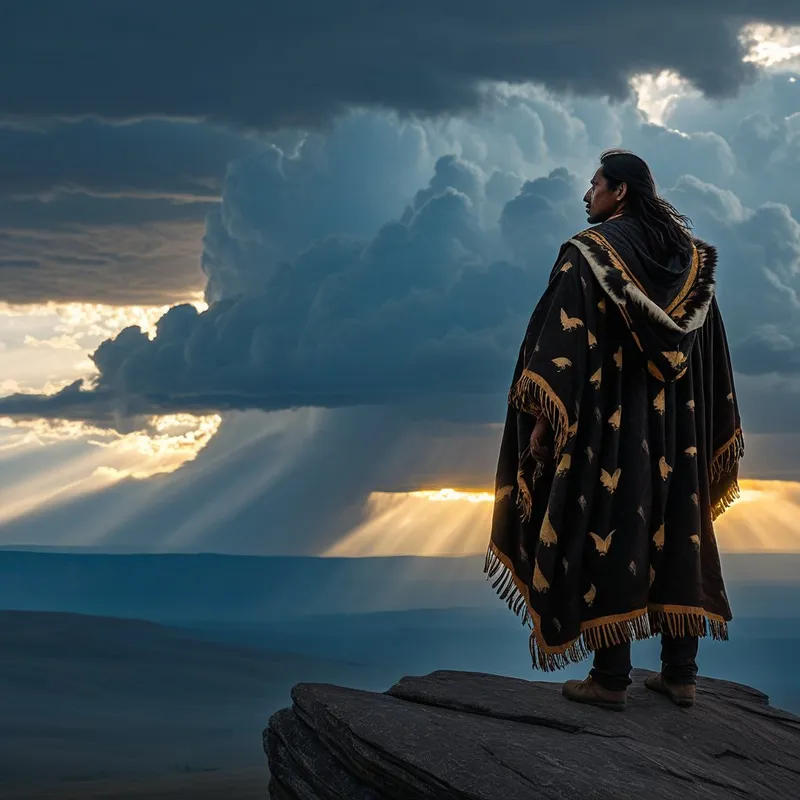
Guided by the holy one, he journeys to a lonely place, a high hill where the sky presses close. He brings nothing but a pipe, a blanket, and his own trembling spirit. For four days and four nights, he will stay. He strips himself of the comforts of the world: no food, no water. He is smudged with the smoke of sacred sage, his body painted with the earth's own colors. The holy person offers prayers to Wakan Tanka, to the Four Directions, to the Grandfathers and Grandmothers of the spirit world. Then, he is left. Utterly alone.
The first day is a battle with the flesh. Hunger claws. Thirst is a fire. The sun is a relentless eye. He prays, he sings the ancient songs given to him, he offers the pipe to the sky. The second day, the mind begins to unravel. Shadows lengthen and seem to move. The wind carries mocking voices. Doubt, that great serpent, coils in his belly. Who are you to seek a vision? You are nothing. He weeps from exhaustion and despair. This is the crying. This is Hanbleceya.
On the third day, in the crucible of his suffering, the veil begins to thin. The world grows strange, luminous. An eagle might circle overhead, and in its shadow, he sees the shape of a thunderbird. A coyote's howl becomes a clear, spoken message. He is visited. Perhaps by an animal spirit—the steadfast buffalo, the cunning spider, the wise bear. Perhaps by an ancestor, a being of light, or a terrifying storm entity. They speak in symbols, in feelings, in overwhelming presences. They test him. They show him things: perhaps his own death, the suffering of his people, the interconnected web of all life. It is terrifying. It is sublime.
On the fourth dawn, as the first light cracks the shell of the world, something settles within him. The vision gifts him a song, a symbol, a power, a new name. It is not always a clear instruction, but a living seed planted deep in his soul. The holy person returns, greets him not as the boy who left, but as one who has spoken with the sacred. He is brought down, given a sip of water, and his experience is carefully, respectfully heard. The vision is now his most sacred possession, a compass for the rest of his days. He has been unmade and remade. He has cried, and the universe has answered.
Cultural Origins & Context
Hanbleceya was not merely a story but a central, lived pillar of Lakota spirituality and identity. It was a rite of passage, but not one undertaken lightly or by everyone at a set age. The call was individual, often precipitated by a personal crisis, a vivid dream, or a deep, inarticulate longing for purpose. The process was meticulously guided by a wicasa wakan, who ensured the seeker was spiritually prepared and the rituals were conducted with proper respect for the powerful forces involved.
The mythic structure of the quest—the isolation, the deprivation, the symbolic death and rebirth—was a technology of the sacred. It served a critical societal function: it generated the community's spiritual leaders, healers, and warriors. A person's vision dictated their role, their medicine, their very name. It connected the individual directly to Wakan Tanka and the helping spirits, bypassing purely human hierarchy. The vision was a personal covenant, but its fruits—the healing, the guidance, the songs—were often for the benefit of the entire oyate. Thus, the myth sustained both personal soul-force and collective cultural resilience.
Symbolic Architecture
At its core, Hanbleceya is a master symbol of the necessary descent into the wilderness of the self. The hill is the axis mundi, the point where the personal psyche touches the transpersonal collective unconscious. The four days and nights mirror the four directions, the four stages of life, and the alchemical process of dissolution, purification, illumination, and integration.
The vision does not come to comfort the ego, but to dismantle it. The seeker must become an empty vessel, cracked by thirst, before the numinous wine of spirit can be poured in.
The hunger and thirst are not mere physical trials; they are the active stripping away of worldly attachments and the conscious mind's dominance. The "crying" is the somatic release of the old identity. The animal spirits that appear are not random but archetypal emissaries. The buffalo might represent abundance and sacrifice, the eagle spiritual sight and message, the bear introspection and healing. They represent latent powers within the human psyche, awaiting recognition and relationship. The new name granted is the symbol of a new psychic orientation—the birth of the authentic Self from the ashes of the persona.

The Dreamer's Resonance
When the pattern of Hanbleceya stirs in the modern dreamer, it signals a profound interior crisis calling for a rite of passage that our culture no longer provides. One may dream of being lost in a vast, empty landscape, of fasting without knowing why, or of pleading with incomprehensible beings for a sign.
Somatically, this can manifest as a deep fatigue with one's current life path, a feeling of being "unfed" by worldly successes, or a literal loss of appetite for old habits. Psychologically, it is the Self initiating a purge. The ego is being invited—or forced—into a state of vulnerability. The dreamer is in the "crying" stage, where old structures are breaking down and the psyche is creating the vacuum necessary for a new guiding principle to emerge. Dreams of receiving a strange gift, a key, or a whispered word directly mirror the vision's gift, indicating the first fragments of a new synthesis arising from the unconscious.

Alchemical Translation
The alchemy of Hanbleceya is a precise map for Jungian individuation. The first step, the conscious decision to seek, is the recognition of the Self's call over the ego's comfort. The ascent to the hill is the active withdrawal of psychic energy from external projections (career, relationships, status) and its redirection inward.
The ordeal on the hill is the nigredo, the dark night of the soul. Here, the conscious mind (the hungry, thirsty seeker) is humbled and broken apart, allowing the contents of the personal and collective unconscious (the spirit visitors) to erupt. This is not pathology, but a sacred chaos. The terrifying or sublime visions are the raw, unintegrated archetypes surfacing for dialogue.
Integration begins not when the vision is understood, but when it is accepted as a sovereign part of the self. The new name is the philosopher's stone—the symbol of a personality now aligned with its own deepest, mythic truth.
Finally, the return with the vision is the rubedo, the embodiment. The holy person who listens is akin to the therapeutic function or the inner witness that helps translate the symbolic language of the unconscious into a livable reality. The modern individual completes this alchemy not by becoming a Lakota visionary, but by finding their own "lonely hill"—be it in therapy, meditation, creative solitude, or nature immersion—and having the courage to stay through the crying, to receive their own unique, life-giving vision, and to let it rename their world.
Associated Symbols
Explore related symbols from the CaleaDream lexicon: