Hamlet's Soliloquy Myth Meaning & Symbolism
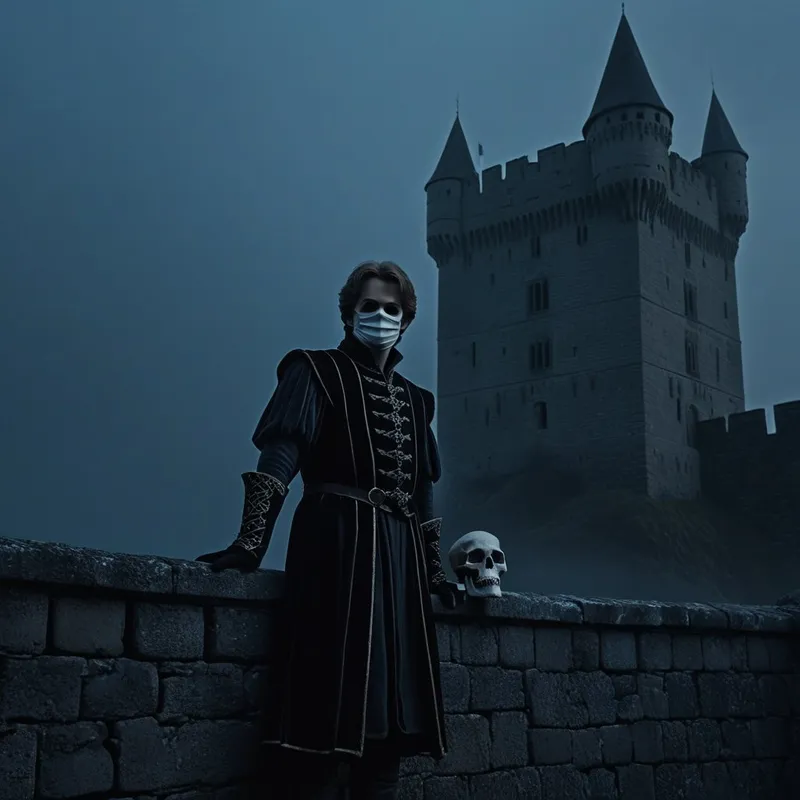
A prince, haunted by a ghost's truth, stands on the precipice of a violent world, wrestling with the ultimate question of being in a timeless moment of consciousness.
The Tale of Hamlet's Soliloquy
Listen, and hear the tale not of a battle fought with swords, but of a war waged in the silent chambers of a soul. The air in Elsinore was thick, a miasma of false smiles and whispered poison. The old King, a lion of a man, was dead, and in his place sat his brother, a serpent who had stolen both crown and queen. But from the cold earth, a specter rose—a figure in armor, its visage the mirror of the slain king. It spoke a truth that turned the world to ash: murder, most foul and unnatural.
The prince, Hamlet, was a scholar, a man of words and wonder, now clothed in the leaden cloak of this knowledge. The ghost’s command was a brand upon his spirit: revenge. Yet, how does a thinking mind become an instrument of bloody justice? He feigned a madness that was but a hair’s breadth from the real thing, a performance to probe the guilt in the new king’s eyes. He pushed away the maiden Ophelia, his love, until her sanity frayed like old lace. He watched his mother, the queen, with eyes that saw only betrayal in her new marriage bed.
In the heart of this performance, he devised a test—a play. Before the court, he staged the very murder the ghost described. As the player-king was poisoned in the garden, he watched the real king’s face contort, rise, and flee the hall. The ghost’s word was true. The evidence was sealed in a sovereign’s panic. The path was clear, the enemy confirmed.
Yet, clarity brought no peace, only a deeper chasm. Later, in a quiet chamber, the weight of all that is and could be descended upon him. The question was no longer “who” or “how,” but “why.” Why move? Why suffer? Why bear the whips and scorns of time, the oppressor’s wrong, the proud man’s contumely? The alternative—a sleep, a quiet end—beckoned like a soft, dark sea. But what dreams might come in that sleep? What unknown country lay beyond the veil of action? It was that dread, that pale cast of thought, that made cowards of us all. The moment of decision stretched into an eternity of contemplation, and the native hue of resolution was sicklied o’er. The enterprise of great pitch and moment lost its name of action.
This was his silent, screaming battle. Not on a field, but on the knife’s edge between being and nothingness. The tale tells us he chose, in that moment, not to choose death, but to live and to act—though his subsequent actions were tangled, tragic, and led to a stage littered with bodies. His soliloquy was the still center of the turning world, the breath held before the plunge. It was the human mind, naked before the universe, asking its first and final question.
Cultural Origins & Context
This myth springs not from an ancient, forgotten tribe, but from the vibrant, anxious soil of the English Renaissance, a culture in tumultuous dialogue with itself. It was a “Shakespearean” world where medieval certainty was crumbling under new ideas from the Continent—humanism, skepticism, and a dawning sense of the individual interior self. The play The Tragical History of Hamlet, Prince of Denmark was performed by the King's Men at the Globe Theatre, a space where groundlings and nobility alike gathered to see their own fears and wonders reflected back at them.
The myth was passed down not on parchment scrolls in temples, but on the boards of the stage, through the breath of actors like Burbage. Its societal function was profound. In an era of political intrigue, religious reformation, and plague, it gave form to the inchoate terror of existential uncertainty. It asked the questions the audience dared not voice: What if the world is not orderly? What if God is silent? What is the value of a single conscience in a corrupt state? The soliloquy itself, a dramatic convention where a character speaks their mind directly to the audience, broke the fourth wall and created a sacred, confessional space. It made the public theatre a private chamber for the collective soul.
Symbolic Architecture
At its core, the myth of the Soliloquy is not about revenge, but about the birth of modern consciousness. Hamlet represents the thinking ego, suddenly burdened with a truth too terrible to ignore yet too consequential to act upon impulsively. The ghost of the father is the voice of the patriarchal superego and the unintegrated trauma of the past, demanding a primitive, bloody resolution.
The undiscovered country from whose bourn no traveller returns is the ultimate symbol of the unconscious itself—not just death, but the unknowable totality of the psyche we fear to confront.
The “To be, or not to be” dilemma is the fundamental psychic split. “To be” is to engage with the painful, messy reality of life, history, and relationship—to accept the burden of the individuation process. “Not to be” is the lure of oblivion, of retreating back into the undifferentiated unconscious, the womb of non-being. The “sleep” he ponders is the temptation of psychic numbness, of refusing the call to consciousness. The “dreams” that might come are the chaotic, archetypal contents of the unconscious that might erupt if the ego’s defenses are lowered.
The entire soliloquy is a map of the psyche in stasis, where the will is paralyzed by the sheer magnitude of its own awareness. Every insult (“the oppressor’s wrong”), every disappointment (“the pangs of despised love”), is weighed not as a single grievance but as the essential condition of a conscious existence.
The Dreamer's Resonance
When this myth stirs in the modern dreamer, it signals a profound somatic and psychological crossroads. You do not dream of a prince in tights. You dream of standing at a threshold—a literal doorway, a career change, a relationship brink—frozen. The body may feel heavy, leaden, as if filled with wet sand. This is the somatic echo of Hamlet’s “too solid flesh.”
The dream landscape is often a labyrinth or a castle with many rooms (Elsinore), representing the complex problem with no clear exit. Authority figures in the dream (bosses, parents, teachers) may morph or speak with a hollow, ghostly authority, representing the internalized “shoulds” and demands that feel alien yet compelling. The core dream emotion is not fear, but an exhausting, debilitating weight of consideration. The dreamer is caught in a loop of weighing infinite outcomes, a cognitive paralysis where every potential path forward is simultaneously visualized and its catastrophic failure pre-lived. This is the psyche’s way of screaming that a decision—any decision—has become a matter of existential significance, where the ego feels its very continuity is at stake.
Alchemical Translation
The alchemical process modeled here is the nigredo, the blackening, the descent into utter confusion and despair. Hamlet’s world-view is shattered (the death of the king/father). The old, naive consciousness (the scholar prince) must die. His soliloquy is the crucible where this dissolution occurs. He holds the opposing elements—the fiery, active impulse for revenge (sulfur) and the watery, reflective impulse for surrender (mercury)—in a state of suspended conflict.
The soliloquy is the prima materia of the soul, the chaotic, black mass of potential from which the philosopher's stone of a realized self can eventually be distilled.
The triumph is not in the bloody conclusion, but in the mere endurance of that moment of conscious tension. To ask the question with full sincerity is to begin the work. For the modern individual, the alchemical translation is this: before you can act authentically, you must first fully confront the terror of acting and the terror of not acting. You must stare into the abyss of both choices until they reveal their true nature—not as simple binaries of good/evil or success/failure, but as different paths of being. The psychic transmutation occurs when one moves from “Should I do it?” to “Who will I become if I do, or if I do not?” This shifts the process from one of external calculation to one of internal forging. The “readiness” Hamlet finally speaks of is the end goal—not a final answer, but a state of integrated being where thought and action are no longer mortal enemies, but reconciled aspects of a self that has consented to its own difficult, conscious existence.
Associated Symbols
Explore related symbols from the CaleaDream lexicon: