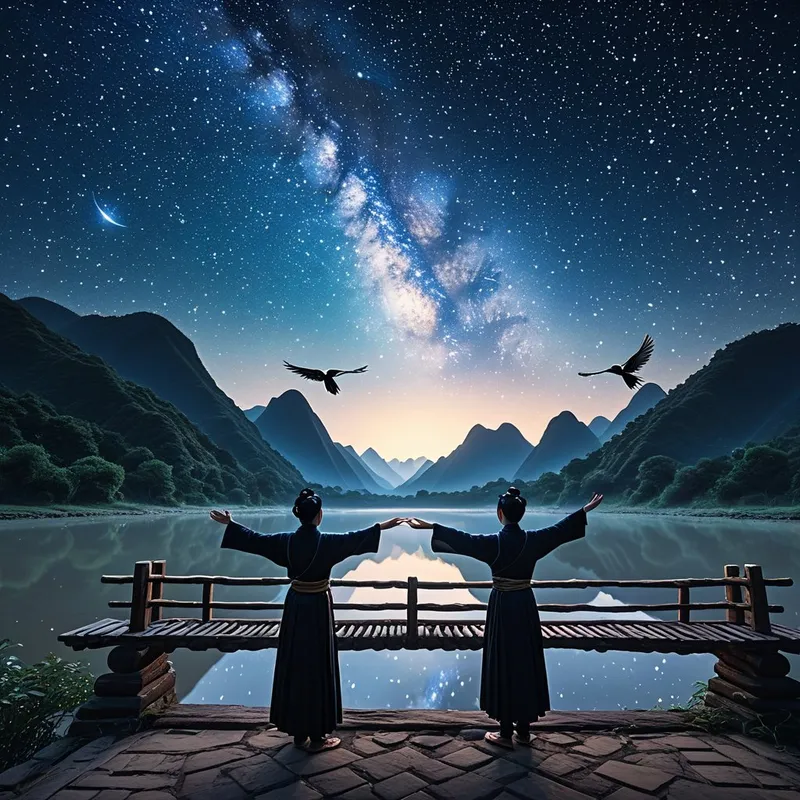
Hairpins of the Immortals Myth Meaning & Symbolism
A celestial weaver and a mortal cowherd, separated by the Milky Way, are granted one annual reunion, their love symbolized by divine hairpins.
The Tale of Hairpins of the Immortals
Listen, and hear the whisper of the stars. In the vault of heaven, where the Jade Emperor rules the celestial courts, there lived his youngest and most gifted daughter, Zhi Nü. Her loom was the fabric of the cosmos itself. With threads of cloud and strands of dawn light, she wove the robes of the gods and the tapestries of the seasons. Her life was one of perfect, lonely order, measured by the rhythmic click-clack of her shuttle. Yet, her heart was a silent loom, waiting for a thread of its own.
Far below, on the green, fragrant earth, lived a humble orphan named Niu Lang. His world was one of honest toil, of sun-warmed grass and the soft lowing of his only companion, an old, wise ox. His days were simple, his nights quiet under the same stars his ox would sometimes gaze upon with knowing eyes.
Destiny is a thread that finds its own needle. Guided by his ox—a beast with the soul of a fallen star—Niu Lang came upon a secluded, crystalline river where seven celestial maidens bathed, their silken robes laid upon the bank like fallen rainbows. Among them was Zhi Nü. Following his ox’s whispered advice, Niu Lang took not a robe, but a single, exquisite jade hairpin that held her heavenly tresses. When the maidens rose, six flew skyward on clouds of silk. Zhi Nü remained, earthbound, her connection to the heavens severed by the absence of that sacred pin.
He emerged from the reeds, not as a thief, but as a supplicant, holding out the pin. In that moment, their eyes met—the star-measured gaze of the goddess and the earth-steady look of the mortal. No words were woven, yet a understanding deeper than speech passed between them. She did not take the pin and flee. She stayed. He returned it, and she used it to bind her hair anew, a binding not just of strands, but of her fate to his. They built a life of profound, simple joy: a cottage, two children, a love that was itself a weaving of heaven and earth.
But the cosmos demands its balance. The Jade Emperor, discovering his daughter’s absence and her union with a mortal, was wrathful. The orderly tapestry of heaven was torn. With a decree that shook the foundations of both realms, he summoned Zhi Nü back to her celestial loom. As she wept, her tears becoming the first rain, the Emperor took her divine hairpin and drew a single, terrible line across the sky. Where it passed, a raging, silver river erupted—the Tian He, the Milky Way—an impassable barrier between the lovers.
Niu Lang, clutching their children, could only watch from the eastern bank as his love stood desolate on the western shore, the endless star-river roaring between them. Their grief was so pure, so vast, that it moved the heart of the Queen Mother of the West. She could not revoke the Emperor’s law, but she could bend it. Once a year, on the seventh night of the seventh lunar month, all the magpies of the world would take pity. They would fly to the Tian He, and with their own bodies, form a living, trembling bridge across the starry torrent. For one night, the Weaver and the Cowherd cross, to hold each other in a silence deeper than the void between stars.
Cultural Origins & Context
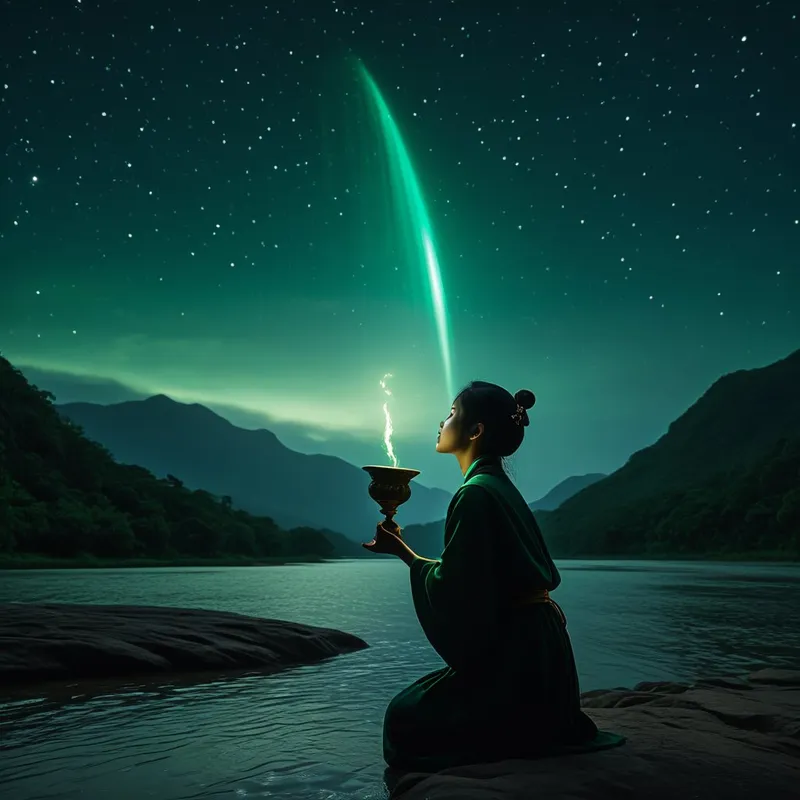
This myth, known as the Qixi legend, is one of China’s Four Great Folktales. Its origins are ancient, with stellar references to the stars Vega and Altair appearing in the Classic of Poetry over 2,500 years ago. The tale solidified during the Han Dynasty and has been celebrated ever since on the Qixi Festival.
It was not merely a romantic story but a societal allegory. Zhi Nü represented the feminine virtue of skilled labor (weaving), while Niu Lang embodied diligent husbandry. Their separation mirrored the rigid social divisions and familial duties that often kept lovers, and even spouses engaged in different labors, apart. The annual reunion offered a narrative of hope, a sanctioned moment where the natural order of devotion could temporarily override the imposed social order. It was told by mothers to daughters, by poets to lovers, and observed by young women who would conduct rituals on Qixi to pray for Zhi Nü’s skill in needlework and, by extension, for a worthy partner.
Symbolic Architecture
At its core, the myth is a profound map of the psyche’s fundamental experience of duality and longing for wholeness.
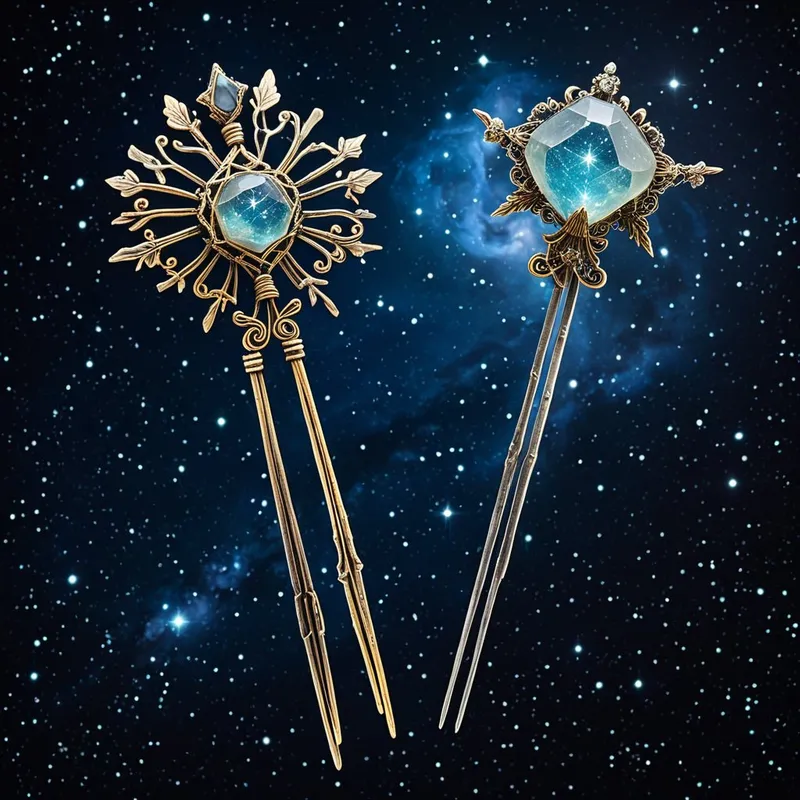
The hairpin is not an ornament; it is the axis between worlds. To remove it is to choose incarnation; to lose it is to be cast into exile.
Zhi Nü symbolizes the anima, the inner feminine principle of connection, creativity, and cosmic patterning. She is the soul’s capacity to weave meaning from experience. Niu Lang represents the animus, the inner masculine principle of groundedness, focused action, and earthly sustenance. Their union is the sacred marriage of spirit and matter, consciousness and the unconscious, the celestial blueprint and its earthly manifestation.
The Tian He (Milky Way) is the great divide: the chasm of time, space, circumstance, and the ego’s perception of separation. It is every obstacle that seems to sever us from our deepest source of love and creativity. The magpie bridge is the miraculous, collective function of the psyche—the synchronicities, intuitions, and acts of compassion (the “birds” of thought and feeling) that can, at appointed times, create a passage where logic says none can exist.
The Dreamer's Resonance
When this myth surfaces in modern dreams, it speaks to a profound experience of separation and yearning. To dream of standing before an uncrossable river of light, seeing a loved one or a cherished part of oneself on the far shore, is to feel the ache of the Cowherd and Weaver.
This is not merely about romantic distance. It can manifest as the artist separated from their inspiration, the seeker from their spiritual home, the child within from a sense of safety. The somatic feeling is often one of a deep, resonant hollowing in the chest—a “celestial homesickness.” The dream is mapping a rift in the psyche itself, where a vital connection between one’s earthly identity (the Cowherd) and one’s soul’s purpose or creative spirit (the Weaver) has been severed by life’s demands, trauma, or neglect. The dream is the psyche’s first acknowledgment of this rift, and the longing it produces is the initial, painful pull towards eventual reconciliation.
Alchemical Translation
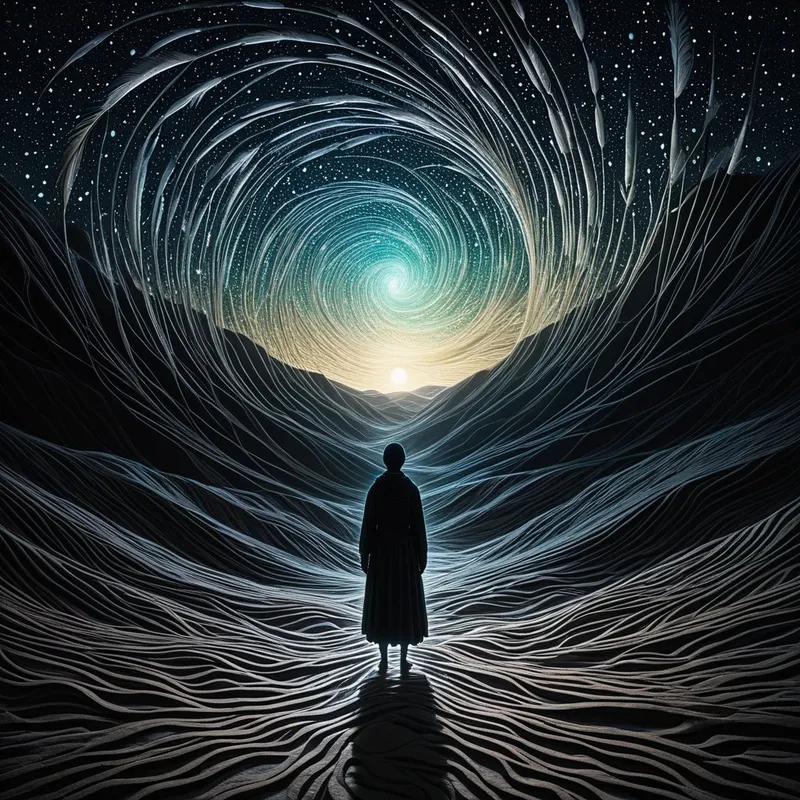
The individuation process modeled here is not one of permanent, blissful union, but of learning to live within the sacred rhythm of connection and separation. The goal is not to demolish the Tian He, but to become the architect of the bridge.
The work of the soul is to become both the lover on the shore and the magpie in the flight. To feel the separation utterly, and to simultaneously participate in building the means to cross it.
First, we must “steal the hairpin”—that is, we must perform the brave, perhaps transgressive act of grounding a piece of our divine potential (an inspiration, a love, a talent) into our earthly reality. This is the Cowherd’s choice to reach for the celestial. Then, we must endure the “drawing of the river”—the inevitable crisis, the painful separation that follows when the ruling consciousness (the Jade Emperor, or our own rigid ego/superego) reasserts control and exiles the soul to a distant shore.
The alchemy occurs in the faithful waiting and the recognition of the appointed time. The Queen Mother of the West represents the deeper, reconciling wisdom of the Self, which introduces the law of rhythm. It teaches that wholeness is not a static state of possession, but a dynamic cycle of yearning, preparation, joyous reunion, and grateful release. We build our magpie bridge through consistent, small acts of devotion to that from which we feel separated: writing one line, meditating for five minutes, reaching out in kindness. These acts are the feathers of the bridge.
Thus, the myth guides us toward a mature spirituality. We are asked to hold the duality: to be fully engaged in our earthly life (the Cowherd with his children) while maintaining a faithful, loving orientation toward our celestial source (gazing across at the Weaver). In doing so, we don’t just cross the bridge once a year; we become the living space where heaven and earth, for fleeting, eternal moments, truly touch.
Associated Symbols
Explore related symbols from the CaleaDream lexicon: