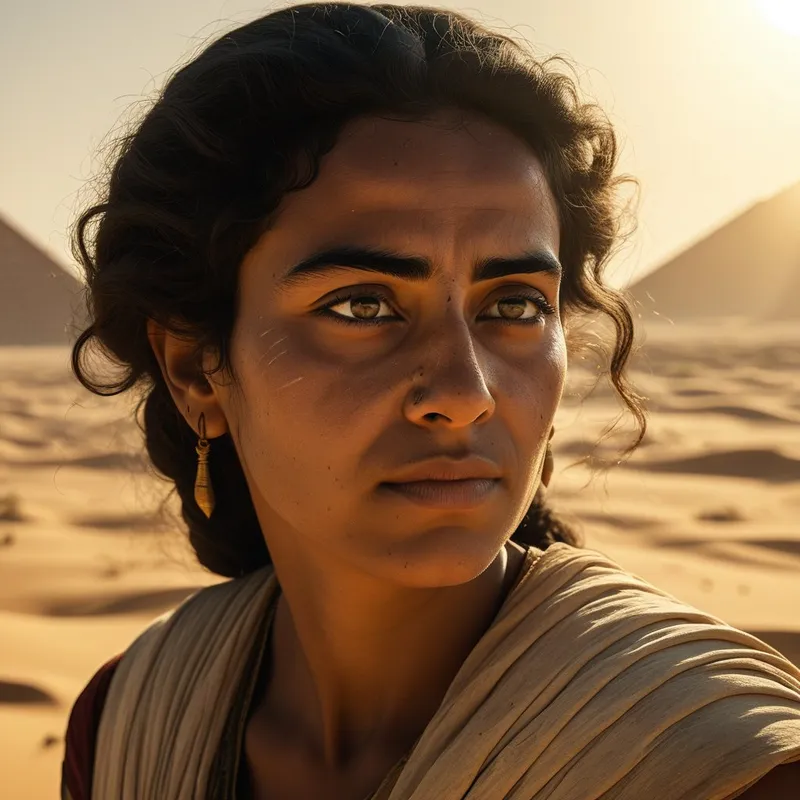
Hagar Myth Meaning & Symbolism
The story of an Egyptian maidservant cast into the desert, who encounters a divine promise in her despair, becoming a matriarch against all odds.
The Tale of Hagar
The sun was a hammer on the anvil of the earth. In the tent of Abraham, the air was thick with the silence of a promise unfulfilled, a silence that had grown teeth over decades. Sarah, her face a map of barren years, looked at her Egyptian maidservant, Hagar. In Hagar’s youth, in the curve of her hip, Sarah saw not a woman, but a vessel. A desperate plan was forged in the furnace of shame: “Go in to my maid; it may be that I shall obtain children by her.”
So Hagar’s body became a contested land. From Abraham’s embrace, life quickened within her. And with that life, a new gaze awoke in her eyes—a gaze that saw her mistress not as a sovereign, but as an equal in the strange economy of fertility. Sarah saw that gaze. The contempt in it was a spark in dry tinder. “May the wrong done to me be on you!” she cried to Abraham, who, seeking peace, surrendered Hagar to her wrath. “Do to her as you please.”
And Sarah pleased to be harsh. The blows were not just of hand, but of spirit. The vessel was now a threat. So Hagar fled. She turned her back on the tent of promise and ran into the wilderness, toward the shifting sands of Shur, toward Egypt, a homeland remembered in the bones. The desert received her, a vast, indifferent mother. Exhaustion finally pinned her beside a spring on the road, her body heavy with the child of a fractured household.
Then, the voice. It did not come from the sky, but from the very ground of her being. The messenger of YHWH found her there, in her desolation. “Hagar, slave-girl of Sarah, where have you come from and where are you going?”
“I am running away from my mistress Sarah,” she gasped, stating the obvious geography of her pain.
But the voice spoke a different map. “Return to your mistress, and submit to her.” It was a command that tasted of ashes. Yet it was followed by a promise that bloomed like a night flower in the desert. “I will so greatly multiply your offspring that they cannot be counted for multitude.” You shall bear a son; you shall name him Ishmael, for YHWH has heard your affliction. He shall be a wild ass of a man, his hand against everyone, and everyone’s hand against him.
In that moment, Hagar, the slave, the pawn, did something unprecedented. She named God. “You are El Roi,” she whispered to the presence. “Have I really seen the One who sees me?” The well where she sat became Beer-lahai-roi, the Well of the Living One Who Sees Me. She returned, not as a broken vessel, but as a woman who had been seen. She bore her son.
Years later, under a different sun, the laughter of a weaned child—Sarah’s own miracle, Isaac—echoed in the camp. Sarah saw Ishmael, the firstborn, playing. “Cast out this slave woman with her son,” she declared, her voice cold and final. “For the son of this slave woman shall not inherit with my son Isaac.”
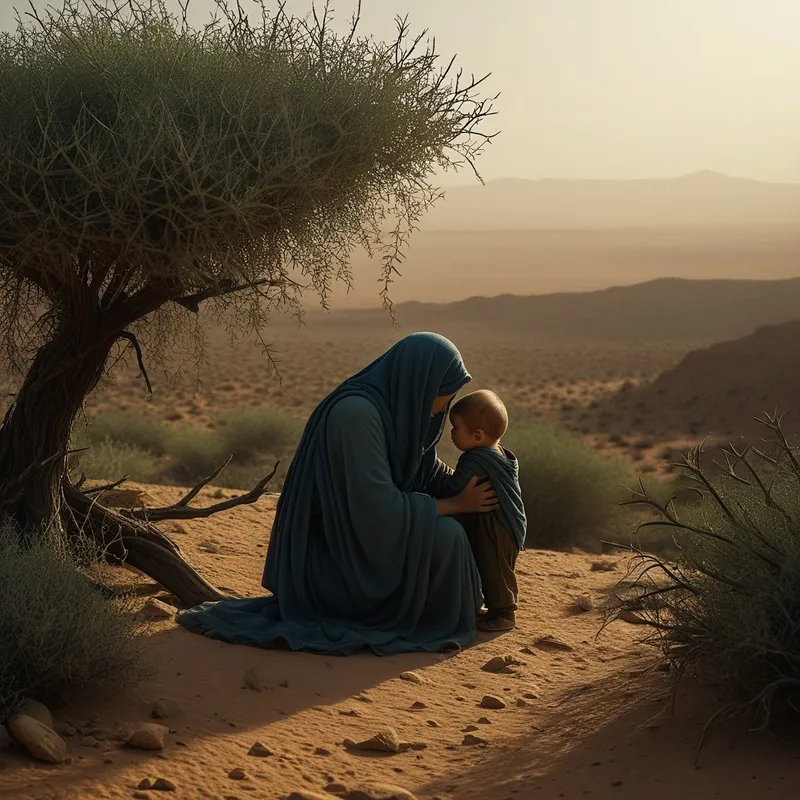
The thing was very distressing to Abraham, but the divine voice confirmed it: “Listen to Sarah.” At dawn, with only bread and a skin of water, Abraham sent Hagar away. She wandered in the wilderness of Beersheba until the water was gone. She placed Ishmael under the scant shade of a bush, then went a bowshot away, for she could not bear to watch her child die. “Do not let me look upon the death of the child,” she wept, her cries lifting on the hot wind.
And God heard the voice of the boy. The messenger of God called to Hagar from heaven. “What troubles you, Hagar? Do not be afraid; for God has heard the voice of the boy where he is. Come, lift up the boy and hold him fast with your hand, for I will make a great nation of him.”
Then God opened her eyes. And she saw a well of water. She filled the skin, gave the boy drink, and lived. God was with the boy; he grew up in the wilderness, an archer. And his mother found him a wife from the land of Egypt.
Cultural Origins & Context
The story of Hagar is woven into the foundational Pentateuch, specifically in the Book of Genesis. It is a narrative strand within the larger epic of the patriarchs, a story preserved and transmitted orally for generations before being codified. Its societal function is complex. On one level, it serves an etiological purpose, explaining the origins of the Ishmaelite peoples, neighbors and sometimes rivals to the Israelites, linking them to Abraham yet distinguishing their lineage and destiny (“a wild ass of a man”).
Told from the perspective of the eventual victors—the lineage of Isaac—it nonetheless preserves a startlingly sympathetic and theologically rich portrait of an Egyptian woman, a foreigner, and a slave. This suggests the tale held a power that could not be erased, even by later editors. It functioned as a cautionary tale about household strife, the perils of surrogate arrangements, and the painful, divinely-sanctioned choices that shaped identity. It was a story that acknowledged the brutal realities of displacement, maternal terror, and survival at the margins of the promised inheritance.
Symbolic Architecture
Hagar embodies the archetype of the Orphan in its most raw form. She is twice exiled: first from her Egyptian homeland into servitude, then from the household of Abraham into the desert. Her journey maps the psyche’s confrontation with the shadow of the dominant narrative—the rejected, the marginalized, the “other” upon whose labor and body the “promise” is paradoxically built.
The wilderness is not a place of punishment, but the crucible of direct encounter. It is only when Hagar is stripped of all human social structures—wife, mistress, household—that she meets the divine face-to-face and names the experience.
The well, Beer-lahai-roi, is the central symbol. It represents the sudden, unexpected source of sustenance and insight that appears when one is utterly emptied. It is the psychic resource hidden in the desert of despair, the vision that comes only after the tears have cleared the dust from the eyes. Hagar’s naming of God, “The God Who Sees,” is a revolutionary act of theological agency. It is the moment the seen one becomes the seer, claiming her experience as the locus of revelation.

The Dreamer's Resonance
To dream in the pattern of Hagar is to be in a somatic state of expulsion and primal survival. The dreamer may find themselves in a barren landscape, cast out from a “house” or group, carrying something precious yet burdensome (a child, a project, a potential) that seems doomed. There is a profound thirst—not just for water, but for recognition, for being seen in one’s distress.
The psychological process is one of hitting the absolute bottom of a resource. It is the “skin-of-water-is-empty” moment in the soul. The dream is not about the injustice of the expulsion (though that pain is real), but about the internal turning point that follows. The weeping is essential; it is the irrigation of the parched soul. The dream asks: Where is your well? What have you, in your anguish, failed to see? The appearance of a helper (the angelic voice, the sudden well) in the dream signals that the unconscious itself is providing the insight needed for the next step of survival, often requiring a fierce, maternal hold on one’s own vulnerable future (Ishmael).

Alchemical Translation
The alchemy of Hagar’s myth is the transmutation of rejected matter into sovereign spirit. She begins as prima materia—the foreign slave, the instrumentalized womb, the discarded shadow. The first heating in the alchemical vessel is her flight and divine encounter, which implants the seed of promise within her condition of servitude. She must return and endure, holding the tension between her seen-ness by God and her unseen-ness by the world.
The second, more brutal heating is her final expulsion with the child. This is the nigredo, the absolute blackness where all seems lost. Here, the old identity as a woman of any household is utterly dissolved.
The promise is not fulfilled in the safety of the tribe, but in the wilderness of the self. The nation born of Hagar is not a dynasty of landholders, but a lineage of resilient, untamable spirit that thrives beyond the walls of the inherited covenant.
The opening of the eyes to see the well is the albedo, the dawn. It is the moment of psychic illumination where what was always present (the well, the resource) is perceived. The sustenance was not sent from afar; it was revealed within the landscape of her ordeal. The transmutation is complete: the orphaned slave becomes the matriarch of a nation through a covenant forged not from inheritance, but from survival and direct revelation. For the modern individual, this models the individuation path of owning one’s “exiled” parts—the cultural, familial, or psychological heritage that feels cast out—and discovering that within that very wilderness lies the wellspring of unique identity and a promise heard not by the collective, but by the soul alone.
Associated Symbols
Explore related symbols from the CaleaDream lexicon: