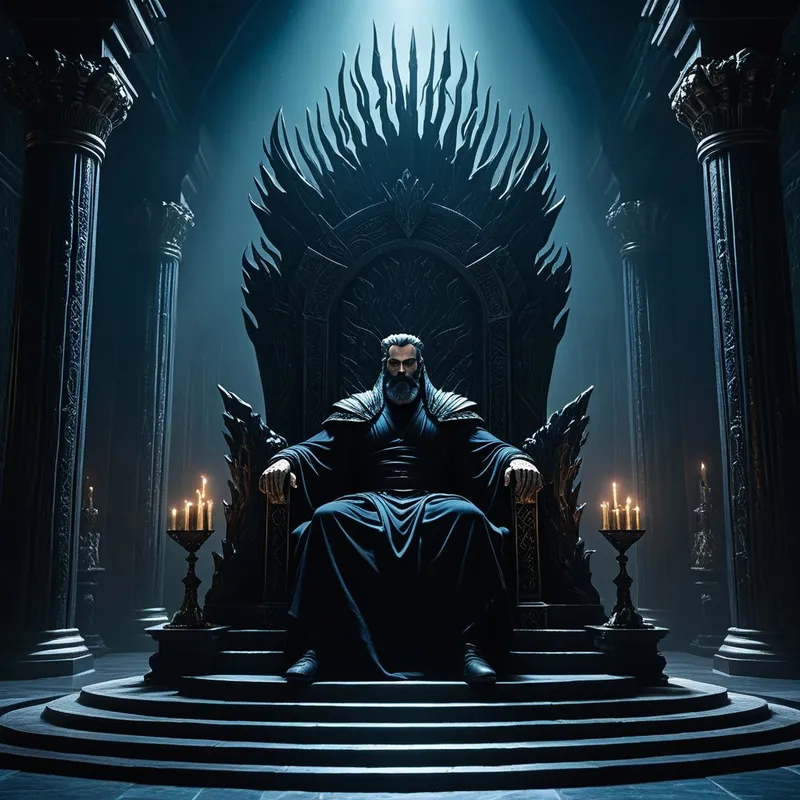
Hades' Underworld Myth Meaning & Symbolism
A myth of descent into the shadowy realm of the dead, ruled by the unseen god Hades, exploring themes of sovereignty, loss, and the soul's necessary journey.
The Tale of Hades' Underworld
Listen, and let the veil between the worlds grow thin. This is not a story of the sun-drenched Olympus, but of the deep, silent kingdom that lies beneath the roots of the world. Here, all rivers of forgetting and memory find their source. Here rules a god who is never named in vain, for to speak his title is to invite his gaze: Hades, the Unseen One, the Rich One, Lord of the Dead.
His realm is not a place of punishment, but of profound, unalterable order. To enter, one must cross the Acheron or the Cocytus, ferried by the silent, skeletal Charon, who accepts only the coin placed upon the tongue of the deceased. At the gate, the three-headed hound Cerberus ensures none may leave. The air is still and scentless, lit by the faint, phosphorescent glow of asphodel flowers blanketing the Meadows of Asphodel. Further in lie the Elysian Fields, and deeper still, the pit of Tartarus.
But the story that truly reveals the nature of this kingdom is one of a rupture, a cry that echoed from the world above into the silent halls below. Persephone, radiant daughter of Demeter, was gathering flowers in a sunlit meadow. The earth suddenly gaped open. From the chasm rose a chariot of blackest iron, drawn by steeds of smoke and shadow. Hades himself reached out, and in a single, swift motion, he took Persephone, and the earth sealed itself above them as if it had never been.
Demeter’s grief was a cataclysm. She wandered the earth, disguised and despairing, and in her sorrow, she withdrew the gift of growth. Famine gripped the world. Mortals starved, and the gods received no offerings. The balance of all life was undone.
In the silent halls of the Underworld, Persephone sat as queen beside her austere husband. She ate nothing, drank nothing, a ghost among ghosts. Yet, in a moment of profound turning—whether by trickery, loneliness, or a dawning acceptance—she accepted a gift from Hades: six seeds of a pomegranate, the fruit of the dead. She consumed them.
This simple act became an unbreakable contract. When Zeus finally commanded Hades to return the girl, the law of the Underworld held fast. For having consumed its food, a part of her now belonged to it. A compromise was struck: for each seed eaten, a month of the year she would reign as Queen beside Hades in the depths. For the rest, she would walk again in the world of light with her mother.
Thus, the wheel of the year was born from this division. When Persephone ascends, Demeter rejoices, and the earth blooms. When she descends, Demeter mourns, and winter holds the land. The Queen of the Underworld moves between the worlds, and her journey is written in the very turning of the seasons and the cycle of all life that dies and is reborn.

Cultural Origins & Context
This central myth of the Rape of Persephone was the sacred narrative at the heart of the Eleusinian Mysteries, the most famous and revered initiatory rites of the ancient Greek world. For nearly two thousand years, from Mycenaean times through the Roman era, initiates traveled to Eleusis to undergo secret rituals that promised a blessed afterlife and a profound understanding of life and death.
The myth was not mere entertainment; it was a living doctrine passed down through ritual re-enactment, hymn, and sacred drama. Its tellers were priests and priestesses, and its audience was a society deeply acquainted with the fragility of life and the immediacy of death. The story functioned as a theodicy, explaining the harsh necessity of seasonal death (winter) and the hope of renewal (spring). More importantly, it provided a map for the soul’s journey, offering a vision of the afterlife that was not merely a shadowy existence but a realm with its own order and the potential for a blessed state. It transformed the terrifying unknown of death into a narrative with rules, a ruler, and even a path to paradise.
Symbolic Architecture
The Underworld is not a metaphor for hell, but for the unconscious—the vast, interior kingdom beneath the surface of our waking ego. Hades himself symbolizes the principle of sovereignty over this hidden realm. He is not evil; he is inexorable, a god of absolute contracts and final boundaries. He represents the psyche’s capacity to hold, to contain, and to enforce the ultimate law of nature: all things must end.
The pomegranate seed is the ultimate symbol of conscious choice within the realm of the inevitable. To eat it is to willingly integrate a piece of the shadow into one’s identity.
Persephone’s abduction is the involuntary descent—the trauma, the depression, the sudden loss that plunges us into our own psychological depths. Her eventual consumption of the pomegranate seeds, however, marks the critical shift from passive victim to active queen. She accepts nourishment from the darkness, and in doing so, claims authority within it. Her dual identity—Kore the Maiden and Persephone the Queen—models the integration of innocence and experience, light and shadow.
The compromise brokered by Zeus represents the necessary rhythm of the conscious psyche. We cannot live permanently in the depths of the unconscious (psychosis), nor can we live forever in naive, sunlit ignorance (inflation). Health is a cyclical journey between the two.

The Dreamer's Resonance
When this mythic pattern stirs in modern dreams, it signals a profound encounter with the shadow and a call to descent. Dreaming of being pulled underground, of finding hidden rooms in a basement, of losing something precious in a deep forest, or of meeting a stern, authoritative figure in a dark place—all are echoes of Persephone’s journey.
Somatically, this process may feel like a heavy depression, a “dark night of the soul,” a loss of vitality, or a compulsive gravitation towards solitude and introspection. Psychologically, it is the ego’s forced confrontation with all it has repressed: unresolved grief, buried trauma, unacknowledged power, or instinctual drives. The dreamer is not being punished; they are being summoned to the court of their own inner Hades to acknowledge what has been left unseen and unruled. The feeling of being trapped in the dream mirrors the initial terror of the abduction, but it contains the seed of the eventual queenship.

Alchemical Translation
The alchemical work modeled by this myth is the nigredo, the blackening, the necessary dissolution of the old, solar ego. The triumph is not an escape from the Underworld, but the achievement of sovereignty within it—the creation of the Philosopher’s Stone, which is the integrated Self.
Individuation is not about reaching a state of perpetual light, but about earning the right to move consciously between the realms of light and dark, carrying the wisdom of each.
For the modern individual, the “abduction” might be a life crisis, a failure, a betrayal, or a deep depression that shatters one’s former identity. The initial phase is pure suffering and resistance (Persephone’s fast). The alchemical turn begins with the hesitant, often reluctant, act of engaging with the darkness on its own terms—entering therapy, journaling, confronting a painful truth, or simply sitting with the despair without fleeing into distraction. This is “eating the pomegranate seed.”
The outcome is not a return to who you were, but a transformation into someone who contains a fundamental duality. You become both the person who walks in the world (Kore) and the one who holds authority over your inner depths (Persephone). You gain the Helm of Hades—the capacity to become invisible, to withdraw consciously into your inner world without being destroyed by it. Your life acquires the authentic rhythm of the myth: periods of engagement and creativity (spring/summer) naturally followed by periods of introspective withdrawal and consolidation (autumn/winter). You become, in essence, the ruler of your own unseen kingdom.
Associated Symbols
Explore related symbols from the CaleaDream lexicon: