Hades' Pomegranate Seeds Myth Meaning & Symbolism
The abduction of Persephone by Hades, her consumption of pomegranate seeds, and the establishment of the seasons as a cycle of loss and return.
The Tale of Hades’ Pomegranate Seeds
Hear now the tale that is sung not of the sun-drenched heights of Olympus, but of the silent depths where the roots of the world drink from the river of memory. In the time before time was divided, Demeter’s daughter, Kore, danced in the meadows of Nysa. She was the very breath of spring, a girl of laughter and light, gathering blooms with her companions. The earth itself smiled beneath her feet.
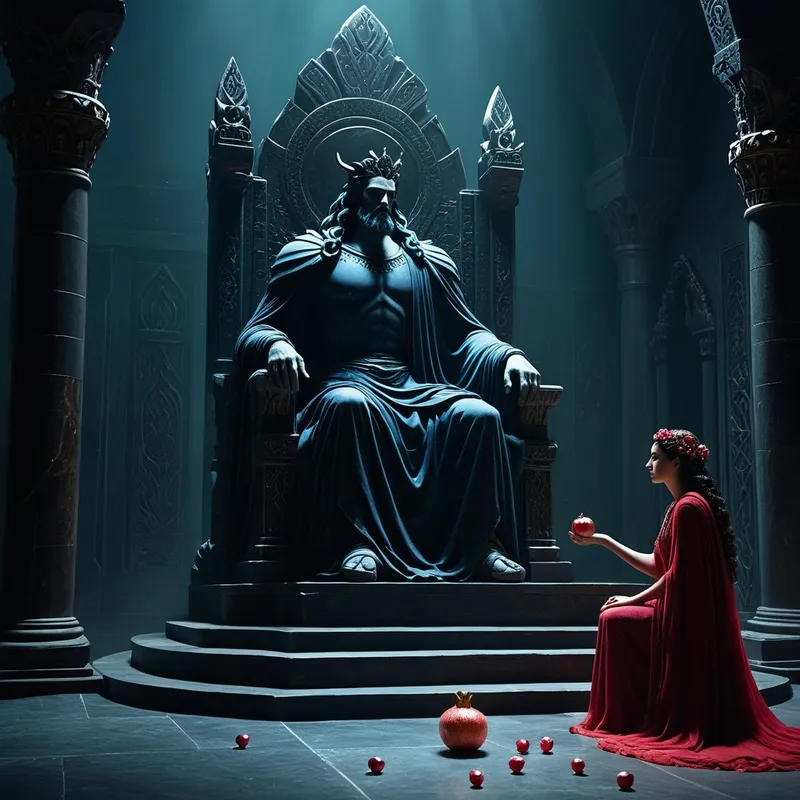
But the earth has a heart, and that heart is dark and deep. From a fissure in the living rock, a thunderous roar erupted. The ground split asunder, and forth came a chariot of blackest obsidian, drawn by steeds whose breath was the chill of the tomb. In it stood Hades, Lord of the Invisible, his gaze as fixed and inevitable as fate. His hand, neither cruel nor gentle, but final, closed around Kore’s wrist. A single cry was swallowed by the closing earth. The sunlit meadow was still, scattered with dropped flowers, a scene of perfect, terrible absence.
Demeter’s grief was a force of nature. She cast off her divinity, wrapped herself in the guise of an old woman, and let the world wither. Crops failed. The green land turned to dust. Mortals starved, and the gods’ altars grew cold. For nine days and nights, bearing torches lit from the fires of her anguish, she searched every corner of the world, but her daughter was not in the world. She was beneath it.
In the sunless kingdom, a different transformation was unfolding. The girl Kore was led to a palace of black rock and gleaming gems, a realm of quiet and eternal order. Hades offered her not a prison, but a throne. She was not a captive, but a guest who would become a queen. The shock of the descent began to settle into a profound stillness. Yet, she ate nothing, for to consume the food of the dead is to bind oneself to their realm forever.
Above, Demeter’s despair threatened the very order of life. Zeus, pressured by the cries of a dying creation, commanded Hades to release her. A flicker of hope returned to the wasted world. As Kore was led back toward the living light, a gardener of the underworld—some say the god himself—offered her a parting gift: a pomegranate, its skin like polished leather holding a universe of ruby seeds. Parched from her fast, perhaps moved by a complexity she did not yet understand, she accepted. She ate six seeds.
That simple, irrevocable act changed everything. For she had taken the underworld into herself. When Hermes brought her to the threshold where Demeter waited, their reunion was a storm of tears and joy. But the secret of the seeds could not be hidden. Because she had consumed the food of his realm, a sacred contract was sealed. She belonged to both worlds, and neither could claim her wholly.
Thus, the great compromise was struck. For six seeds, she would return to the underworld for six months of the year, reigning as Persephone, the dread and gracious queen. For the other six, she would ascend to walk with her mother, and the earth would bloom with Demeter’s delight. The wheel of the year was born from a mother’s grief, a god’s longing, and a maiden’s fateful taste of a crimson fruit.
Cultural Origins & Context
This myth, central to the Eleusinian Mysteries, was not merely a story but a lived, sacred reality for the ancient Greeks. It was the heart of their most profound religious experience, passed down through initiatory rites at Eleusis for nearly two millennia. The Homeric Hymn to Demeter, our primary source, functions as a sacred text, detailing the abduction and establishing the ritual framework.
Its societal function was multifaceted. On the surface, it was an etiological myth explaining the seasonal cycle, giving meaning to the death and rebirth of vegetation. On a human level, it mirrored the ancient Greek experience of a daughter’s marriage—a sudden departure from the mother’s home (the abduction) to a husband’s realm (the underworld), a transition fraught with loss but necessary for the creation of a new household and lineage. Most powerfully, for the initiates at Eleusis, the myth modeled the journey of the soul itself, promising that life continued beyond the visible, and that a profound, transformative wisdom (telos) could be found through a sacred encounter with the depths.
Symbolic Architecture
The myth’s power lies in its flawless symbolic architecture, where every element is a facet of a profound psychological truth.
Kore represents the unconscious, nascent self—the potential for life and growth still bound to the mother archetype (Demeter). Her abduction is not a crime, but a necessary numinous invasion: the call of the deep psyche to individuate. The conscious ego cannot choose this descent; it is seized by it.
Hades is not a villain, but the lord of the invisible interior. His realm is the unconscious itself—the place of memory, instinct, and the psychic substrate from which all consciousness springs. His abduction is the soul’s inevitable confrontation with its own depths.
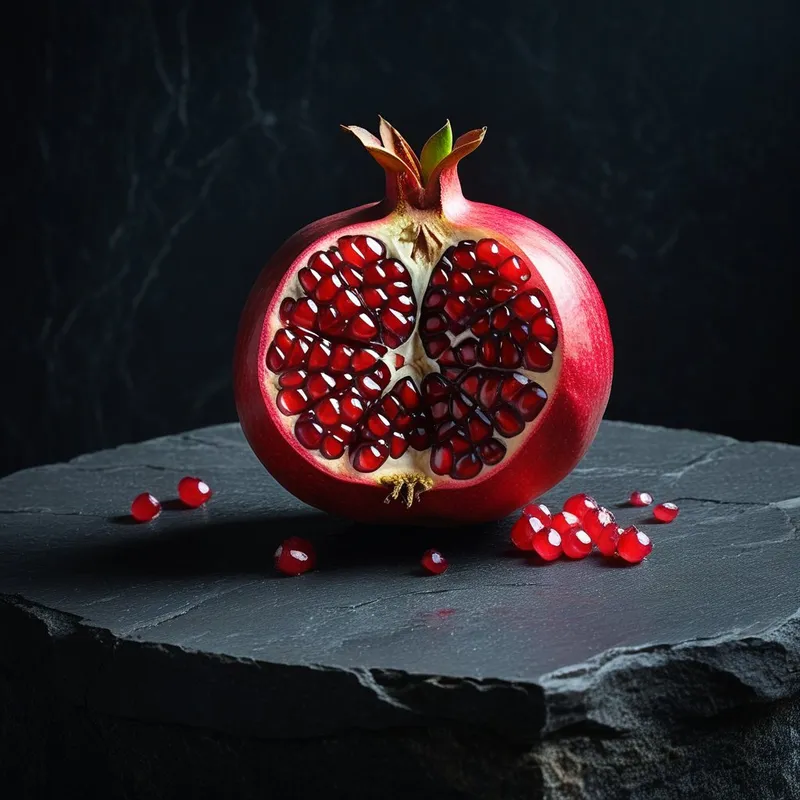
The pomegranate is the fruit of the underworld, the concentrated essence of the experience of the depths. To eat its seeds is to consciously integrate a piece of that shadowy realm into one’s own substance.
The six seeds are critical. They represent a partial, but binding, commitment. Persephone does not stay forever in the dark, nor does she return to the light unchanged. She becomes the Queen of Two Realms. This is the symbol of the integrated psyche: the conscious ego (the light-world self) that has made a pact with the contents of the unconscious (the dark-world self) and gained sovereignty from both.

The Dreamer’s Resonance
When this myth stirs in modern dreams, it signals a profound initiation underway in the dreamer’s psyche. Dreaming of being pulled underground, of finding oneself in vast, silent caverns, or of encountering a solemn, authoritative figure in the dark mirrors Kore’s abduction. This is the somatic feeling of being overtaken by a depression, a life transition, or a calling that feels larger than one’s will.
Dreaming of a pomegranate, especially of eating its seeds or being stained by its juice, signifies the point of no return in a psychological process. The dream ego is accepting a truth, a memory, or a facet of its own nature that it had previously rejected or ignored. The “stain” is the indelible mark of this integration; once seen or known, it cannot be unknown. The dreamer may feel a sense of dread mixed with a strange sense of rightness—the ambivalence of Persephone at the moment of consumption. These dreams often cluster around times of significant loss, career change, or deep therapy, marking the shift from being a victim of circumstance (abducted) to becoming an agent of one’s own depth (choosing to eat).

Alchemical Translation
The alchemical process mirrored here is the individuation—the creation of the philosophical gold, which is the fully realized Self. Demeter’s unchecked grief represents the initial nigredo, the blackening, the utter dissolution of the old conscious attitude. The world of light and order must fall apart for the journey to begin.
Kore’s descent is the solutio, a dissolution into the prima materia of the unconscious. Her time in the underworld, culminating in the eating of the seeds, is the crucial stage of separatio and coagulatio. She separates from her identity as only her mother’s daughter, and through the act of eating (assimilation), she begins to coagulate a new, more complex identity.
The great compromise—the cyclical division of the year—is the ultimate alchemical formula. It rejects permanent identification with either pole (eternal light or eternal darkness) in favor of a rhythmic, conscious participation in both.
For the modern individual, this translates to the sacred duty of honoring one’s own cycles. We are not meant to live in perpetual summer (endless productivity, optimism, extroversion) nor in endless winter (withdrawal, depression, introspection). The myth mandates a seasonal soul. We must have our Persephone winters: times to descend, to be with our inner Hades, to rule the kingdom of our shadows and forgotten potentials. And we must have our Kore springs: times to ascend, to create, to relate, and to manifest in the world. The pomegranate seeds are the token of this pact—the hard, gem-like kernels of wisdom we bring back from the dark to nourish our life in the light. To refuse the descent is to live in Demeter’s famine. To refuse the return is to be lost in the halls of memory. To accept both is to become sovereign.
Associated Symbols
Explore related symbols from the CaleaDream lexicon: