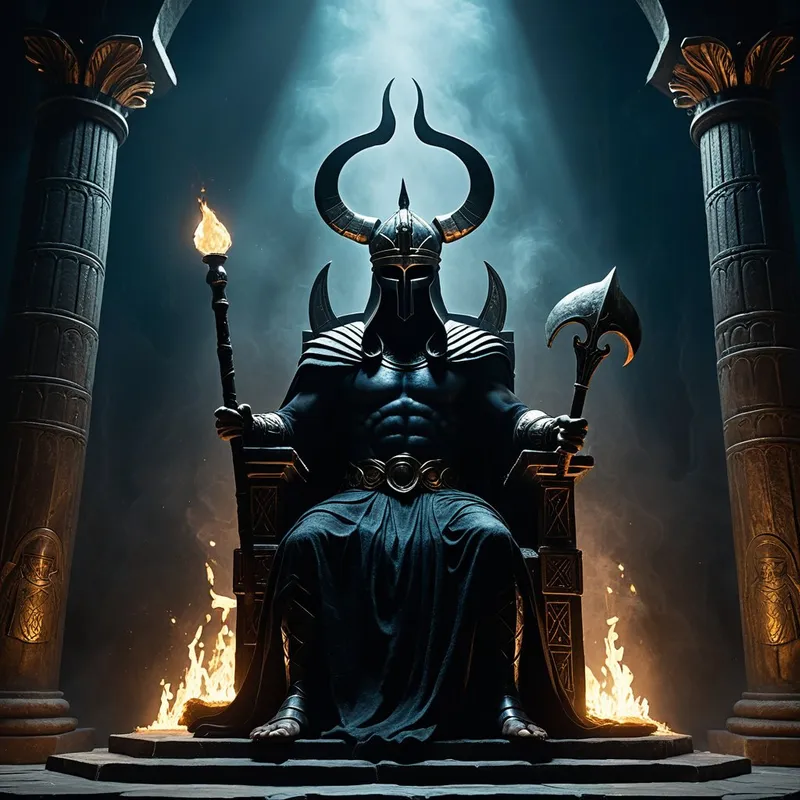
Hades' Helm of Darkness Myth Meaning & Symbolism
The magical helm of the underworld god, granting invisibility, symbolizing the power of the unconscious and the necessity of facing what is hidden.
The Tale of Hades’ Helm of Darkness
Listen, and hear of a power that moves in the spaces between breaths, a gift not of light, but of the profound dark from which light is born. Our tale begins not on sun-drenched Olympus, but in the deep, echoing halls of [the world](/myths/the-world “Myth from Tarot culture.”/) below. Here rules [Hades](/myths/hades “Myth from Greek culture.”/), the Unseen One, brother to Zeus and [Poseidon](/myths/poseidon “Myth from Greek culture.”/). His kingdom is wealth, for all things return to [the earth](/myths/the-earth “Myth from Hindu culture.”/), but it is a wealth of silence, of finality. And among his treasures is one most peculiar: a helmet, forged in the first smithies of the Titans. It is not adorned with plumes or gold, but is simple, cold, and wrought from a metal that thirsts for light. This is the Helm of Darkness, the Cap of Invisibility.
The air in [the underworld](/myths/the-underworld “Myth from Greek culture.”/) is still, heavy with the dust of ages. Then, a ripple—a mortal presence, desperate and determined. It is the hero [Perseus](/myths/perseus “Myth from Greek culture.”/)</ab title>, son of Zeus, tasked with a deadly errand: to bring back the head of [the Gorgon](/myths/the-gorgon “Myth from Various culture.”/) [Medusa](/myths/medusa “Myth from Greek culture.”/). To look upon her is to become stone, forever. He is armed with a mirrored shield from Athena, winged sandals from [Hermes](/myths/hermes “Myth from Global/Universal culture.”/), but for his quest to even begin, he needs the one [thing](/myths/thing “Myth from Norse culture.”/) that can hide him from the monstrous sisters who guard [Medusa](/myths/medusa “Myth from Greek culture.”/). He needs to become a ghost among monsters.
His journey downward is a descent through fear itself. The path to Hades’ throne is lined with whispers of the dead, but Perseus holds his purpose like a torch. He stands before the dark god, not as a supplicant begging for life, but as a hero on a path ordained by [the Fates](/myths/the-fates “Myth from Greek culture.”/) themselves. Hades, the rich one, listens. He sees not a thief, but an instrument of divine will. Without a word, the lord of the dead gestures. A nymph, one of the Naiads of [the Styx](/myths/the-styx “Myth from Greek culture.”/), steps forward, bearing the helm. It is unassuming, yet the very air around it seems to dim. Perseus takes it. The metal is colder than ice, a chill that seeps into the bone, not of temperature, but of absence.
Now, in the grey, petrified wastes where the Gorgons dwell, Perseus dons the helm. He does not vanish in a puff of smoke; rather, the world forgets him. He becomes a walking silence, a gap in perception. The dread sisters, Stheno and Euryale, stir in their sleep, sensing a disturbance in the air, a wrongness they cannot see. Perseus moves among them, a breath of nothing. Using Athena’s shield as a mirror, he finds the sleeping Medusa. In that mirrored surface, he sees her terrible visage without meeting her gaze. The helm holds. His own heartbeat is the loudest sound in the universe. With a single, guided stroke, the deed is done. The helm’s power does not falter as he flees, the wrathful sisters clawing at the empty air where he once was not. The gift of the Unseen One has allowed him to confront the ultimate face of terror and return, not just alive, but transformed, carrying a power that turns the living to stone—a power born from facing the unseen with unseen aid.
Cultural Origins & Context
The myth of the Helm of Darkness is woven into the oldest layers of Greek epic poetry, most famously in the Theogony of Hesiod and the later adventures of Perseus. It was not a standalone folktale but a crucial narrative device within a larger heroic cycle. Bards and poets recited these tales, not as simple entertainment, but as foundational texts that explored the boundaries of the human and divine, the seen and unseen worlds.
Its societal function was multifaceted. On one level, it explained the provenance of legendary artifacts in heroic genealogy. On a deeper level, it reinforced the cosmological order. The helm originates from the Titans, the old chaotic powers, but is now held in stewardship by Hades, a ruler of the new, more structured Olympian order. This symbolized the containment of primal, chaotic powers (like invisibility, obscurity) within a defined realm (the [Underworld](/myths/underworld “Myth from Greek culture.”/)), from which they could be loaned out for specific, fate-driven purposes. The myth taught that the powers of chaos and oblivion are not destroyed, but managed, and can even be harnessed by heroes who approach them with respect and a sanctioned purpose.
Symbolic Architecture
The [Helm of Darkness](/symbols/helm-of-darkness “Symbol: The Helm of Darkness, often associated with invisibility and protection, symbolizes the hidden depths of the psyche and the unseen aspects of one’s character.”/) is far more than a magical [plot](/symbols/plot “Symbol: A plot symbolizes the unfolding of a story, representing personal narratives and life direction.”/) [device](/symbols/device “Symbol: A device in dreams often symbolizes the tools or mechanisms that we use to navigate our inner or outer worlds.”/). It is a profound [symbol](/symbols/symbol “Symbol: A symbol can represent an idea, concept, or belief, serving as a powerful tool for communication and understanding.”/) of the unconscious mind and [the principle](/symbols/the-principle “Symbol: A fundamental truth, law, or doctrine that serves as a foundation for a system of belief, behavior, or reasoning, often representing moral or ethical standards.”/) of the [shadow](/symbols/shadow “Symbol: The ‘shadow’ embodies the unconscious, repressed aspects of the self and often represents fears or hidden emotions.”/). [Hades](/symbols/hades “Symbol: Greek god of the underworld, representing death, the unconscious, and hidden aspects of existence.”/)’ [realm](/symbols/realm “Symbol: The symbol of ‘Realm’ often signifies the boundaries of one’s consciousness, experiences, or emotional states, suggesting aspects of reality that are either explored or ignored.”/) itself is the ultimate [metaphor](/symbols/metaphor “Symbol: A figure of speech where one thing represents another, often revealing hidden connections and deeper truths through symbolic comparison.”/) for the [psyche](/myths/psyche “Myth from Greek culture.”/)’s [basement](/symbols/basement “Symbol: The basement in dreams often symbolizes the unconscious mind, where hidden fears, repressed memories, and unacknowledged aspects of the self reside.”/)—the repository of all we have forgotten, repressed, or fear. The [helm](/symbols/helm “Symbol: A helm represents leadership, control, and protection, often symbolizing authority, direction, and responsibility in navigating life’s challenges.”/), as its key [artifact](/symbols/artifact “Symbol: An object from the past carrying historical, cultural, or personal significance, often representing legacy, memory, or hidden knowledge.”/), represents the [ability](/symbols/ability “Symbol: In dreams, ‘ability’ often denotes a recognition of skills or potential that one possesses, whether acknowledged or suppressed.”/) to move unseen within that [realm](/symbols/realm “Symbol: The symbol of ‘Realm’ often signifies the boundaries of one’s consciousness, experiences, or emotional states, suggesting aspects of reality that are either explored or ignored.”/).
To wear the Helm of Darkness is to operate from the unconscious, to be guided by intuition and instinct rather than the glaring light of conscious ego.
It is not a [weapon](/symbols/weapon “Symbol: A weapon in dreams often symbolizes power, aggression, and the need for protection or defense.”/) of aggression, but one of stealth, introspection, and necessary deception (of monsters, both external and internal). Perseus cannot defeat Medusa by force of arms alone; he must become invisible, must shift his mode of being from the heroic, visible [actor](/symbols/actor “Symbol: An actor represents roles, transformation, and the performance of identity in dreams.”/) to the unseen witness, using [reflection](/symbols/reflection “Symbol: Reflection signifies self-examination, awareness, and the search for truth within oneself.”/) (Athena’s [shield](/symbols/shield “Symbol: A symbol of protection, defense, and boundaries, representing personal security, resilience, and the need to guard against external threats or emotional harm.”/)) to safely perceive the terrifying [truth](/symbols/truth “Symbol: Truth represents authenticity, honesty, and the quest for knowledge beyond mere appearances.”/). The helm allows for the approach. The mirrored shield allows for the confrontation. Together, they model the process of engaging with [the shadow](/myths/the-shadow “Myth from Jungian culture.”/): first by withdrawing the blinding light of judgment (invisibility), then by observing its reflection indirectly.
The helm also symbolizes the gift that comes from the parts of ourselves we deem dark or unwanted. Hades, often simplistically viewed as a [villain](/symbols/villain “Symbol: A character representing opposition, moral corruption, or suppressed aspects of self, often embodying fears, conflicts, or societal threats.”/), is here a granter of crucial aid. He is the part of the psyche that holds our buried strengths, our latent capacities for survival that are not polite or sunny, but are utterly effective.
The Dreamer’s Resonance
When this myth pattern stirs in the modern dreamer, it often signals a necessary descent into the personal underworld. To dream of becoming invisible, of wearing a helmet or cloak of shadow, points to a somatic and psychological process of withdrawal. [The ego](/myths/the-ego “Myth from Jungian culture.”/) is stepping back. This is not necessarily depression or dissociation in a pathological sense, but a sacred retreat.
The body may feel heavy, quiet, or numb in such dreams—a somatic echo of the helm’s “coldness,” which is the feeling of psychic energy being pulled inward for internal work. The dreamer might be navigating a situation in waking life where direct, conscious confrontation is impossible or destructive. The unconscious is recommending a strategy of stealth, of observation, of working from the shadows of one’s own intuition. Alternatively, dreaming of seeking such a helm indicates a profound need for a resource that feels missing: the ability to hide, to be protected from an overwhelming gaze (often of judgment, expectation, or a terrifying truth). The dream is pointing toward the need to petition one’s own inner Hades—to respectfully engage with the deep, often ignored parts of [the self](/myths/the-self “Myth from Jungian culture.”/) that hold the power of concealment and strategic retreat.
Alchemical Translation
The journey of Perseus with the helm is a perfect allegory for the alchemical stage of [nigredo](/myths/nigredo “Myth from Alchemical culture.”/), the blackening or descent. In the process of individuation—becoming one’s whole, unique self—one must first confront and integrate the shadow. The Helm of Darkness is the tool for this initial, perilous phase.
The alchemical work begins not in illumination, but in willingly entering the darkness and learning to see by means of it.
The conscious ego (Perseus) cannot integrate the petrifying Medusa (a core complex or traumatic shadow content) directly. To try is to be frozen, stuck in a pattern of stone. First, the ego must don the “helm”—it must suspend its normal, identifying consciousness. This is the practice of active imagination, meditation, or any state where the loud “I” becomes quiet and observational. From this place of humble invisibility, one can then use the “shield” of reflection—journaling, therapy, art—to observe the terrifying content indirectly, safely. The act of “beheading” Medusa is not destruction, but differentiation; it is separating the paralyzing power of the complex from its energy, claiming the Gorgon’s head (the transformed symbol) as a new power for the psyche.
The [triumph](/myths/triumph “Myth from Roman culture.”/) is not that Perseus destroys the unseen realm, but that he enters into a relationship with it, borrows its power for a sacred task, and returns to the upper world forever changed. So too, the modern individual does not “defeat” their unconscious. They learn to petition it, receive its strange gifts (like the capacity for stealth, patience, or deep introspection), and use those gifts to navigate their most daunting challenges, emerging not unscathed, but carrying a transformed power born from the heart of darkness itself.
Associated Symbols
Explore related symbols from the CaleaDream lexicon: