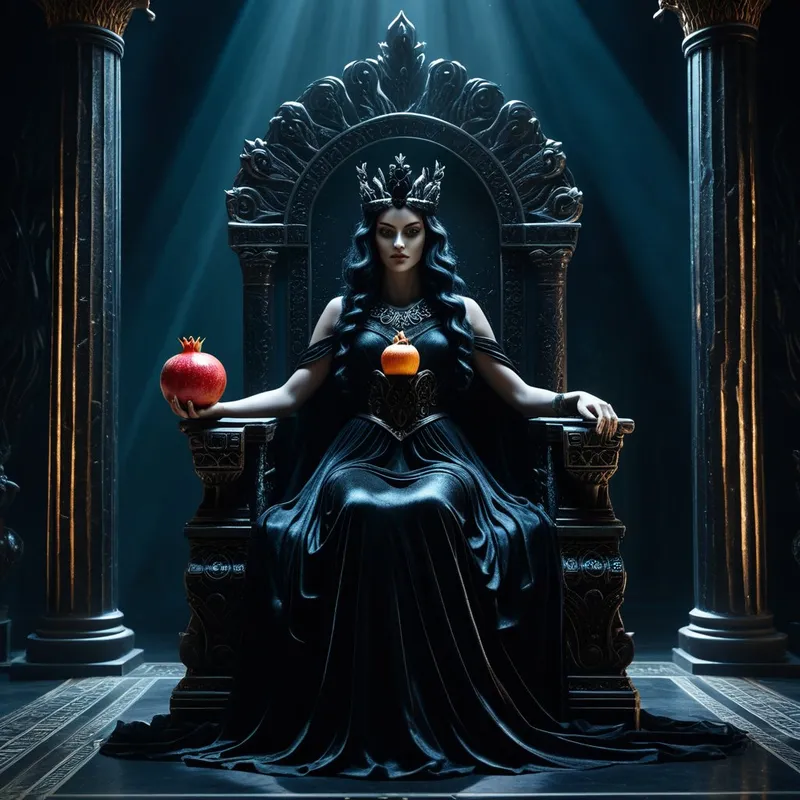
Hades and Persephone Myth Meaning & Symbolism
The maiden Persephone is taken by Hades to the underworld, sparking a cycle of grief and return that explains the seasons and the soul's descent.
The Tale of Hades and Persephone
Listen, and hear the story that cracks [the world](/myths/the-world “Myth from Tarot culture.”/) in two—a tale of a girl, a flower, and [the earth](/myths/the-earth “Myth from Hindu culture.”/) that swallowed her whole.
In the first light, when the world was young and green, Demeter walked the fields, her touch the secret of life itself. Her daughter, Kore, was the spring incarnate. Her laughter was the sound of budding leaves, her footsteps left meadows in her wake. She danced with the Horae in the Nysian plain, a circle of light in a world of light.
But in the deep, silent dark beneath the roots of mountains, a loneliness grew. [Hades](/myths/hades “Myth from Greek culture.”/), lord of the invisible realms, watched from the shadows of his kingdom. He saw not just a maiden, but a queen who could bring a different kind of life to his sunless halls. He went to his brother, Zeus, and received a silent, fateful nod.
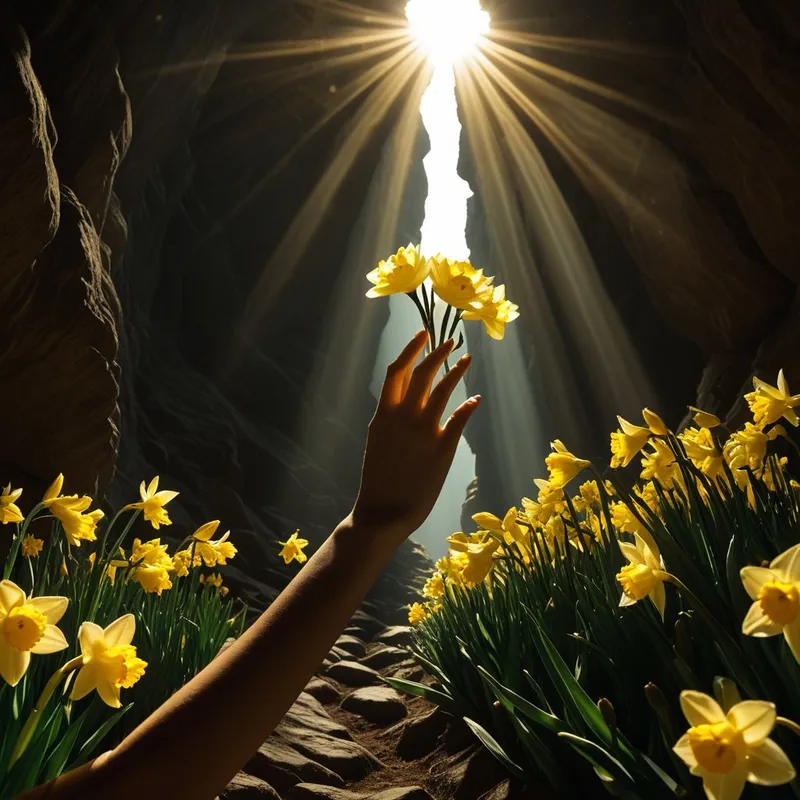
The day was deceptively bright. Kore wandered from her companions, drawn to a [narcissus](/myths/narcissus “Myth from Greek culture.”/) of such blinding, hypnotic beauty it seemed to drink the very light. As she reached for it, the earth did not yield—it roared. The meadow split asunder with a sound like a thousand trees falling. From the black chasm, a chariot of blackest iron drawn by immortal, smoke-dark horses erupted. Hades, clad in shadows that drank the sun, seized her. Her cry was swallowed by the rushing wind and the grinding stone as the earth sealed itself above them, leaving only a scar in the grass and a fading echo.
Above, the world went mute. Demeter felt the severing in her soul. She tore her hair, cast aside her divinity, and walked the earth as a grieving crone, a drought following her like a cloak. The green world withered. Famine gripped the land. Mortals prayed to deaf heavens.
Below, in the House of Hades, a silent drama unfolded. The lord of the dead offered not violence, but a throne. He offered [Persephone](/myths/persephone “Myth from Greek culture.”/)—for that was the name she would earn—not as a prisoner, but as his equal. The kingdom of ghosts, the wealth of gems in the dark, the silent respect of all that has passed: it was hers. Yet, she ate nothing, for to consume the food of the dead is to bind oneself to them forever.
The suffering above could not last. The balance of all things was crumbling. Zeus sent messenger after messenger. Hades, the inflexible, agreed to release her—but only if she had not partaken of his hospitality. But as Persephone turned to ascend to the light, a gardener of [the underworld](/myths/the-underworld “Myth from Greek culture.”/), Ascalaphus, bore witness: he had seen her, in her loneliness or perhaps her dawning acceptance, eat seven seeds from a blood-red pomegranate.
The compromise was as brutal as it was eternal. For each seed consumed, a month must be spent below. Thus, for one-third of the turning year, Persephone reigns as dread Queen in the land of shadows. And for the other two, she walks again in the world of light with her mother. And so, when Persephone descends, Demeter mourns, and autumn falls, winter grips the world. When her daughter returns, the goddess rejoices, and life erupts in a frenzy of green and blossom. The maiden was gone. The Queen had been born. The world itself now breathes with the rhythm of her journey.
Cultural Origins & Context
This was not merely a story of seasons, but a central aetiological myth for the ancient Greeks, most famously detailed in the Homeric Hymn to Demeter. This hymn was likely performed in the context of the Eleusinian Mysteries, the most revered initiatory cult of the ancient world. For over a thousand years, initiates traveled to Eleusis to undergo secret rites that promised a blessed afterlife, with the myth of Demeter and Persephone at their [sacred heart](/myths/sacred-heart “Myth from Christian culture.”/).
The myth was passed down by poets and priests, functioning on multiple societal levels. On the surface, it explained the agricultural cycle vital to survival. On a deeper, civic level, it modeled the traumatic transition of a young woman from her mother’s house (gynaikeion) to her husband’s, a real “descent” that mirrored [Persephone’s abduction](/myths/persephones-abduction “Myth from Greek culture.”/). Most profoundly, in the Mysteries, it became a map for the soul’s journey through death and the hope of renewal, offering a powerful counter-narrative to the bleak, shadowy existence promised in common eschatology. It was a story told to make sense of loss, to sanctify transition, and to whisper that even from the deepest darkness, a return—changed, but whole—was possible.
Symbolic Architecture
The myth is a perfect symbolic ecosystem. Persephone is the [anima](/symbols/anima “Symbol: The feminine archetype within the male unconscious, representing soul, creativity, and connection to the inner world.”/) or the conscious ego in its naive state—all surface [beauty](/symbols/beauty “Symbol: This symbol embodies aesthetics, harmony, and the appreciation of life’s finer qualities.”/) and untapped [depth](/symbols/depth “Symbol: Represents profound layers of consciousness, hidden truths, or the unknown aspects of existence, often symbolizing introspection and existential exploration.”/). [Hades](/symbols/hades “Symbol: Greek god of the underworld, representing death, the unconscious, and hidden aspects of existence.”/) is not a [villain](/symbols/villain “Symbol: A character representing opposition, moral corruption, or suppressed aspects of self, often embodying fears, conflicts, or societal threats.”/), but the personification of the unconscious and the inevitable call to individuation. His [realm](/symbols/realm “Symbol: The symbol of ‘Realm’ often signifies the boundaries of one’s consciousness, experiences, or emotional states, suggesting aspects of reality that are either explored or ignored.”/) is the [psyche](/myths/psyche “Myth from Greek culture.”/)‘s [basement](/symbols/basement “Symbol: The basement in dreams often symbolizes the unconscious mind, where hidden fears, repressed memories, and unacknowledged aspects of the self reside.”/), where all that is forgotten, feared, and potent resides.
The abduction is not a crime, but a summons. The soul is not stolen; it is claimed by a destiny too deep to ignore.
Demeter represents the binding power of the known, the maternal complex that must be broken for true selfhood to emerge. The [pomegranate seeds](/myths/pomegranate-seeds “Myth from Greek culture.”/) are the ultimate [symbol](/symbols/symbol “Symbol: A symbol can represent an idea, concept, or belief, serving as a powerful tool for communication and understanding.”/) of conscious [choice](/symbols/choice “Symbol: The concept of choice often embodies decision-making, freedom, and the multitude of paths available in life.”/) within the unconscious realm. They are the [knowledge](/symbols/knowledge “Symbol: Knowledge symbolizes learning, understanding, and wisdom, embodying the acquisition of information and enlightenment.”/) of the [underworld](/symbols/underworld “Symbol: A symbolic journey into the unconscious, representing exploration of hidden aspects of self, transformation, or confronting repressed material.”/), ingested and made part of [the self](/myths/the-self “Myth from Jungian culture.”/). This is the point of no return in any profound transformation: one cannot “un-know” the [depths](/symbols/depths “Symbol: Represents the subconscious, hidden emotions, or foundational aspects of the self, often linked to primal fears or profound truths.”/) once they have been truly tasted. The cyclical [resolution](/symbols/resolution “Symbol: In arts and music, resolution refers to the movement from dissonance to consonance, creating a sense of completion, release, or finality in a composition.”/) symbolizes the achieved [integration](/symbols/integration “Symbol: The process of unifying disparate parts of the self or experience into a cohesive whole, often representing psychological wholeness or resolution of internal conflict.”/)—[the ego](/myths/the-ego “Myth from Jungian culture.”/) no longer lives solely in the bright world of the [persona](/symbols/persona “Symbol: The social mask or outward identity one presents to the world, often concealing the true self.”/), but learns to rule, with sovereignty, the rich darkness within.

The Dreamer’s Resonance
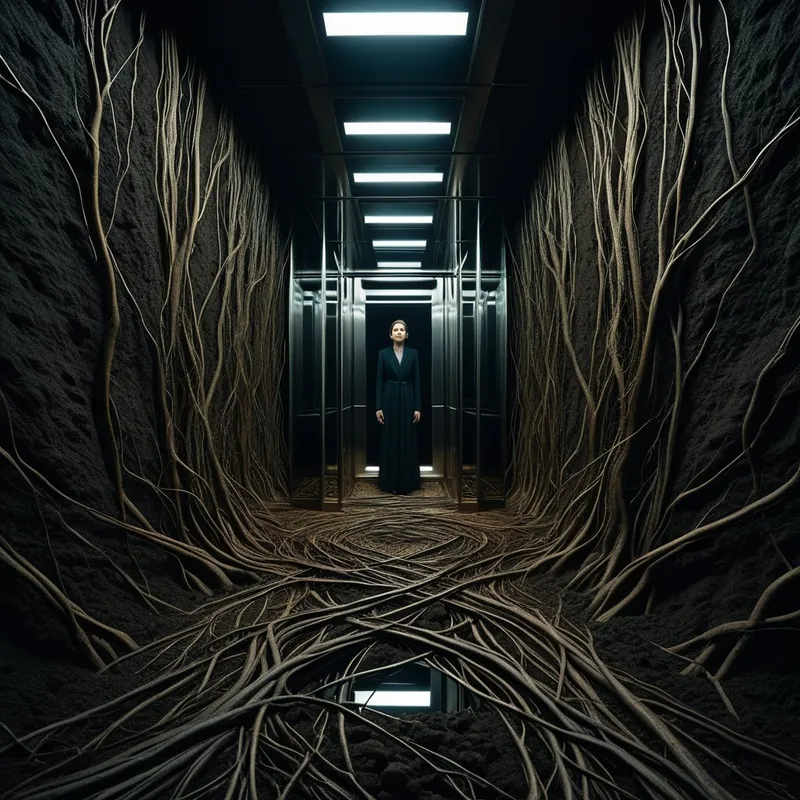
When this myth stirs in modern dreams, it signals an active, often tumultuous, process of psychic descent. Dreaming of being pulled underground, of elevators falling endlessly, or of finding opulent rooms in basements points to the ego’s encounter with the Hades principle. The dreamer may feel a sense of forcible initiation—a job loss, a depression, a rupture in a key relationship—that, like [the chariot](/myths/the-chariot “Myth from Tarot culture.”/), severs them from their familiar “meadow.”
Somatically, this can feel like a heavy depression, a literal “low” feeling, or a sense of being trapped. Psychologically, it is the beginning of shadow-work. The figure of Hades in a dream is rarely monstrous; he is more often solemn, powerful, and compelling, representing an aspect of the dreamer’s own power or repressed desire that demands recognition. Persephone’s dual role appears in dreams of finding authority in unexpected, dark places, or of holding a resonant, glowing object (the pomegranate seed) that signifies a binding, transformative insight gained from the depths. The dreamer is moving from a state of being acted upon to one of wielding sovereignty over their own inner darkness.
Alchemical Translation
The alchemical journey—[nigredo](/myths/nigredo “Myth from Alchemical culture.”/) (blackening), albedo (whitening), [rubedo](/myths/rubedo “Myth from Alchemical culture.”/) (reddening)—is perfectly modeled here. The abduction is the nigredo, the descent into [the prima materia](/myths/the-prima-materia “Myth from Alchemical culture.”/), the chaotic, dark night of the soul where all former identity dissolves. Persephone’s initial grief and fasting in the [underworld](/myths/underworld “Myth from Greek culture.”/) is this stage of dissolution.
Her acceptance of the pomegranate is the crucial turn. This is the rubedo, the sealing of the process with a conscious act that integrates the opposing realms. The red juice of the pomegranate is the elixir vitae, the blood of new life born from confrontation with death.
Individuation is not about staying in the light, but about earning the right to move fluidly between the realms, carrying the wisdom of each to the other.
The final, cyclical resolution is the goal of alchemy: the creation of the [lapis philosophorum](/myths/lapis-philosophorum “Myth from Alchemical culture.”/), or in psychological terms, the Self. The modern individual undergoing this transmutation moves from being a child of circumstance (Kore in the meadow) to becoming an author of their own fate (Persephone the Queen). They no longer deny the underworld of their psyche—their grief, rage, trauma, or primal instincts—but learn to rule it, to find its hidden wealth, and to understand that their vitality is dependent on this regular, sacred descent and return. They become, like the myth itself, a container for both life and death, joy and grief, eternally cycling and eternally whole.
Associated Symbols
Explore related symbols from the CaleaDream lexicon: