Guinevere's Bower Myth Meaning & Symbolism
A hidden garden of sovereignty, a secret of the heart, and the sacred space where a queen's private self blooms, with fateful consequences for a kingdom.
The Tale of Guinevere's Bower
Listen, and I will tell you of a secret that grew in the heart of Logres. It was not a secret of treason, not at first, but a secret of the soul. In the high, ringing halls of Camelot, where the Round Table shone like a second sun, Queen Guinevere walked as a figure of perfect grace. Her laughter was a gift to the court, her counsel wise, her bearing the very image of a kingdom's glory. Yet, her heart carried a weight no crown could balance—the weight of being forever seen, forever queen, and never simply Guinevere.
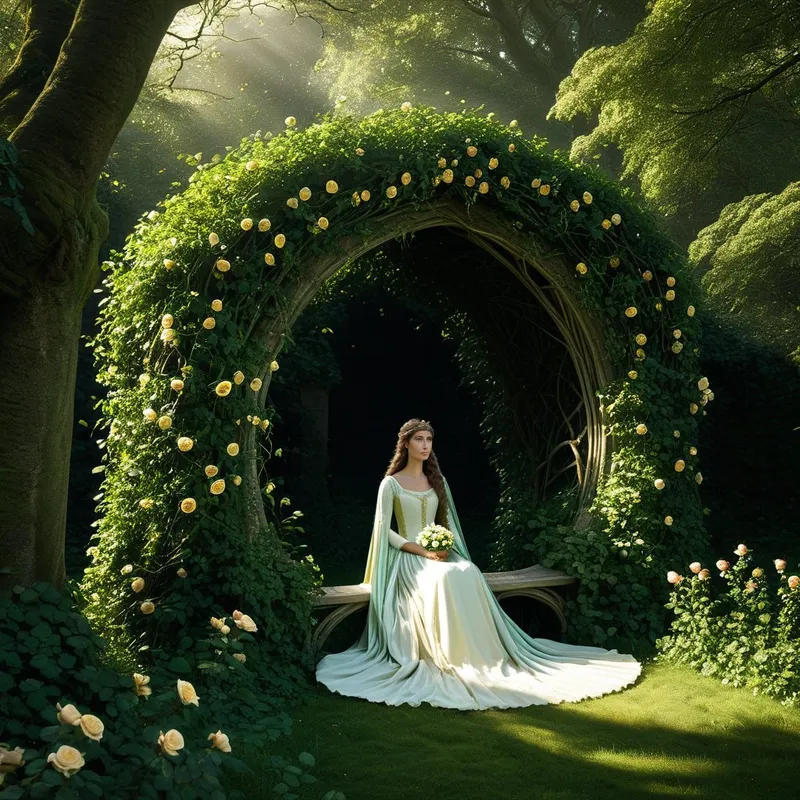
So, she planted a secret. Beyond the tiltyards, past the herb gardens, through a forgotten postern gate in the castle's oldest wall, there was a track known only to the white harts and the queen. It led into a deep, silent fold of the forest, a place where the light fell in green-gold pillars. There, with her own hands, she wove a sanctuary. She trained hawthorn and dog-rose over a bent-wood frame, creating a living chamber—a bower. She planted lilies for purity, violets for faithfulness, and rosemary for remembrance. A clear spring bubbled in one corner, its sound a constant, gentle hymn. This was Guinevere's Bower, a kingdom of one, a chapel for a self the world was not permitted to know.
Here, she would shed her heavy silks for a simple linen shift. Here, she was not the guarantor of a realm's fertility, but a woman who could weep for the passing of a bird, or smile at the pattern of sunlight on moss without an audience. The bower was her true sovereignty, a space where the contract between her public duty and private soul was renegotiated in whispers with the wind.
But a secret of the heart, once grown, seeks its own sun. It was to this bower that she led Sir Lancelot du Lac. Not as queen to knight, but as soul to witnessing soul. Within those woven walls, their love—forbidden, fervent, and fatal—bloomed as wildly as the roses. The bower, once a sanctuary for a solitary self, became the stage for a shared self, a hidden world where the most powerful vows of the court were both honored in passion and broken in spirit. The very isolation that protected it also nurtured the seed of the kingdom's undoing.
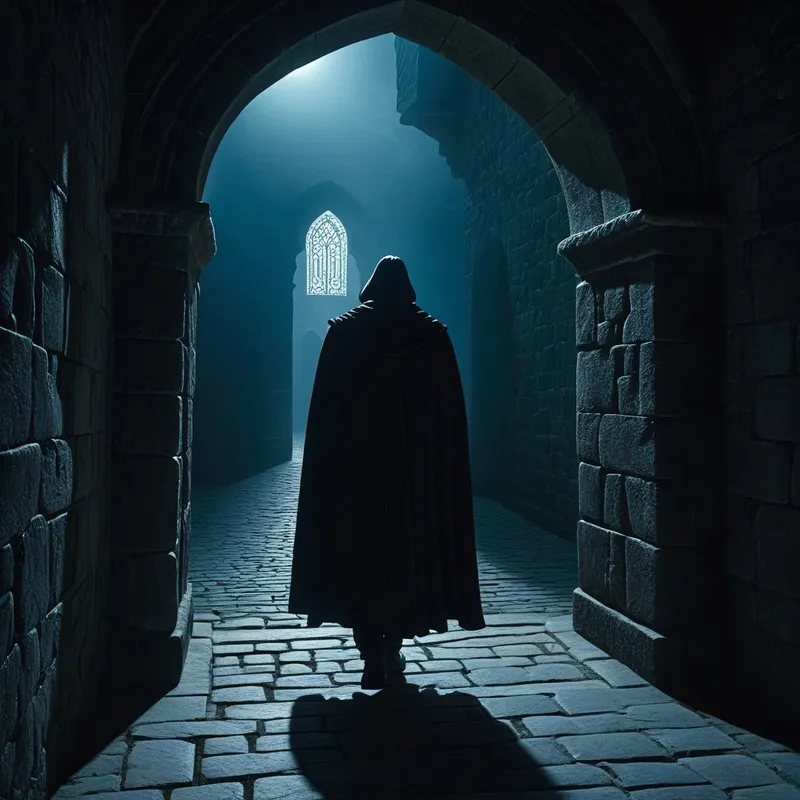
The end came not with a shout, but with a discovery. The jealous knight Sir Mordred, ever watching from shadows of his own making, found the secret path. He saw the crushed grass, the snapped lily, the intimate disorder of a shared space. He did not see the sanctuary, the soul, or the love. He saw only evidence. The bower was no longer a secret; it was a crime scene. Its exposure tore the delicate veil between the private and the political, unleashing accusation, war, and the slow, tragic crumbling of the golden age of Camelot. The garden was trampled, the woven walls torn asunder, not by an army, but by the cold, public gaze of a betrayed kingdom.
Cultural Origins & Context
The motif of Guinevere's Bower is not a single, codified myth from one text, but a haunting refrain woven through the later tapestry of Arthurian romance, particularly in the works of Chrétien de Troyes and the sprawling Middle English Stanicic poems. It emerges as the tradition deepens its psychological interest in the characters, moving from chronicles of battles to explorations of interior conflict.
In a culture where a queen's body was a symbol of the land's integrity and her behavior a direct reflection of the king's authority, the concept of a private, autonomous space for her was radical. The bower was a narrative device that allowed medieval poets to give Guinevere an interiority otherwise denied her by her symbolic function. It was passed down not in law books, but in courtly romances read aloud in noble halls, serving as a thrilling, dangerous fantasy of private emotion and agency within a rigidly public world. Its societal function was complex: it simultaneously condemned the adultery that sprung from it, yet secretly valorized the intense, personal authenticity the space represented—a tension at the very heart of the courtly love tradition.
Symbolic Architecture
At its core, the bower is the archetypal Temenos, a sacred precinct walled off from the collective. It symbolizes the authentic self in its nascent, vulnerable state—the parts of our psyche we cultivate away from the roles society imposes (the Queen, the Knight, the Leader).
The bower is the soul's private chamber, where the costumes of persona are hung upon the thorny rose, and the face we never show the world is washed in the spring of our own making.
The act of concealing it is not merely about hiding a transgression, but about protecting something too tender for the harsh light of collective judgment. The bower's location, deep in the forest, connects it to the untamed, instinctual realm of the Silva, as opposed to the civilized, conscious order of Camelot (the Civitas). Guinevere's journey to it is a symbolic descent into the personal unconscious. The tragedy is that when the hidden content (her love for Lancelot) is violently dragged into the collective sphere before it has been consciously integrated, it destroys both the private sanctuary and the public order. The bower thus embodies the perilous necessity and the profound risk of cultivating a true self within a world of duty and expectation.

The Dreamer's Resonance
To dream of Guinevere's Bower is to dream of one's own secret garden. The dreamer may find themselves in a hidden, beautifully overgrown room, a locked garden, or a secluded forest glade they feel is "theirs." This is a dream of the nascent Individuation.
Somatically, it often accompanies a feeling of deep peace mixed with anxiety—the bliss of solitude and authenticity, shadowed by the fear of discovery. Psychologically, the dream signals a stage where the ego is consciously tending to previously neglected or repressed aspects of the personality. Is the bower in your dream thriving or dying? Is it invaded? The condition of the space reflects the state of this inner work. Dreaming of being discovered in the bower points to the acute fear of vulnerability, of having one's fragile, real self judged and rejected by the "court" of family, peers, or society. The dream is the psyche's way of staging the central drama between self-care and self-revelation.

Alchemical Translation
The myth models the alchemical Opus—the great work of psychic transmutation—with devastating clarity. The bower is the Vas Hermeticum, the sealed vessel where the raw matter of the soul (Guinevere's un-queened self) is left to ferment and transform.
The first stage of the work is always concealment: the creation of a protected space where the base metal of our conditioned identity can soften and begin to change, away from the oxidizing air of public opinion.
The love affair with Lancelot represents the necessary, often chaotic, union of opposites within that vessel (conscious and unconscious, duty and desire, persona and shadow). This is the coniunctio. The catastrophe of exposure by Mordred is the premature breaking of the vessel. In psychological terms, this is the eruption of unconscious contents into consciousness in a raw, undigested form—a psychotic break, a devastating shame attack, a reactive life decision made from exposed vulnerability. It destroys the transformative process.
The alchemical lesson for the modern individual is not to avoid having a bower, but to be the fierce guardian of its boundaries. The work of individuation requires that sacred, private space. The triumph is not in never sharing its contents, but in choosing when and how to integrate what has been nurtured there into the wider "kingdom" of one's life, from a place of strength and sovereignty, not from a place of forced exposure. One must become both the tender gardener of the bower and the wise ruler of Camelot, learning to let the two realms communicate without one destroying the other.
Associated Symbols
Explore related symbols from the CaleaDream lexicon: