Guinevere Myth Meaning & Symbolism
The queen of Camelot, whose heart's choice between king and knight reveals the eternal conflict between duty and desire, order and chaos.
The Tale of Guinevere
Hear now the tale of the Flower of Britain, she for whom kingdoms were forged and shattered. In the high summer of Logres, when the sword was drawn from the stone and a new sun rose over the land, there was a queen. Guinevere. Her beauty was not merely of face, but of a spirit that mirrored the land itself—fertile, fierce, and bound by deep, ancient laws. She came to Arthur Pendragon as the final jewel in his crown, a binding of the old royal bloodlines to his new, hard-won throne. Camelot, that shining citadel of justice and order, was built as much for her as by him; its high white towers were to be the flawless setting for its flawless queen.
For a time, the dream held. The Round Table gleamed, justice flowed from the court like a clear river, and the queen presided over a court of poetry and pageantry. The air in the great hall smelled of rushes, beeswax, and hope. Yet within the queen’s bower, a colder wind sometimes stirred. Her duty was a magnificent, gilded cage. She was the heart of the kingdom, yet her own heart beat to a rhythm older than law, a pulse as wild as the forest beyond Camelot’s orderly fields.
Then came the storm in the form of a man, the greatest of knights. Lancelot du Lac, whose prowess was matched only by the intensity of his soul. When their eyes first met in the crowded hall, it was not a meeting but a recognition, as if two halves of a sundered song had found their chord. What began as courtly admiration became a secret, torrential river flowing beneath the stone foundations of the kingdom. Their love was a stolen sacrament, conducted in whispered words in the garden, in glances across the crowded hall that carried the weight of a vow. It was a treason not of malice, but of overwhelming authenticity, a force that proved stronger than any oath sworn on a relic.
The golden facade cracked. The whispers began, slithering like serpents through the court, nurtured by the envy of lesser men like the venomous Mordred. The inevitable accusation fell, the trial by combat was demanded, and Lancelot, in his desperate fidelity to the queen, fought for her honor and in doing so, exposed their truth. He rescued her from the pyre, a knight against the world, but in that violent salvation, he shattered the Table. Arthur, the king bound by his own laws, was forced to pursue them. The fellowship was broken, brother turned against brother on the field of Camlann.
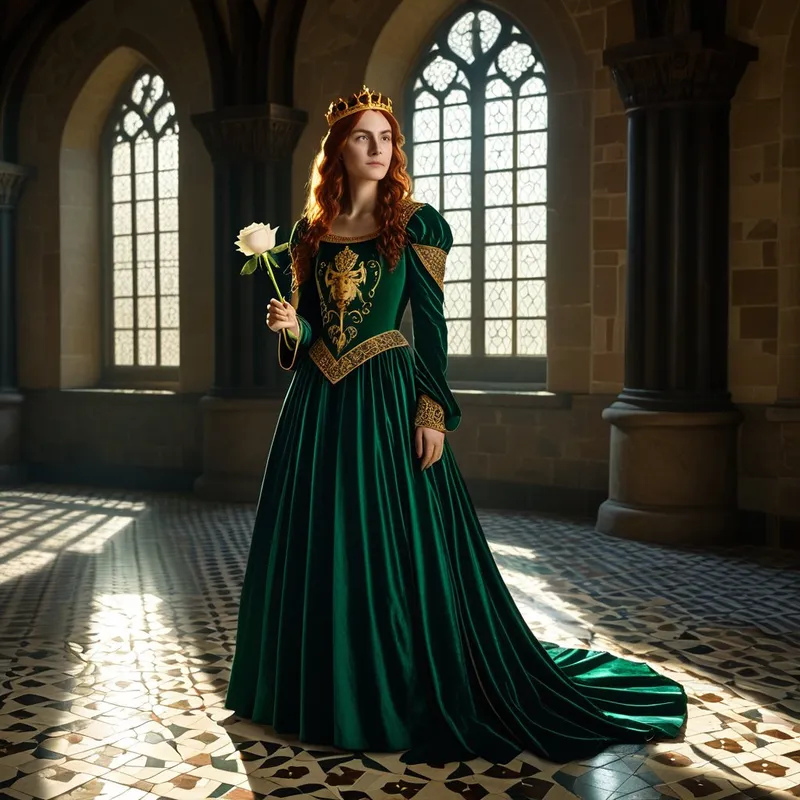
In the ashes, Guinevere’s story finds its final transformation. With Arthur mortally wounded and borne away to Avalon, and Lancelot returning too late, a ghost of his former glory, the queen disappears from the world of courts and crowns. She enters the stark silence of the nunnery at Amesbury. There, no longer a symbol or a prize, she kneels on cold stone. She trades emerald silks for rough wool, the adoration of a court for the contemplation of a single, flickering candle flame. When Lancelot comes at last, finding her a holy abbess, they meet not as lovers, but as penitents. Their final farewell is a renunciation spoken in tears, a closing of the circle. She remains, ruling now only her own soul, until her death, when she is laid to rest beside her king, a queen in eternity if not in life.

Cultural Origins & Context
The figure of Guinevere is woven from many threads, emerging from the shadowy borderland between Welsh folklore, French romance, and English chronicle. Her earliest likely roots lie in Celtic sovereignty mythology, where the king’s right to rule was sacramentally married to the goddess of the land. Guinevere, whose name may derive from the Welsh Gwenhwyfar meaning "White Fairy" or "White Phantom," carries this numinous, land-linked quality. She is less a documented historical person than an evolving archetype, shaped by the needs and anxieties of the cultures that told her story.
The tale was primarily carried and transformed by the bards and conteurs of the 12th and 13th centuries, most notably Chrétien de Troyes. Writing for the courts of France, Chrétien and his successors infused the older Celtic matter with the complex code of courtly love. In this context, Guinevere became the ultimate object of knightly devotion, the queen whose favor was the highest reward, yet whose love inherently created a catastrophic conflict with feudal duty to the king. The story served as a thrilling, dangerous thought-experiment for aristocratic audiences, exploring the tensions between personal desire and social obligation, between the heart’s law and the kingdom’s law. Later, English authors like Sir Thomas Malory codified these threads into the tragic, national epic of rise and fall, where Guinevere’s role as the catalyst for the kingdom’s destruction was solidified.
Symbolic Architecture
Guinevere is not merely a character but a living symbol of the anima within the psychic kingdom of Camelot. Camelot itself represents the conscious ego’s striving for perfect order, justice, and control—a magnificent but ultimately rigid structure.
The queen is the soul of the kingdom, and when the soul is not honored, the kingdom must fall.
Arthur, as the ruling ego-consciousness, wins his throne through strength and principle but "acquires" his anima (Guinevere) as part of his royal identity, not through a deep, conscious relationship. She is a function of his kingship, not its partner. Lancelot represents the untamed, passionate depth of the shadow and the contrasexual soul-image. His unparalleled skill and moral complexity embody all that is exceptional, instinctual, and dangerous to the established order. The love affair, then, is the inevitable, often devastating, connection between the neglected soul (Guinevere) and the powerful, unconscious contents (Lancelot) that the ruling consciousness has failed to integrate.
The final retreat to the nunnery is profoundly symbolic. It represents the withdrawal of the anima from external projection and drama into the interior castle of the soul. It is a movement from being the cause of conflict to becoming the container of transformation through solitude, introspection, and a harsh, personal accountability.
The Dreamer's Resonance
To dream of Guinevere is to encounter a constellation of feeling related to divided loyalty, forbidden longing, and the cost of authenticity. One may not dream of a queen in a medieval gown, but of a situation where one is torn between a "right" choice that feels sterile or dutiful (the King/Arthur) and a "wrong" choice that feels electrically alive and deeply resonant (the Knight/Lancelot). This often manifests in dreams of being caught between two partners, two careers, or two core identities.
Somatically, this can feel like a literal heartache, a tightening in the chest, or a sensation of being split down the middle. Psychologically, the dreamer is likely grappling with a profound inner conflict where a part of the self that has been consigned to the shadows (a passion, a creativity, a wildness) is demanding recognition and integration, threatening to upend a carefully constructed life of "shoulds" and obligations. The dream is a signal that the psyche’s sovereignty is at stake; the ruling attitude of the conscious mind is being challenged by the soul’s deeper needs.

Alchemical Translation
The myth of Guinevere models the painful but necessary alchemy of individuation, specifically the stage of mortificatio—the death of an old, outworn psychic structure to make way for new life. Camelot’s fall is not a meaningless tragedy but the necessary dissolution of an immature paradise, a consciousness that believed it could achieve wholeness through perfection and suppression.
The true throne is not made of gold and order, but of the reconciled fragments of a shattered heart.
The process begins with the nigredo, the blackening: the darkening of the perfect dream through betrayal, exposure, and the eruption of the shadow (the scandal, the battle). This is a descent into guilt, shame, and chaos. The albedo, the whitening, is symbolized by Guinevere’s retreat to the nunnery—a purification through radical simplification, solitude, and the burning away of persona. She ceases to be the object of desire or blame and becomes the subject of her own redemption.
Finally, the rubedo, the reddening, is not a return to Camelot, but the achievement of a different kind of sovereignty. It is the integration witnessed in her final, mature meeting with Lancelot and her eventual burial beside Arthur. The opposites—duty and desire, king and knight, law and love—are not reconciled in life, but in the perspective of death and eternity. For the modern individual, this translates to the hard-earned wisdom that follows a life-shattering conflict. It is the ability to hold one’s own complex history without collapsing into self-justification or eternal penitence, to become the ruler of one’s own inner kingdom by having lived through, and taken responsibility for, its glorious and catastrophic civil war. The integrated self is not the perfect ruler of a shining city, but the humble monarch of a rich, scarred, and authentic interior landscape.
Associated Symbols
Explore related symbols from the CaleaDream lexicon: