Griffin Myth Meaning & Symbolism
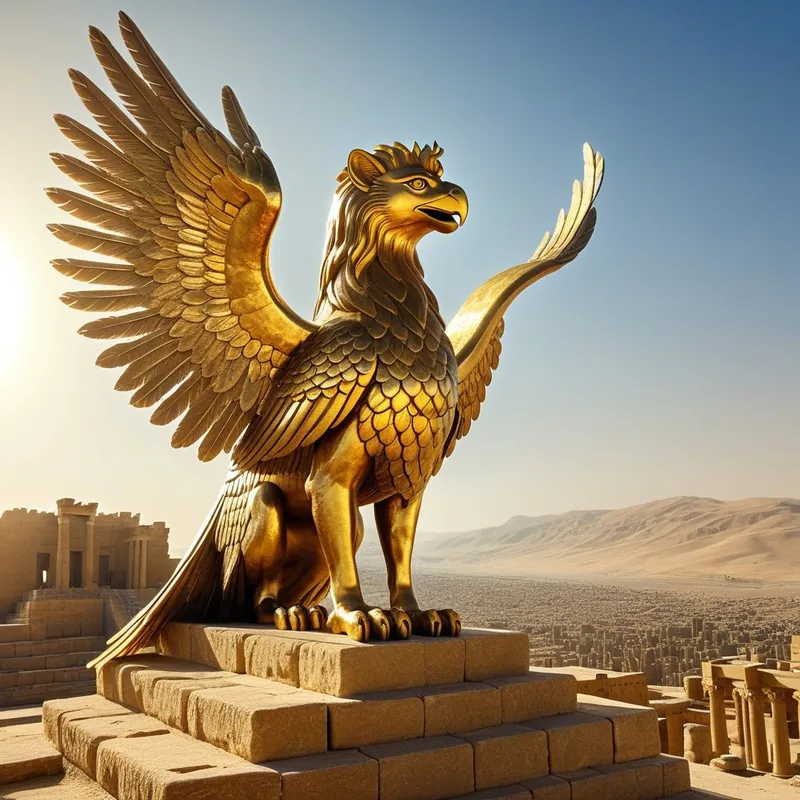
The Homa, a Persian Griffin, is a mythical bird-lion hybrid, a celestial guardian of divine grace, justice, and the sacred threshold between heaven and earth.
The Tale of the Homa
Let your mind travel back, to when the world was younger and the air hummed with older magics. In the high, silent places where the earth scrapes the belly of the sky, where the sun forges the rocks into gold and the wind carries the scent of distant, impossible oceans, it makes its home. It is the Homa.
Listen.
It does not hunt as the lion hunts, nor does it scavenge as the eagle might. It is a creature of essence, not of appetite. Its nourishment is the light of the sun, the clarity of the mountain air, the whispered prayers that rise from the plains below. It is said that to even glimpse its shadow passing over you is to be blessed for a lifetime—a cascade of fortune, a mantle of protection. To be touched by a feather that falls from its wing is to be anointed, marked for a destiny greater than yourself.
But the Homa is not merely a bestower of gifts. It is the guardian of the sacred threshold. In the deepest canyon, where two worlds breathe against each other—the world of form and the world of spirit—it perches. Its lion’s paws, rooted in the firmament of the mountain, hold the earth steady. Its eagle’s eyes, sharper than a diamond’s edge, scan the horizons of both realms. It allows passage only to those whose hearts are in alignment, whose intentions are as clear as the mountain spring. To the deceitful, the arrogant, the cruel, its presence is a wall of silent, immovable force. Its cry is not heard with the ear, but felt in the bone—a vibration that tests the integrity of the soul.
There is a story, whispered by firelight, of a proud king who sought the Homa’s feather to place in his crown, believing it would cement his rule for ten thousand years. He climbed the impossible peaks with an army of servants, cutting paths where none existed. When he finally stood before the vast alcove where the Homa rested, he demanded his prize as a ruler demands tribute. The Homa simply looked at him. It did not speak, but in that look, the king saw the true scale of his kingdom—a tiny, fleeting stain on the endless tapestry of time. He saw the fragility of his walls, the vanity of his name. He left the mountain a different man, ruler not of lands, but finally, of his own self. The blessing he received was not the one he sought, but the one he needed.
The Homa’s greatest mystery is its death. It is said that when its time in this cycle is complete, it does not fall. It ascends to the highest thermal, folds its wings, and immolates itself in a burst of pure, silent flame. From the ashes, a new Homa is born instantly, more radiant, more potent. Its cycle is not one of decay, but of perpetual renewal—a death that is not an end, but a refinement.
Cultural Origins & Context
The Griffin, known most profoundly in Persian lore as the Homa (also Simurgh in later epic poetry), is not a monster of fable but a pillar of cosmic symbolism. Its origins are etched into the spiritual landscape of ancient Iran, woven through Zoroastrian cosmology, royal iconography, and the epic narratives of poets like Ferdowsi in the Shahnameh.
Functionally, the Homa served multiple layers of societal meaning. For kings and emperors, its image—lion and eagle combined—was the ultimate emblem of legitimate sovereignty, embodying both the lion’s terrestrial power and the eagle’s celestial authority. It was the divine right to rule, made manifest in myth. For the common person, the Homa was a benevolent, almost karmic force. Its shadow-blessing represented the hope for divine grace (Farr) that could fall upon anyone, regardless of station, rewarding purity and effort. It was passed down not just in formal texts, but in oral traditions, on the rugs woven by artisans, and in the glazed tiles of palaces, making it a ubiquitous presence in the Persian imaginative world.
Symbolic Architecture
The Griffin is a perfect archetype of synthesis. It is the ultimate resolution of duality, a sacred hybrid that transcends the sum of its parts.
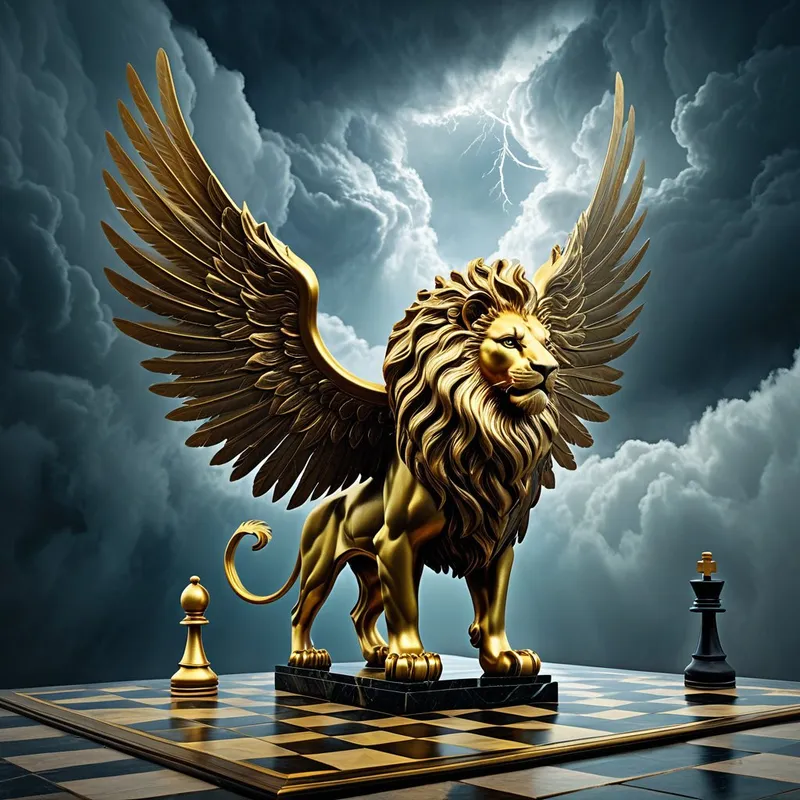
The lion is the grounded self, the ego, raw power, and earthly passion. The eagle is the soaring spirit, the intellect, vision, and connection to the divine. The Griffin is the sovereign self that has integrated both.
Psychologically, it represents the achieved state of individuation where our instinctual nature (the lion) and our spiritual aspirations (the eagle) are not at war, but are fused into a single, purposeful entity. The lion’s domain is the "below"—the unconscious, the body, the drives. The eagle’s domain is the "above"—consciousness, ideals, the super-ego. The Homa, perched on the mountain pass, is the Self that guards the passage between these two realms within us. It allows for conscious traffic only when the ego is in service to the whole, preventing the inflation of spirit or the tyranny of brute instinct.
Its death-by-fire and instant rebirth is the core symbol of alchemical transmutation. It represents the process where an old, outmoded structure of the self must be willingly sacrificed in a crucible of intense experience (suffering, insight, ordeal) to be reborn as a more authentic, resilient, and enlightened form.
The Dreamer's Resonance
When the Griffin, the Homa, enters modern dreams, it signals a critical juncture in the dreamer’s psychic development. It is not a casual visitor.
To dream of seeing its distant, majestic form often coincides with a feeling of being at a life threshold—a career change, a spiritual awakening, the end of a relationship. The Homa watches, assessing readiness. To dream of being blocked by it, or feeling its intimidating, silent pressure, suggests the dreamer is attempting to cross an inner boundary with unintegrated motives—perhaps spiritual bypassing (the eagle alone) or forceful, ego-driven ambition (the lion alone). The somatic feeling is often one of awe mixed with frustration, a literal "standing at a gate."
The most potent dream is to be blessed by its shadow or a falling feather. This typically follows a period of sincere inner work or a painful but necessary sacrifice. The psychological process here is the granting of internal legitimacy. The dreamer’s unconscious is conferring a sense of earned grace, the "right to rule" their own inner kingdom with newfound wisdom and authority. The feeling upon waking is often profound calm and solidified purpose.
Alchemical Translation
The myth of the Homa provides a precise map for the alchemical opus of the soul, the journey toward psychic wholeness.
The first stage, Nigredo, is the recognition of our fragmented state: we feel the pull of the earthy lion (desires, anger, survival fears) and the lofty eagle (spiritual longing, intellectual pride) as separate, often conflicting forces. This is the desert the traveler crosses before seeing the Homa.
The Albedo, the whitening, is the ascent to the mountain pass—the conscious effort to bring these opposites into dialogue through introspection, therapy, or creative expression. We approach the guardian.
The Griffin itself is the symbol of the Coniunctio Oppositorum—the sacred marriage of opposites. Its very existence is the goal.
The Rubedo, the reddening or glorious stone, is the moment of integration. This is not merely balance, but fusion. It is the king humbled before the Homa, his false sovereignty dissolved so true inner sovereignty can be born. The lion’s strength becomes the grounded power to manifest will in the world. The eagle’s vision becomes clear, compassionate insight, free from inflation. The self that emerges guards its own thresholds wisely, knowing what to let in and what to keep out.
Finally, the Homa’s fiery death and rebirth is the Citrinitas, the yellowing, representing the ongoing nature of this work. Each achieved state of wholeness is not final. Life will present new challenges that require the old, now-rigid form of the self to be willingly surrendered to the flames of new experience, to be reborn again, more refined. The process is cyclical, eternal, and each iteration grants a greater capacity to hold the divine tension of being both creature and creator, fully earthly and fully divine. The Persian Griffin, therefore, is not just a myth of power, but a timeless manual for becoming sovereign of your own soul.
Associated Symbols
Explore related symbols from the CaleaDream lexicon: