Great Year Myth Meaning & Symbolism
A cosmic cycle where the constellations realign, the world is cleansed by fire and flood, and humanity is reborn from the ashes of the old age.
The Tale of Great Year
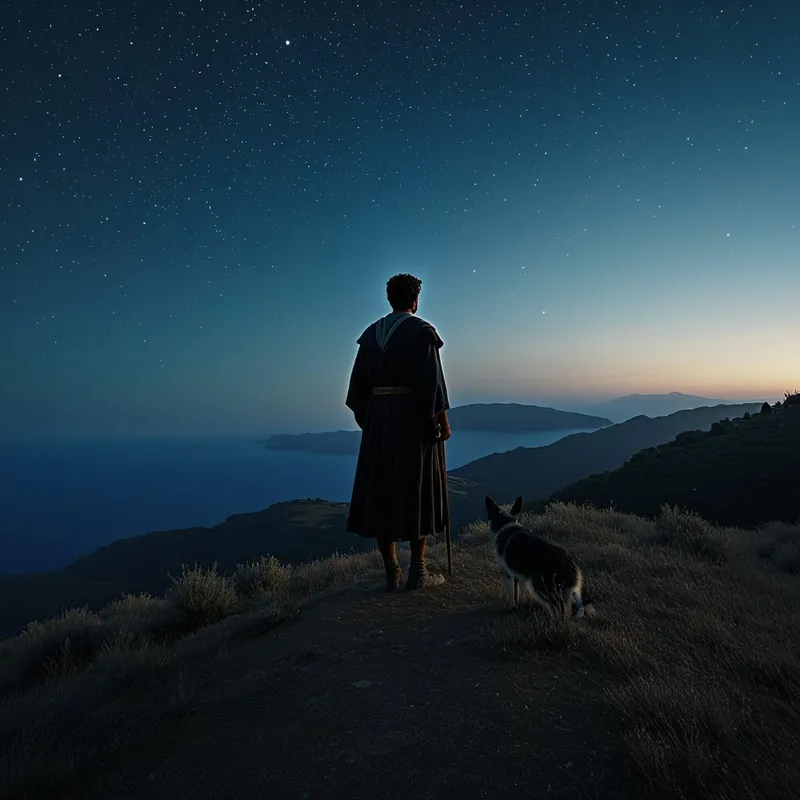
Listen. The air grows heavy, not with storm, but with a silence that has weight. The shepherd on the hillside feels it first—a prickling on his neck, a wrongness in the wind. He looks up. The familiar friends of the night, the Bear and the Hunter, seem to tremble in their fixed places. It is a shudder that travels down the spine of the world.
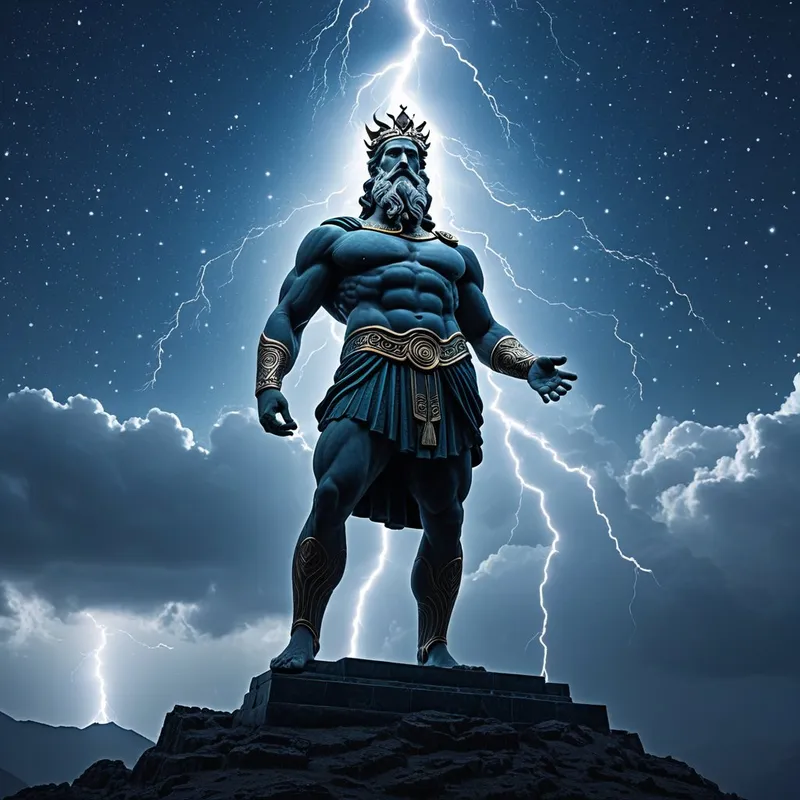
For this is no ordinary night. This is the turning. The Great Year draws to its close. High on Olympus, Zeus stirs. His gaze, which usually sweeps over the petty quarrels of men, now fixes on the celestial vault. He sees the slow, grinding dance that mortals cannot perceive—the wobble of the world itself. The point where the sun rises at the spring equinox has crept, degree by stolen degree, through the house of the Ram, through the Fishes, and now… it hesitates on the threshold. The cosmic clock’s final grain of sand is about to fall.
A sigh escapes the lips of the gods, a sound like the wind leaving a forest. It is time. Zeus raises his hand, not in anger, but in profound, terrible necessity. A single bolt of lightning, pure and white, arcs from his fist. It does not strike a city or a proud king. It strikes the heart of the sky. The constellations themselves scream in silent friction. The firmament cracks.
Then comes the fire. Not a wildfire, but a celestial conflagration. Helios, in his chariot, drives not across the sky but through it, his horses maddened, the sun’s disc blazing with a heat that does not warm but consumes. The seas boil away into steam. The mountains flow like wax. Every work of human hand, every temple, every scroll, every whispered prayer turns to ash and is carried upward on a great, hot wind.
When the last stone has melted and the last echo of life has faded, Zeus nods to his brother, Poseidon. From the depths of the abyssal plain, a groan answers. The waters that were steam now return, condensing into a deluge that has no beginning and no end. It falls for an eternity, quenching the fire, cooling the stone, until the world is a perfect, smooth sphere of water under a blank, starless sky.
And in that silence, in that perfect void, something remains. Not a thing, but a potential. A memory held in the mind of the cosmos. From the mud of the new ocean floor, from the mingled ash of all that was, a new seed stirs. The Golden Seed of humanity, planted at the dawn of time, splits open. New life, innocent and unburdened by the sins of the previous age, crawls onto the fresh shores. The stars slowly reappear, not where they were, but shifted. A new constellation now marks the spring equinox. The Great Year has turned. The world, scoured clean by absolute catastrophe, is born again, and the long, slow climb toward wisdom and folly begins once more.
Cultural Origins & Context
The concept of the Great Year, or Annus Magnus, was not a single, standardized myth told in epic verse, but a profound philosophical and cosmological idea woven through Greek thought. It finds its most articulate expressions in the works of philosophers like Plato and Heraclitus, and in the astronomical observations of figures like Hipparchus, who identified the precession of the equinoxes.
This was not a story for the marketplace, but for the symposium and the academy. It was a myth for thinkers, a narrative framework to explain the observable, yet glacially slow, drift of the heavens against the calendar of human affairs. Its societal function was to provide a cosmic scale for history and ethics. It answered the haunting question: does civilization have an eternal, linear trajectory, or does it move in vast, repeating cycles of growth, hubris, destruction, and rebirth? For the Greeks, it was decidedly the latter. The myth served as the ultimate memento mori not for a person, but for an entire age, tempering human pride with the humbling vision of a universe that periodically resets itself.
Symbolic Architecture
At its core, the Great Year is the archetype of the complete cycle. It symbolizes the necessary death that precedes any true renewal. It is not merely change, but cataclysm followed by genesis.
The cosmos does not renovate; it incinerates and reconceives. The psyche, in its deepest transformations, follows the same ruthless, creative law.
The fire and flood are not arbitrary punishments, but complementary cleansing agents. Fire represents the purgative, spiritual force—the burning away of old forms, rigid structures, and accumulated karma. Flood represents the dissolution of boundaries, the return to the primordial, undifferentiated state—the womb of potential from which new life can emerge. Zeus and Poseidon, sky and sea, represent the two great, opposing elemental forces that must collaborate in the work of cosmic rebirth.
Psychologically, the entity of the Great Year represents the Self in its most transcendent aspect—the part of the psyche that orchestrates the total disintegration and reintegration of the personality. It is the inner imperative that, when the old "age" of our identity becomes corrupt, stagnant, or false, arranges a profound crisis to make way for a more authentic existence.
The Dreamer's Resonance
When this myth stirs in the modern unconscious, it does not manifest as a literal dream of stars falling. Instead, it appears as dreams of total, world-ending personal transformation. The dreamer may experience:
- Dreams of apocalyptic landscapes: Visions of their childhood home burning down or being submerged, symbolizing the end of their foundational psychic structures.
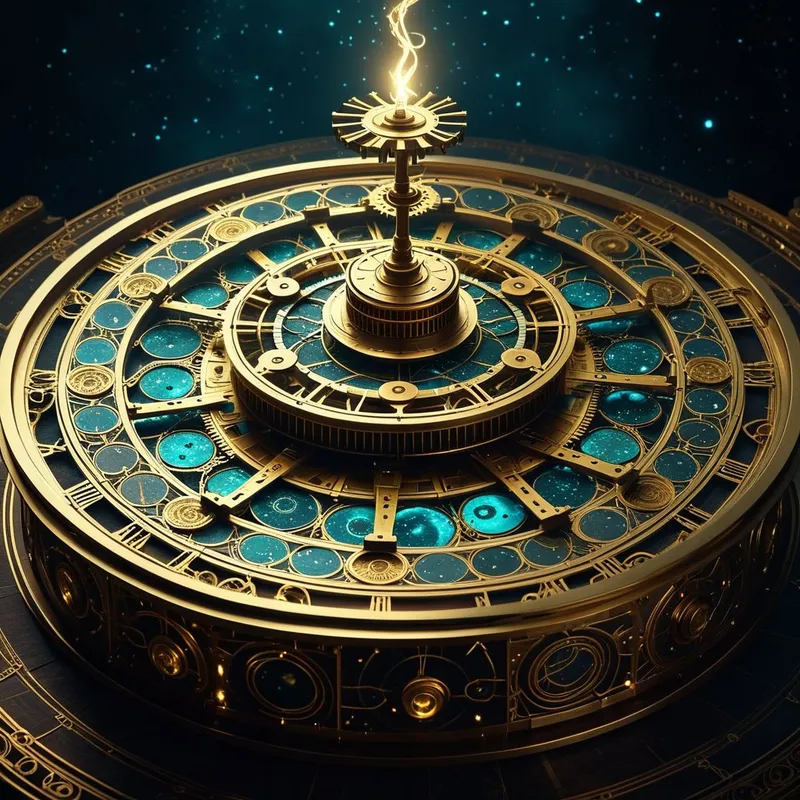
- Dreams of cosmic clocks or gears: Images of immense, slow-turning machinery in the sky or deep underground, indicating the perception of a vast, impersonal psychological process underway that is beyond their conscious control.
- Dreams of being the sole survivor, watching a city vanish, then walking into a blank, new wilderness. This is the somatic feeling of the ego witnessing the collapse of its familiar world (relationships, career, identity) and the terrifying, open potential of what comes next.
The psychological process is one of deintegration—the deliberate, often painful, breaking apart of a consolidated personality so that it may reconstitute itself at a higher level of complexity and authenticity. The dreamer is in the floodwaters, feeling everything they knew dissolve.

Alchemical Translation
The alchemical journey mirrored in the Great Year is the Opus Magnum—the Great Work—of the soul. For the modern individual seeking individuation, the myth provides a map for navigating the most profound personal revolutions.
First comes the Nigredo, the blackening, represented by Zeus's fire. This is the conscious crisis: the depression, the burnout, the shocking failure, the "dark night of the soul" that reduces the ego's carefully constructed world to ashes. It feels like annihilation.
Next is the Albedo, the whitening, symbolized by Poseidon's flood. After the fire, a great emotional release—tears, grief, surrender—washes over the psyche. This is the dissolution of ego boundaries, a return to a state of receptive openness. It is a watery, reflective state where one confronts the blank slate of possibility.
The triumph of the myth is not in avoiding the conflagration, but in understanding that you are both the city that burns and the seed that sleeps in the universal ash.
From this fertile mud emerges the Citrinitas, the yellowing, and finally the Rubedo, the reddening—the birth of the new, golden race of humanity within the self. This is the dawn of a new psychological "age." The individual operates from a renewed center, having integrated the lessons of the previous cycle. Their values, perspectives, and life are realigned, just as the equinox shifts to a new constellation. The process is never final; the gears keep turning. But to have consciously lived through one Great Year of the psyche is to learn the sacred rhythm of death and rebirth, and to find courage not in permanence, but in the eternal, creative return.
Associated Symbols
Explore related symbols from the CaleaDream lexicon: