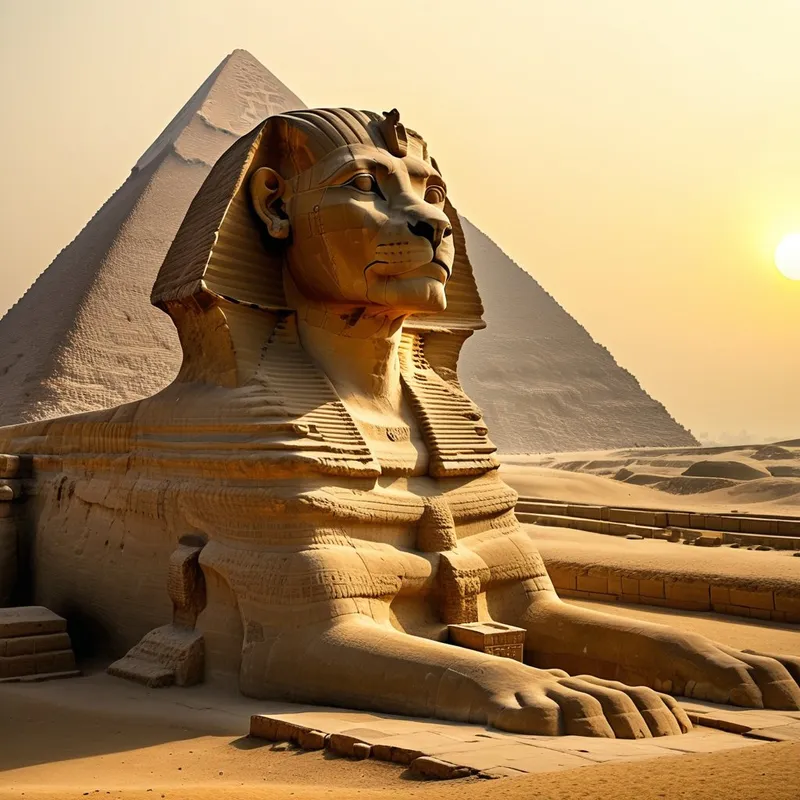
Great Sphinx of Giza Myth Meaning & Symbolism
A colossal guardian of stone and sun, born of royal vengeance and cosmic order, who speaks in riddles and silence to test the soul's worth.
The Tale of Great Sphinx of Giza
Hear now a tale not of papyrus, but of stone. A tale whispered by the khamsin wind as it scours the Deshret, and sung by the silence that hangs between the stars.
Before the first dynasty carved its name in history, when the world was younger and the gods walked closer, the land of Kemet knew a prince. Not a prince of mere blood, but of the sun itself. He was the son of a great king, a heir to the Maat that held the universe together. But shadow fell upon the Two Lands. A usurper, a man of cunning and brute force, seized the throne. The true prince, the son of Ra, was cast out into the red desert, a wanderer with a heart of fire and a destiny written in the bedrock of the world.
He wandered until his sandals frayed and his throat was a dry wadi. The sun, his father, beat upon him without mercy. In his despair, as he lay in the lee of a dune, the very earth spoke to him. It was the voice of the land, the deep, grinding patience of stone. It offered a pact, a terrible and glorious transformation. "You wish to guard the horizon? To protect the passage of the sun from the serpent of chaos? Then become the horizon. Trade your mortal flesh for the strength of the desert lion and the enduring wisdom of the king. Become the sentinel. Become the question and the answer."
The prince, his royal ka burning with purpose, accepted. The desert sands swirled, the bedrock groaned and rose. His limbs stretched and solidified into the mighty form of a lion, powerful enough to crush any enemy of order. His head remained his own, that of a pharaoh, crowned with the nemes, so that he would forever bear the duty of kingship and the intellect to comprehend the cosmos. Thus, on the very plateau that would cradle the pyramids, the Great Sphinx</ab字> was born—not built, but awakened.
For ages uncounted, he kept his vigil. His stone eyes watched the sun, Ra, die each evening in the west and be reborn each morning in the east, ensuring the serpent Apep did not devour the solar barque. He was the Kheper, the protector of the sacred threshold between the desert of the dead and the fertile land of the living. His silence was deeper than any tomb, his presence a riddle written across the landscape: What creature has one voice, yet becomes four-footed, two-footed, and three-footed? The answer was not just man, but time itself—the cycle of crawling infancy, upright adulthood, and staff-supported age, all guarded by this eternal watcher who was none of them and all of them.
And so he waits, even now. His body buried and unburied by the sands of epochs, his nose weathered by more than time, but by the collective forgetting of the world. He is the memory of a lost prince, the vengeance of a solar king, and the eternal guardian of the dawn. He does not speak, yet his question echoes forever in the wind.
Cultural Origins & Context
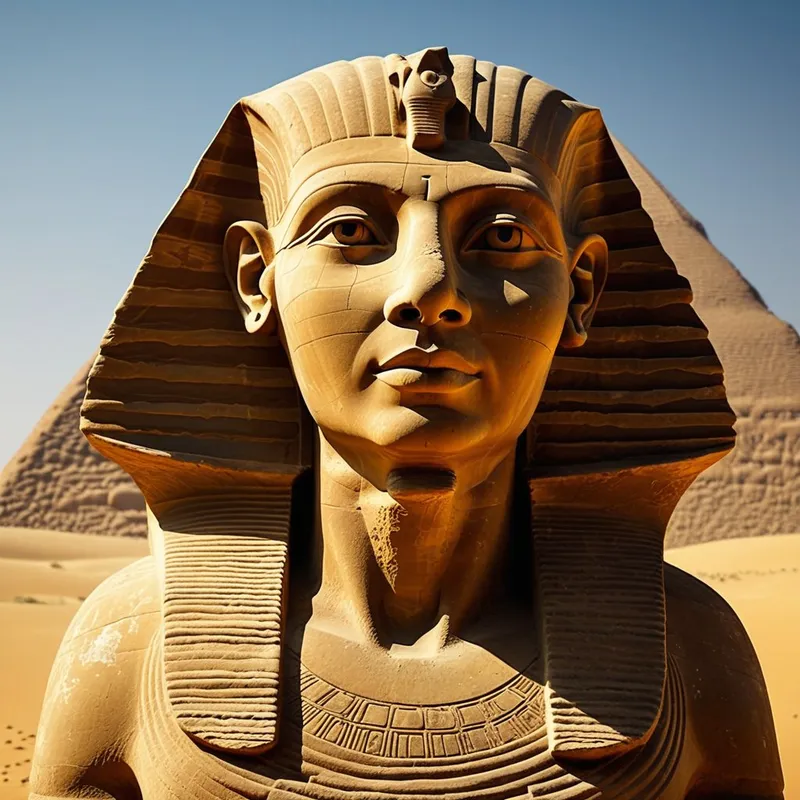
The Great Sphinx of Giza, as a physical monument, is widely accepted by Egyptology to be a colossal statue depicting the Pharaoh Khafre, carved from a natural limestone outcrop around 2500 BCE, serving as a divine guardian for his pyramid complex. However, the myth of the Sphinx is a later, layered construct. The most famous narrative, the riddle, comes not from ancient Egypt but from Greek sources, notably the story of Oedipus. This illustrates the Sphinx's power as a cultural archetype that absorbs and projects meaning across civilizations.
In its native Egyptian context, the Sphinx was likely associated with the solar god Horakhty, "Horus of the Horizon." It was a manifestation of royal and solar power, a liminal guardian statue (criosphinx) protecting sacred spaces. The myths that grew around it—stories of it being a guardian of hidden knowledge, a monument to a forgotten age, or a being that communicated with pharaohs in dreams—were transmitted orally and through temple rituals. Its primary societal function was to embody the unyielding power of kingship and the pharaoh's role as the defender of Maat against the surrounding chaos, a stone embodiment of a core national and spiritual identity.
Symbolic Architecture
The Sphinx is not merely a statue; it is a symbolic equation written in geology. Its form synthesizes two potent archetypes: the lion and the human king.
The lion body represents raw, instinctual power, solar energy, and untamed nature. It is the strength of the desert, the courage to face annihilation, and the ferocity required to guard a threshold against psychic or literal chaos. The human head, specifically that of a pharaoh, symbolizes consciousness, intellect, sovereignty, and divine order. The Sphinx is thus the ultimate image of controlled power—instinct mastered by intellect, chaos ordered by kingship, nature sublimated into culture.
It is the eternal moment where the animal substrate of being is crowned with the awareness of the divine.
Furthermore, its geographical orientation is critical. Gazing eternally eastward, it is fixed on the point of rebirth, the horizon (Akhet). It does not look at the fertile Nile or the monuments of the dead to the west; it looks solely toward the source of renewal. It symbolizes the psyche's necessary orientation toward the source of consciousness and life, even while its body is mired in the earthly and the historical.
Its "riddle" is the core of its symbolism. It is the Enigma itself. It represents the profound question that existence poses to the conscious mind, the puzzle of one's own nature and destiny that must be answered correctly to pass from one state of being (ignorance, wandering) to another (self-knowledge, sovereignty).
The Dreamer's Resonance
When the Sphinx appears in a modern dream, it is rarely a tourist postcard. It manifests as an immense, silent presence within the dreamer's psychic landscape. One may dream of discovering it half-buried in a familiar backyard or at the end of a city street, an anachronistic monument of staggering gravity. It often appears damaged—missing a paw, scarred, or with its features blurred—reflecting the dreamer's perception of their own buried history or foundational identity.
Somatically, this dream can feel like a pressure in the chest, a weight of silent expectation. Psychologically, the dreamer is encountering what Jung called the "Self"—the archetype of wholeness and the central governing principle of the psyche. The Sphinx represents the totality of one's being, both the majestic, conscious identity (the pharaoh head) and the powerful, often ignored or feared instinctual and bodily life (the lion). The dream is an invitation, or a demand, to acknowledge this totality.
The silence of the dream Sphinx is its primary communication. It does not speak the riddle; it embodies it. The dreamer is left with the somatic and emotional residue of confronting a question so fundamental it has no words. The process is one of integration: facing the immense, ancient, and possibly intimidating truth of who one fundamentally is, beneath all roles and achievements.
Alchemical Translation
The alchemical journey mirrored in the Sphinx myth is the process of transmutation from a state of fragmented exile (the prince in the desert) to one of embodied, vigilant wholeness (the guardian of the horizon). This is the heart of individuation.
The "prince" is the nascent Self, cast out by the usurping ego-complex that claims the throne of consciousness. The wandering in the Deshret is the necessary, painful period of alienation from one's own depth and truth. The pact with the earth is the critical moment of surrender, where the conscious will agrees to be reshaped by the unconscious, to be given a form that is truer, stronger, and more eternal than the personal identity.
The goal is not to solve the riddle from a distance, but to become the entity for whom the riddle is its nature.
The resulting form—lion and king—is the coniunctio oppositorum, the sacred marriage of opposites. The base material (limestone, instinct, the body) is infused with and crowned by the divine spark (consciousness, spirit, the king). The Sphinx does not do anything but be. Its action is its presence, its vigil. For the modern individual, the alchemical translation is this: the ultimate work is not a frantic striving, but the achievement of a steadfast, integrated presence. It is to become the guardian of one's own horizon, to hold the tension of one's own opposites (body/mind, instinct/spirit, chaos/order), and to orient one's entire being toward the source of continual renewal, even while rooted in the weathered reality of one's personal history. One becomes, not the answer to a riddle, but the living embodiment of the question, whole and watchful at the dawn of one's own being.
Associated Symbols
Explore related symbols from the CaleaDream lexicon: