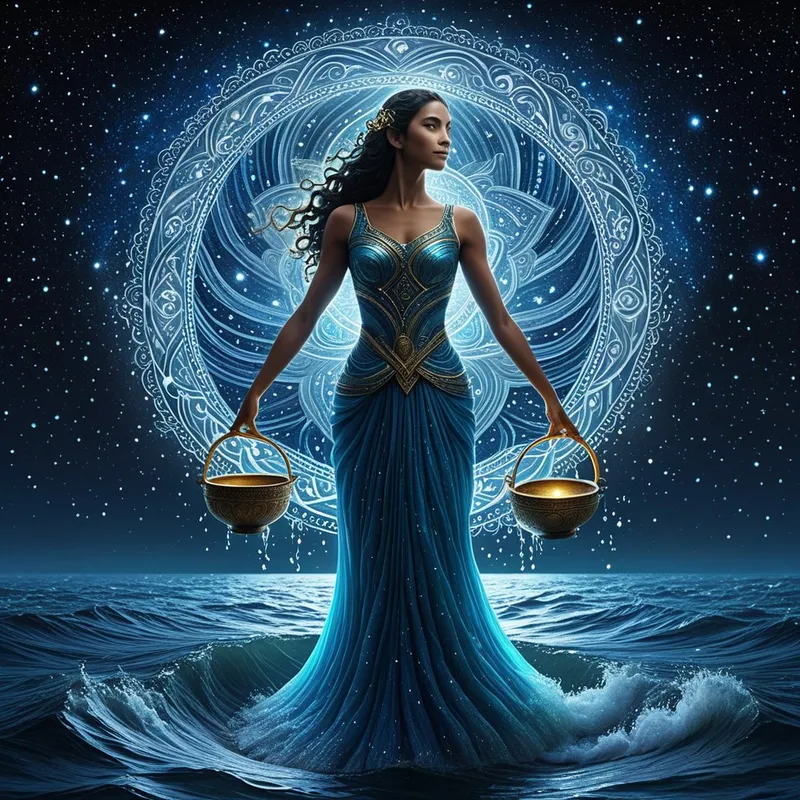
Great Mother/Water Goddess Myth Meaning & Symbolism
A primordial goddess of water embodies the source of all life, the chaos of creation, and the deep unconscious from which consciousness emerges.
The Tale of Great Mother/Water Goddess
In the time before time, there was only the dark, silent, and boundless deep. No sun pierced its gloom, no wind stirred its surface. It was the Nun, the Apsu, the Garbhodaka—a womb of infinite potential, cold and still. And within that womb, she slept. She was not yet a form, but a presence: the murmuring promise of life, the pull of the tide yet to be, the memory of rain held in a single, un-fallen drop.
Her dreaming stirred the deep. From the core of her solitude, a longing swelled—a desire not for another, but for expression. The silent waters began to churn. This was the first movement, the first sound: a deep, resonant hum that was both song and sigh. From the whirl of those dark waters, she drew herself forth. She became the vessel and the poured. She was Tiamat, whose body was the roiling, salty ocean; she was Naunet, the hidden one who encircled the world. She was the Nereid and the Ganga, descending from heaven.
Her tears became the rivers, her breath the mist and the monsoon. She laughed, and the first springs bubbled from the earth's heart. She wept in sorrow or rage, and the waters rose, swallowing the shores, reminding all of her primal power. She offered her liquid body as the crucible. Within her, the silt of chaos settled into the first mudflats. From her fertile, watery loins, the first green things pushed toward a light she herself now dreamed into being—the reflection of her own luminous consciousness on the surface of her being. All creatures swam from her, crawled onto the lands she revealed, and drank from her endless generosity. She was the source, the sustainer, and the eventual dissolver. To return to her waters was to return to the beginning, to be cradled in the ultimate, silent dark from which new dreams might one day form.
Cultural Origins & Context
This is not one myth, but the first and most persistent refrain in the human story. The Great Mother as Water Goddess appears in the earliest fragments of human expression: in the Venus figurines found near ancient springs, in the cave paintings that echo with the sound of underground rivers. She was the central reality for agricultural and riverine societies—the Hapi of the Nile, the Inanna who descended to the Kur, the Great Goddess of Old Europe.
Her stories were told not just in words but in ritual. They were enacted by priestesses at sacred wells, invoked by shamans in rain dances, and embodied in the daily journey to the river for water—the lifeline of the community. Her function was existential: she explained the origin of life, governed the terrifying and necessary cycles of flood and drought, and provided a metaphysical map of the cosmos. The world was an island in her cosmic sea; the heavens above were another ocean from which her rain descended. She was the ultimate context, the medium in which all life, and all story, floated.
Symbolic Architecture
Psychologically, the Water Goddess represents the unconscious itself—the vast, impersonal, and fertile ground of being from which consciousness (the land, the individual ego) emerges.
She is the matrix, the mater, the undifferentiated state that precedes the pain and the glory of separation.
Her waters symbolize the fluid medium of the psyche: emotions, intuition, memory, and the instinctual flow of life. They are creative and nurturing, but also chaotic and utterly indifferent. The goddess gives life freely, but she also reclaims it in the flood; she is the loving mother and the devouring womb. This dualism is not a contradiction but the fundamental nature of reality. The symbol integrates what the conscious mind often seeks to split: creation and destruction, nurture and annihilation, the personal comfort of the womb and the impersonal terror of the abyss. To relate to this archetype is to acknowledge that the source of our deepest nourishment is also the source of our deepest fears—the place where the "I" dissolves.
The Dreamer's Resonance
When this myth stirs in the modern dreamer, it often manifests as dreams of vast, ambiguous bodies of water. To dream of a calm, inviting ocean may signal a readiness to connect with the deep well of creativity or emotion. To dream of a rising flood in one's house points to an overwhelming influx from the unconscious—a surge of repressed feeling, memory, or psychic content threatening to engulf the familiar structures of the ego.
Dreams of finding a hidden spring in a cellar, or of a goddess figure rising from a lake, indicate a potent encounter with the anima or the primal feminine source. The somatic experience is key: the dreamer may feel the coolness of the water, the terror of drowning, or the profound peace of floating. These dreams mark a critical phase where the psyche is negotiating its relationship with its own foundational, autonomic processes. It is the Self signaling a need to acknowledge, and ultimately navigate, the inner sea upon which the fragile vessel of identity sails.
Alchemical Translation
The individuation process modeled by this myth is not a heroic conquest, but a sacred return and a transformative immersion. The ego, having struggled to build its dry land of identity, must now turn back to the waters it once crawled from.
The alchemical work is the solve et coagula: to dissolve the rigidities of the conscious attitude in the waters of the unconscious, and to coagulate a new, more fluid consciousness that remembers its source.
This is the "night sea journey." The modern individual must learn to sail upon the inner ocean, not as a conqueror, but as a respectful navigator. It requires surrendering the illusion of total control—allowing the old, brittle self-structures to be washed away in the flood of authentic feeling or new insight. The triumph is in achieving a conscious relationship with the unconscious. One learns to draw from the deep well of creativity and intuition without being drowned by its contents. One becomes like the goddess herself: a vessel that contains the chaotic, life-giving waters, giving them form and direction. To integrate this myth is to become a living confluence, where the stream of individual awareness flows consciously from, and back into, the eternal, nurturing, and terrifying sea of the Great Mother.
Associated Symbols
Explore related symbols from the CaleaDream lexicon: