Gratiae Myth Meaning & Symbolism
The myth of the three Gratiae, goddesses of grace, beauty, and charm, reveals the sacred art of giving, receiving, and returning favor in human relationships.
The Tale of Gratiae
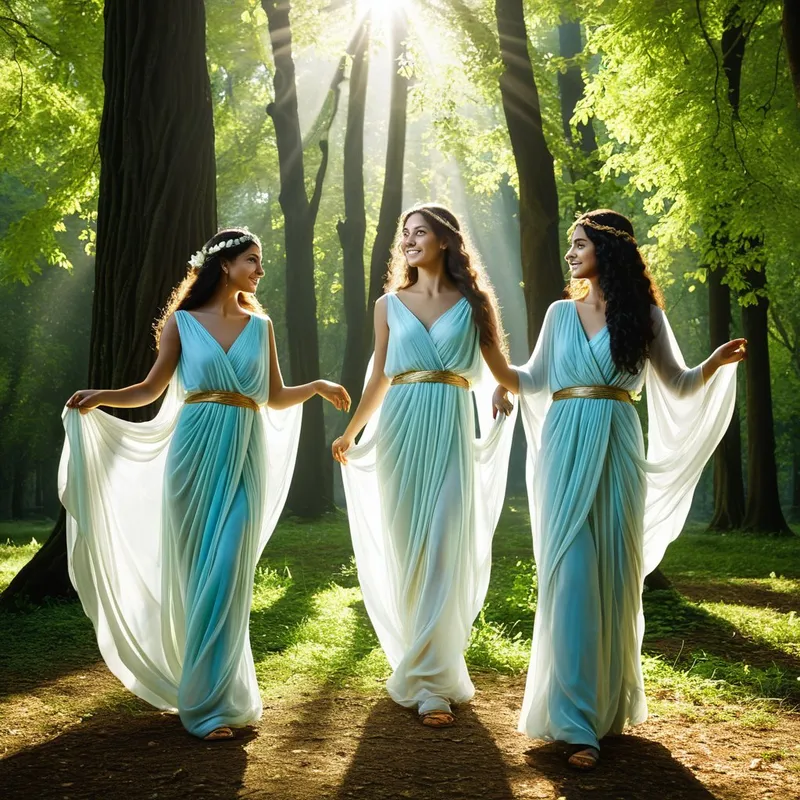
Listen. In the golden age of the world, when the air itself hummed with the potential of creation, there existed a sacred law older than the gods of the Capitol. It was a law not of stone or decree, but of motion, of breath, of the very pulse that binds soul to soul. And its living embodiment was found in a sun-drenched grove, where the light fell not in shafts, but in liquid pools of honey and amber.
Here, they moved. Not as individuals, but as a single, breathing organism of grace. They were three: Aglaia, whose name meant “Splendor,” radiated a light that made the very leaves glisten. Beside her, Euphrosyne, “Joy,” moved with a laughter that was the sound of clear springs over smooth stones. And completing their circle was Thalia, “Bloom,” from whose footsteps flowers unfurled in perpetual celebration.
They were never still. Their dance was the world’s first conversation. Aglaia would extend a hand, offering a blossom woven from sunlight. Euphrosyne would receive it, her touch transforming it into a note of pure, scentless music. Thalia would then take that note and let it fall from her fingertips as dew, which nourished the earth from which Aglaia’s next blossom would spring. Give, receive, return. The cycle was seamless, eternal, and utterly necessary.
Mortals who stumbled upon their grove did not see three goddesses. They felt a single, overwhelming sensation: the exquisite rightness of connection. A soldier would feel his battle-hardened heart soften, remembering a kindness. A poet would find words flowing not from struggle, but from a sudden, generous fullness. A lonely soul would sense, for the first time, that to be part of the great web of life was to be both a giver and a gift.
Their mother was Venus, born of sea-foam and celestial longing, and their father was often named as Bacchus, the liberator. Thus, their grace was no mild pleasantry; it was the offspring of divine love and ecstatic freedom. They attended every gathering of the gods, not as mere decoration, but as the essential lubricant of harmony. Where they danced, contracts were sealed not just with words, but with mutual goodwill. Feasts became true communion. Strangers became guests, and guests became friends.
Their myth has no thunderous battle, no tragic fall. Its drama is subtler, far more profound. It is the quiet, terrifying moment when the dance stops. When a hand is offered and finds empty air. When a gift is taken and kept, its energy dying in closed fists. The Romans knew this was the true desolation—not the absence of things, but the fracture of the cycle. The Gratiae, therefore, were not a luxury. They were the very mechanics of a civilized soul, the sacred rhythm that turns a collection of individuals into a people, and a human life from a barren stretch into a fertile, interconnected garden.
Cultural Origins & Context
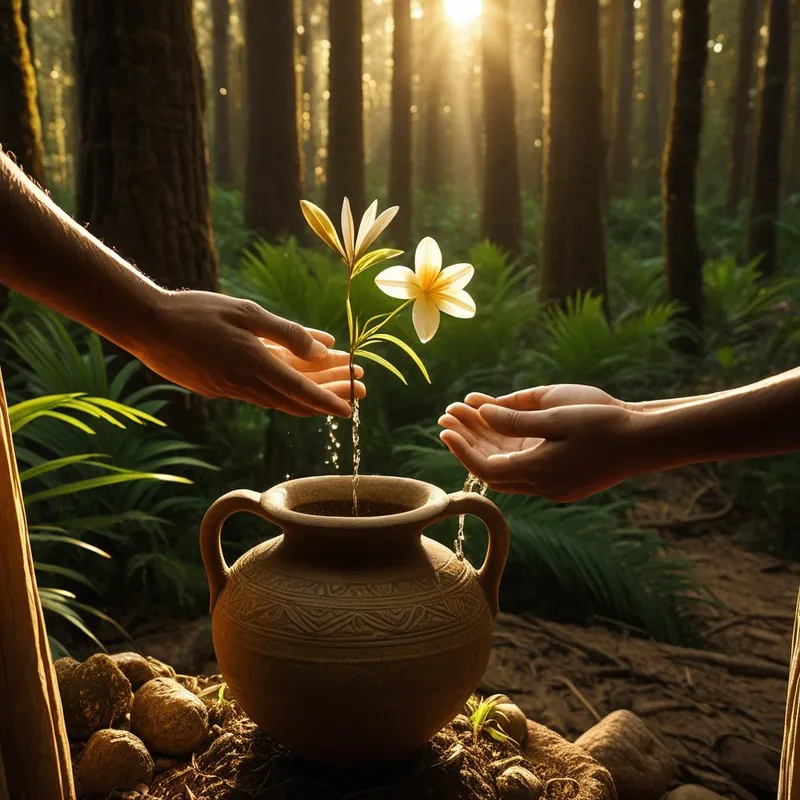
The Gratiae, known more widely by their Greek name, the Charites, were deeply woven into the fabric of Roman civic and social life. Their worship was less about grand temples—though they had shrines, often attached to those of Venus or Apollo—and more about a pervasive social principle. They represented gratia, a Latin word of immense depth meaning favor, charm, gratitude, and influence, all in one.
In the pragmatic Roman mind, society was a complex web of obligations and benefits (beneficia). The cycle of giving a favor, receiving it, and returning it (often in a different form) was the glue of client-patron relationships, political alliances, and family bonds. The Gratiae mythologized this essential social contract. They were invoked at weddings to bless the reciprocal bond of marriage. They were present at feasts to ensure conviviality and the free flow of wine and wit. Artists and poets called upon them not just for inspiration, but for the charm that would make their work pleasing and persuasive to others.
Their stories were passed down not as epic poems of isolated heroes, but as embedded knowledge in the works of poets like Ovid and Horace, and in the ubiquitous art that decorated homes, baths, and public spaces. To see a fresco of the three Graces was to receive a daily reminder: your life is part of a reciprocal dance. Cultivating gratia was a mark of civilization itself.
Symbolic Architecture
At its core, the myth of the Gratiae is a symbolic blueprint for the psyche’s movement beyond isolation. The three sisters are not separate entities but three phases of a single, vital process.
Aglaia (Splendor) symbolizes the initial impulse, the offering of the self. This is the spark of creativity, the gesture of love, the act of vulnerability. It is the psyche’s outward movement, risking its essence in the world.
Euphrosyne (Joy) symbolizes the receptive vessel. This is the capacity to be affected, to take in, to accept beauty and kindness without guilt or immediate calculation. It is the open heart, the listening ear, the joy of receiving that validates the giver.
Thalia (Bloom) symbolizes the transformative return. This is not repayment in kind, but the new creation that arises from the union of giving and receiving. It is the gratitude that becomes a new generosity, the inspiration that becomes art, the love that nurtures growth.
The true self is not found in isolation, but in the dynamic circuit of offering, acceptance, and creative return. To break the circle is to starve the soul.
Their eternal dance, often depicted with two facing one way and one the other, represents the perfect flow of psychic energy. They are the archetypal pattern of healthy relationship—with others, with our own creative spirit, and with the world itself. Their connection to Venus and Bacchus underscores that this grace is rooted in eros (life-force, attraction) and ecstasy (the breaking of ego-boundaries), not in cold, transactional duty.
The Dreamer's Resonance
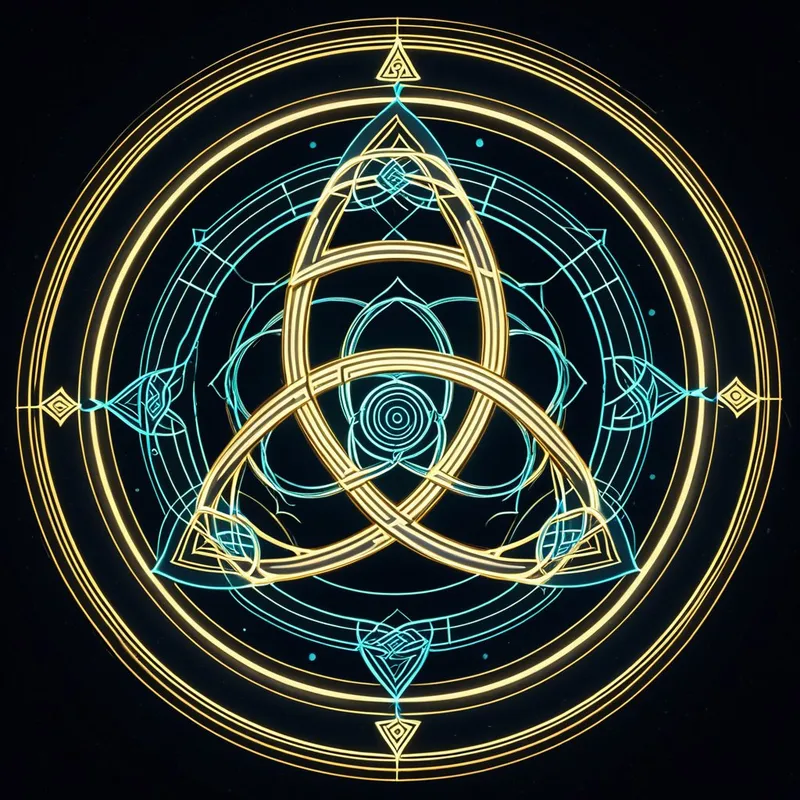
When the pattern of the Gratiae stirs in the modern unconscious, it often surfaces in dreams of triads, circles, and exchanges. You may dream of three identical figures, or of being the third person completing a group. You might dream of endlessly passing an object—a cup, a child, a glowing stone—in a silent, ritualistic manner. Alternatively, you may have the inverse: nightmares of a broken circle, of a gift rejected, of your own hands unable to release or accept something.
Somatically, this can feel like a tension in the chest—a constriction around the heart chakra, which governs giving and receiving love. Psychologically, it signals a reckoning with the economy of your relationships. Are you trapped in the role of the perpetual giver (Aglaia), pouring yourself out until you are empty? Are you stuck as the receptive one (Euphrosyne), unable to initiate or reciprocate, thus fostering dependency or resentment? Or are you unable to complete the cycle (Thalia), hoarding the energy you receive, letting it stagnate rather than letting it bloom into something new?
The dream is highlighting an imbalance in the sacred circuit. It calls for an examination of where the flow of your psychic and emotional energy is blocked, urging a return to the integrative dance.

Alchemical Translation
For the modern individual on the path of individuation—the process of becoming a whole, integrated Self—the Gratiae model the alchemical operation of circulatio: the circular distillation and purification of the spirit. Our raw, unconscious impulses (the prima materia) must be offered up (Aglaia), consciously received and felt in all their complexity (Euphrosyne), and then transformed into a conscious attitude or creative act (Thalia). This cycle repeats, each revolution refining the soul.
Individuation is not a linear conquest, but a graceful rotation: offering the shadow to the light, receiving the light’s revelation, and returning to the world forged anew.
The "heroics" here are internal and relational. The struggle is to maintain the circuit against the ego’s desire to either selfishly hoard or selflessly annihilate itself. The triumph is not a slain dragon, but a relationship healed, a creative block dissolved, a moment of genuine, non-transactional kindness. It is the cultivation of inner gratia—the charm that is not manipulation, but the authentic radiance of a psyche in harmonious flow.
To integrate the Gratiae is to understand that your greatest power lies not in what you possess, but in what you are willing to put into circulation. Your splendor, your joy, and your capacity to bloom are not yours alone; they are currencies of the soul, meant to flow in the sacred dance that connects all things. In honoring their myth, we remember that to be human is to be a link in the golden chain of giving, receiving, and becoming.
Associated Symbols
Explore related symbols from the CaleaDream lexicon: