Go/Weiqi Myth Meaning & Symbolism
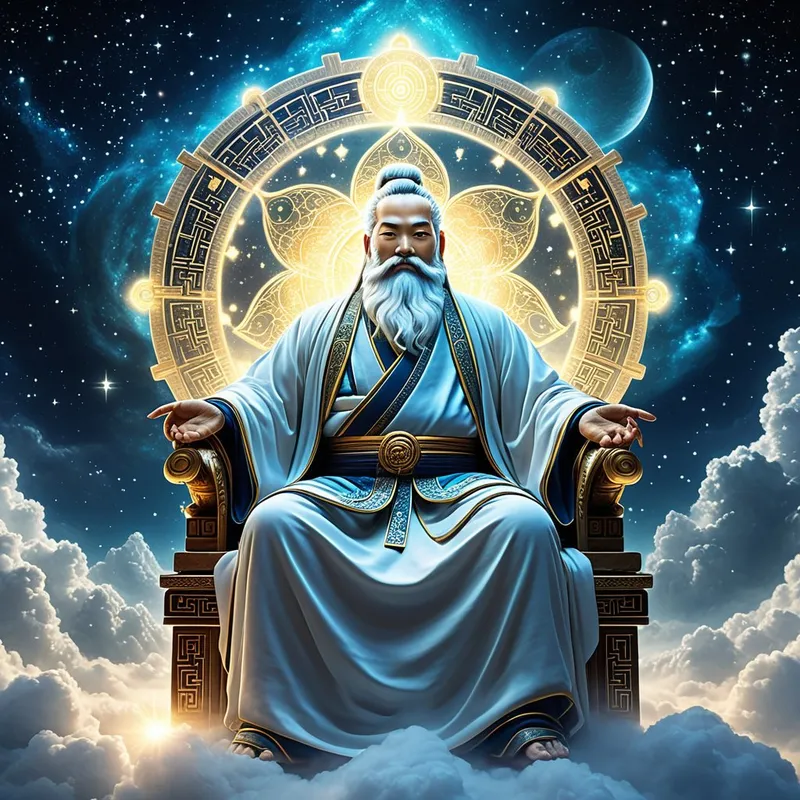
A celestial deity plays a game of Go with a mortal woodcutter, offering a glimpse into the divine patterns that weave fate and reality.
The Tale of Go/Weiqi
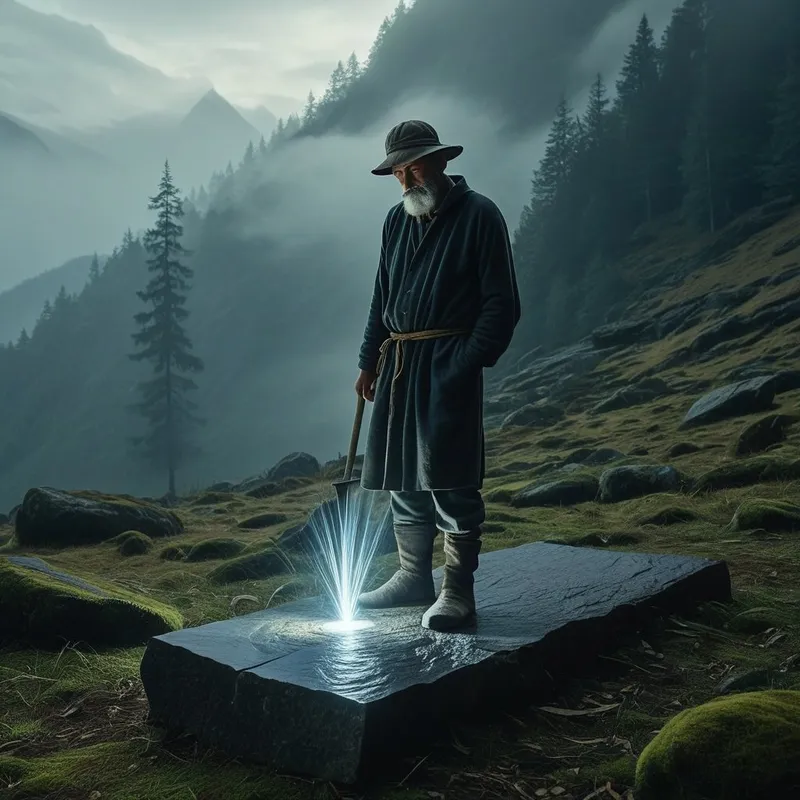
Listen, and hear a tale not of thunderous battles, but of profound silence. A tale not of clashing steel, but of the soft click of stone upon wood. In the mist-wrapped peaks of the Kunlun Mountains, where time flows like a lazy river, there lived a woodcutter named Wang Zhi. His life was the rhythm of the axe, the scent of pine, and the weight of the bundle on his weary back.
One day, chasing the stray scent of rare herbs deeper than he had ever ventured, Wang Zhi stumbled into a clearing that hummed with a stillness unlike any other. The air was thick, sweet with the perfume of unknown flowers. In the center, upon a naturally flat stone slab, sat two figures. One was an old man with a beard like a waterfall of snow and eyes that held the depth of still lakes. His robes seemed woven from cloud and twilight. The other was a youth, his face serene, his gaze fixed on the grid between them.
They were playing Weiqi. But this was no ordinary game. The board was the stone slab itself, its lines etched by no mortal hand. The stones were not of slate and shell, but of condensed night and captured moonlight—black as a starless void, white as the heart of a lotus. With each click of a stone, Wang Zhi felt not a sound, but a shift in the world. A bird would pause in its song. A cloud would stall in its journey. The very sunlight seemed to pool and bend around the players.
Wang Zhi leaned on his axe, forgotten. He watched as the old man—a Xian, he was sure—placed a stone. A valley on the distant horizon seemed to grow deeper. The youth replied, and a stream in the forest changed its course with a gentle gurgle. This was no pastime. This was the weaving of reality itself. The game was a living tapestry of mountain and valley, of growth and containment, of Yang and Yin. Wang Zhi watched, his hunger and thirst vanished, replaced by a swelling awe that filled his chest to bursting.
He did not know if he stood there for an hour or a century. Finally, with a pattern of breathtaking complexity settled upon the board, the immortal looked up, not at his opponent, but at Wang Zhi. A smile touched his lips, kind and infinitely ancient. Then, both figures dissolved like mist in the morning sun. The clearing was empty, save for the stone slab, the finished game, and Wang Zhi’s rusted axe head, which crumbled to dust at his feet. He returned to his village, but no one knew him. Generations had passed. In his hand, he clutched a single black Go stone, still warm, the only proof that he had not dreamed it all.
Cultural Origins & Context
The story of Wang Zhi is a cornerstone of Chinese mythology and folklore, with variations appearing in texts like the Sunzi Suanjing and later collections of strange tales (zhiguai). It is not a state myth of creation, but a Taoist-infused parable of the individual’s encounter with the absolute. Passed down by storytellers and scholars, it served multiple functions: as an allegory for the deceptive nature of time, as a demonstration of the profound depth hidden within a seemingly simple game, and as a narrative anchor for the belief that the cosmos operates on principles of strategic balance and pattern.
The myth elevates Weiqi from a board game to a cosmogram. It tells us that the game’s true masters were not in imperial courts, but in the celestial realms. By framing a humble woodcutter as the witness, it democratizes the potential for enlightenment; wisdom is not for the privileged alone, but can be stumbled upon by anyone who wanders off the beaten path with an open heart. The story validates the game’s status as one of the Four Arts, placing it on par with music, calligraphy, and painting as a essential discipline for harmonizing the human spirit with the great patterns of heaven and earth.
Symbolic Architecture
At its core, the myth presents Weiqi as a symbolic language for the fundamental processes of existence. The board is the Tao—the boundless field of potentiality. The grid lines are the ten thousand things, the distinctions and relationships that arise from the undifferentiated whole.
The game is not about annihilation, but about influence. Not about killing, but about living. Each stone is a commitment, a declaration of intent in the void.
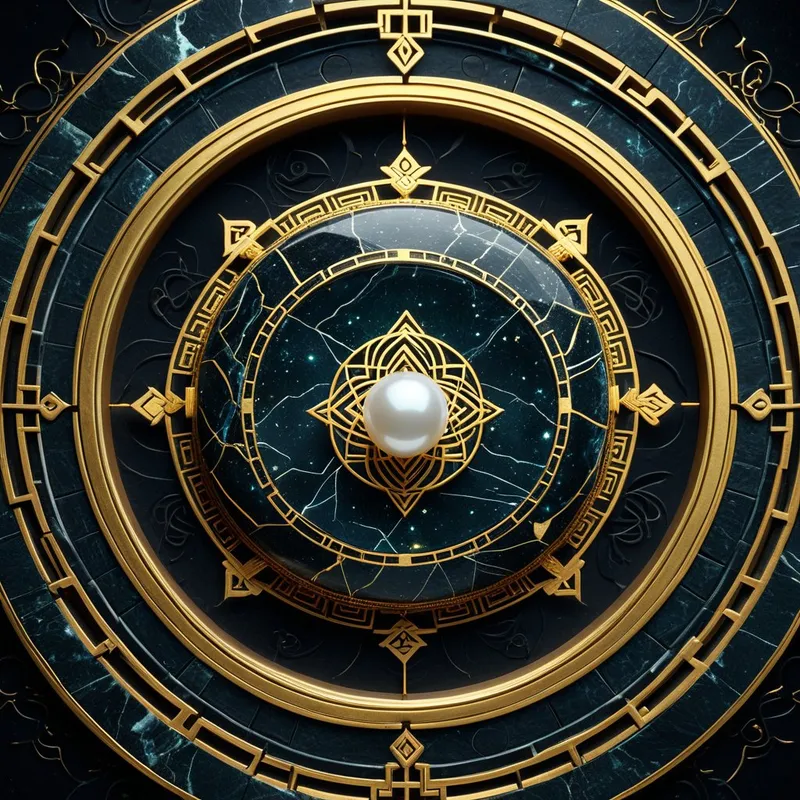
The two players represent the eternal dance of complementary opposites: the old Xian (tradition, wisdom, the established order) and the youth (innovation, potential, the emerging pattern). Wang Zhi, the witness, symbolizes the human consciousness that can, in rare moments of grace, perceive this divine activity. His dissolved axe is the alchemical dissolution of his old, utilitarian self—the "woodcutter" identity is burned away in the face of the numinous. The stone he brings back is the Self archetype made tangible; a seed of the cosmic pattern now embedded in the human world.
The Dreamer's Resonance
When this myth surfaces in modern dreams, it rarely appears as a literal scene of immortals on a mountain. More often, it manifests as the feeling of the myth. A dreamer may find themselves in a sterile, grid-like office, where every decision (placing a "stone") seems to ripple out with immense, unforeseen consequences, filling them with both awe and anxiety. They may dream of a simple object—a chess piece, a pebble—that holds an unbearable weight of meaning, a nucleus of fate.
Somatically, this can feel like a suspension of ordinary time—a moment of hyper-clarity where the noise of the world falls away, and one is confronted with the sheer architecture of their own life choices. The psychological process is one of witnessing the pattern. The ego (Wang Zhi) is taken to the edge of its understanding and forced to observe a game much larger than itself. This can trigger a profound disorientation, the "crumbling axe" moment, which in therapy or inner work signals the beginning of a deconstruction of the persona. The dream is an invitation to stop merely cutting wood (acting on automatic, survival-based impulses) and to start reading the board.

Alchemical Translation
The individuation journey modeled here is not one of heroic conquest, but of patient, strategic awakening. The first alchemical stage, nigredo (the blackening), is Wang Zhi’s wandering and his initial confusion in the face of the sublime. The game itself, in its complex interplay of black and white, represents the coniunctio oppositorum—the confrontation and ultimate marriage of opposites within the psyche: conscious and unconscious, aggression and nurture, activity and receptivity.
To play the game is to engage in a ritual of self-creation. Each move is a question asked of the universe, and the evolving board is the universe’s answer.
The immortal’s final smile is the albedo (the whitening), the moment of illuminating insight. He does not speak because the knowledge transmitted is ineffable; it is understood through the pattern, not through words. Wang Zhi’s return to a changed world is the rubedo (the reddening), the integration of this cosmic perspective into earthly, human time. He is now a stranger, because he carries an inner truth that sets him apart. The single stone is the lapis philosophorum—not granting physical immortality, but the psychological immortality of an awakened perspective. For the modern individual, the alchemical work is to find that "clearing" in one’s own life—through meditation, analysis, or deep contemplation—and to have the courage to watch the game, to let the old tools of identity crumble, and to carry back from that encounter the one stone that changes everything.
Associated Symbols
Explore related symbols from the CaleaDream lexicon: