Gospel of Thomas Myth Meaning & Symbolism
A collection of secret sayings of Jesus, promising that those who uncover their own meaning will not taste death.
The Tale of the Gospel of Thomas
Listen. This is not a tale of a journey to a distant land, nor of a battle with a monstrous beast. This is a tale of a whisper that became a roar within the silent chambers of the soul.
In the years when the world was heavy with empire and the air thick with promises of salvation from above, there moved another current, deep and quiet as an underground river. It spoke not of kingdoms to come, but of a kingdom already here, hidden. Its prophet was a man who walked the dust of Judea, but his words were not like the others. He spoke in riddles that cut like a knife and healed like a balm. They called him Didymos Judas Thomas, the Twin.
He did not write a story of birth and death. Instead, he collected the secret sayings, the living words that fell from the teacher’s lips like seeds. “Whoever discovers the interpretation of these sayings,” the text begins, a voice emerging from the parchment like a breath from a tomb, “will not taste death.”
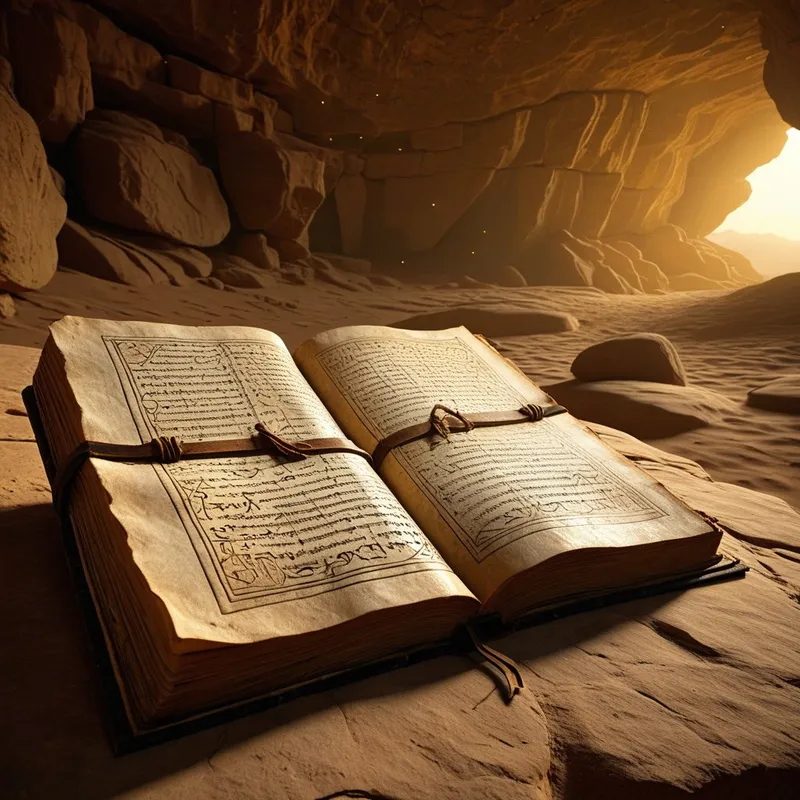
Imagine a scroll, hidden in a jar of clay, buried in the red earth of Nag Hammadi. The desert wind howls outside, but inside the jar, there is only a potent silence. The words wait. They speak of a mustard seed smaller than all seeds that becomes a great tree. They speak of a treasure hidden in a field, of a pearl of great price. They speak of the world as a corpse, and the living as those who are awake inside it.
The central drama is not played out on a hill called Golgotha, but in the inner landscape of the listener. The conflict is ignorance against recognition. The rising action is the gradual, often frustrating, work of turning the sayings over in your mind, like a stone in your hand, feeling for the fissure of truth. “Split a piece of wood,” one saying commands, “and I am there. Lift up the stone, and you will find me.”
The resolution is not a theological conclusion, but a shattering realization. It is the moment the seeker understands that the light they have been seeking on the mountain, in the temple, in the heavens, is the very same light that projects the image onto their own eye. “The Kingdom is inside of you,” the saying thunders in a whisper, “and it is outside of you. When you come to know yourselves, then you will be known, and you will understand that you are children of the living Father.”
Cultural Origins & Context
This text emerged from the fertile, heterodox soil of early Christianity, a time of profound experimentation and debate. The Gnostic currents, of which the Gospel of Thomas is a prime exemplar, were not a unified church but a constellation of seekers. They were often educated, Hellenized individuals for whom the orthodox narrative of sin and sacrificial atonement felt insufficient. They hungered for a wisdom that was immediate and transformative.
The Gospel of Thomas was likely composed in the late 1st or early 2nd century, possibly in Syria. It was passed down not from pulpits to crowds, but from teacher to student in intimate settings. Its societal function was subversive: it democratized access to the divine. You did not need a priestly lineage or a sanctioned sacrament; you needed only the capacity to listen deeply and interpret courageously. It was a guide for the solitary awakening, a manual for those who felt like strangers in a world they perceived as a flawed creation, a fallen realm. Its burial at Nag Hammadi around the 4th century speaks to its suppression as orthodoxy solidified, preserving it not for the world, but for a future that might be ready to hear its unsettling message anew.
Symbolic Architecture
The Gospel of Thomas is not a myth in the narrative sense, but a mythic structure built entirely from symbolic logic. Its core symbol is the saying itself—the logion. Each is a paradox designed to short-circuit ordinary thinking.
The sayings are not puzzles to be solved, but mirrors to be confronted. In them, you do not find information about God; you find God as the activity of your own seeking.
The figure of Thomas as the “Twin” is paramount. He represents the divine counterpart, the true Self (the Self) that is the twin of the ego. To know the sayings is to recognize this twin within. The “Kingdom” is not a place but a state of perception—the unmediated experience of unity, where the split between seeker and sought, inner and outer, divine and human, dissolves. The “death” one will not taste is the death of identification with the mortal, isolated ego, the sleep of unconsciousness.
The recurring images—the hidden treasure, the single eye, the new garment, the solitary ones—all point toward an interior reality that is whole, luminous, and autonomous. The world’s values are inverted: the first shall be last, the poor are blessed, the solitary elect are the truly rich.

The Dreamer's Resonance
When this mythic pattern stirs in the modern psyche, it often manifests in dreams of discovery and hidden knowledge. One might dream of finding a secret room in their own house, filled with ancient books or glowing artifacts. They may dream of a teacher who speaks in cryptic phrases that feel vitally important upon waking, even if the words are forgotten. There is a somatic quality of recognition—a shiver, a sudden intake of breath, a feeling of something “clicking” into place.
Psychologically, this signals the ego’s initial, often reluctant, engagement with the Self. The dreamer is going through the process of disillusionment with external authorities and prefabricated answers. There is a hunger for something authentic, a knowledge that feels earned and intrinsic. The frustration of the paradoxical sayings in the dream mirrors the frustration of therapy or self-work: the answer is not given, it is evoked from within. The dreamer is being called to become their own interpreter, to take authority for their own inner truth.

Alchemical Translation
The alchemical process modeled here is the solve et coagula—dissolve and coagulate—applied to consciousness itself. The old, solidified identity (the ego convinced it is a mere mortal in a material world) must be dissolved by the acid of the paradoxical sayings. This is the nigredo, the dark night of the soul, where meaning collapses and one feels lost in a desert of questions.
The treasure is hidden in the field precisely because the field is the self. The labor of digging is the labor of introspection, and the moment of discovery is the moment the digger realizes they are the treasure.
The rising action of contemplation is the albedo, the whitening, where insights begin to gleam in the darkness. Finally, the recognition—the gnosis—is the rubedo, the reddening, the dawn of a new, integrated consciousness. The “pearl of great price” is the integrated psyche, for which one must sell all they previously valued (their old assumptions, dependencies, and self-concepts).
For the modern individual, this myth maps the path of individuation away from collective religious dogma and toward a personal, experiential spirituality. It champions the inner sage over the outer savior. The struggle is against the inertia of unconscious living; the triumph is the birth of the one “who stands alone,” who has found the living water within and knows, finally, that they will not taste death, for they have awakened to the eternal in the midst of the temporal.
Associated Symbols
Explore related symbols from the CaleaDream lexicon: