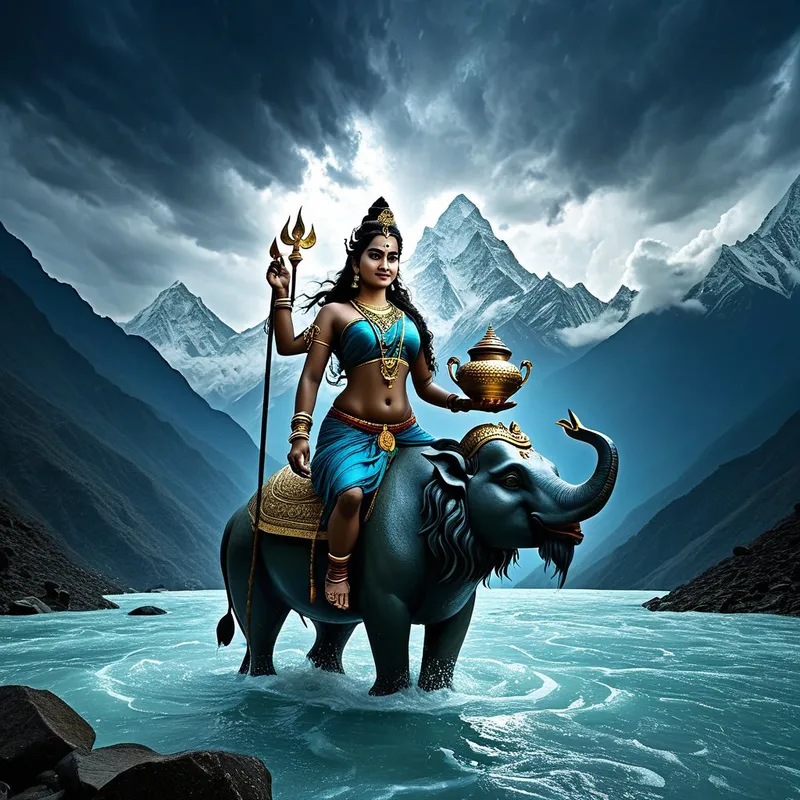
Goddess Ganga Myth Meaning & Symbolism
The celestial river's descent to earth, tamed by Shiva's hair, is a myth of sacred flow, purifying chaos, and the soul's journey to liberation.
The Tale of Goddess Ganga
Listen. Before time was counted in years, the world was parched, its soul a desert of ash and unwept tears. In the heavens, flowed the Ganga, a river of stars and liquid song. She was not merely water; she was the boundary between chaos and creation, a torrent of pure consciousness, too fierce, too free for the mortal realm.
On earth, a king named Sagara sought to perform a horse sacrifice to claim the heavens. The gods, threatened, stole the sacrificial horse. Sagara sent his sixty thousand sons to find it. They scoured the earth and, in their arrogance, dug deep into the underworld, disturbing the sage Kapila at his meditation. With a single glance of fiery wrath, Kapila reduced them all to ashes. Their souls could not ascend; they were trapped, cursed to wander as restless ghosts, for they lacked the sacred waters for their final rites.
Generations passed under this shadow of unresolved grief. A descendant, the devout king Bhagiratha, took upon himself the impossible task. He stood on one leg for a thousand years, his prayer a single, piercing note aimed at the heart of Brahma. Pleased, Brahma appeared. “The river will descend,” he said, his voice like distant thunder, “but her fall will shatter the earth. Only Shiva can bear her force.”
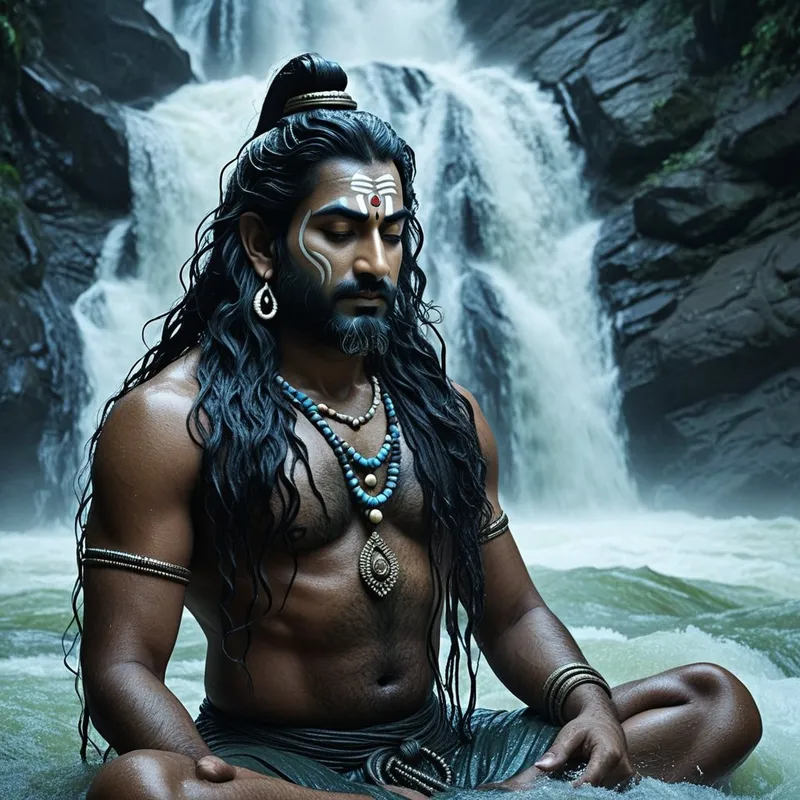
So Bhagiratha prayed again, for another age, turning his soul into a vessel of pure need. In the icy fastness of Mount Kailash, Shiva, the great yogi, opened his eyes. He saw the king’s torment, the ghosts’ anguish, and the river’s proud, destructive potential. He nodded, a gesture that shifted the axis of the worlds.
The heavens tore open. Goddess Ganga descended, not as a gentle stream, but as the entire fury of the cosmic ocean, a vertical tsunami meant to humble the earth. She fell with the roar of a thousand monsoons, a deluge to end all worlds. And Shiva, serene, merely raised his matted, uncut locks—the Jata. The river, with all her arrogant might, crashed into that tangled, infinite labyrinth. For years she swirled, trapped, humbled, her fury turned to confusion, her chaos woven into countless threads. Then, gently, from the ends of his hair, Shiva let her flow—not as one destructive force, but as seven sacred, life-giving streams.
The first stream followed the desperate, running figure of Bhagiratha. It flowed over the ashes of the sixty thousand, a cool, whispering benediction. The smoke of their pyres did not rise in sorrow, but in liberation, as each soul was washed clean and set free. The river touched the earth at last, not as a conqueror, but as a mother, filling the cracked lips of the land, giving it a name, a pulse, a story that flows to this very day.
Cultural Origins & Context
The myth of Ganga’s descent, or Gangavatarana, is woven into the epic fabric of the Mahabharata and the Puranas. It is a story told by sages in forest hermitages, recited by priests during ritual ablutions, and sung by mothers to children on the banks of the river herself. Its primary societal function was etiological—explaining the sacred origin of the Ganges River—but its purpose ran far deeper.
It served as the foundational narrative for the central Hindu practice of snan and the death rite of asthi-visarjan. By linking the river’s origin to the liberation of ancestors, the myth established Ganga as the ultimate purifier, a liquid axis mundi connecting heaven, earth, and the underworld. It transformed geography into theology, making every drop of her water a repository of divine grace and historical memory, a tangible link between human action (Bhagiratha’s penance) and cosmic response.
Symbolic Architecture
At its core, the myth is a profound allegory of the relationship between raw, undifferentiated power and conscious, transformative containment. Ganga represents the primordial, unconscious force—be it emotion, psychic energy, or divine will—in its pure, potentially annihilating state. She is life itself, but life untamed, which is indistinguishable from destruction.
The uncontained spirit floods and drowns; the spirit received, channeled, and humbled gives life and washes clean the past.
Bhagiratha represents the human ego’s conscious intent and relentless aspiration. His penance is the focused discipline required to invoke a transformative power far greater than oneself. However, intent alone is insufficient; it requires a transcendent container.
That container is Shiva, the archetypal ascetic and lord of dissolution. His matted hair (Jata) is not mere hair; it is a symbol of controlled chaos, a psychic structure capable of receiving, breaking down, and reorganizing overwhelming energy. The descent into the Jata is the critical alchemical process—the solve—where the unitary, destructive force is dissolved into multiplicity. The release as seven streams is the coagula—the re-formation of that energy into usable, creative, and nourishing patterns for the world.
The Dreamer’s Resonance
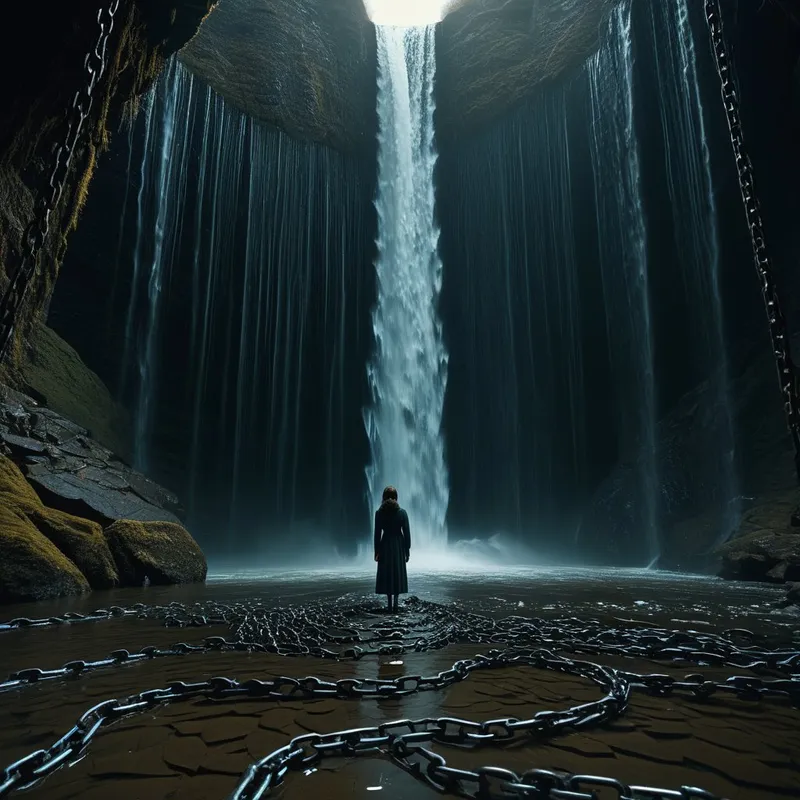
When this myth stirs in the modern unconscious, it often manifests in dreams of overwhelming floods, of standing under powerful waterfalls, or of finding secret, labyrinthine waterways within one’s own home or body. These are not dreams of mere fear, but of potent psychic pressure.
The somatic experience is one of being inundated—by emotion (grief, rage, passion), by responsibility, or by a surge of creative or spiritual energy that feels too large to handle. The dreamer is in the position of the earth: facing a descent that threatens to shatter their current structure of self. The psyche is announcing that a great, perhaps long-invoked, force is now descending from its “celestial” state in the unconscious into conscious reality. The critical question posed by the dream is: Where is your Shiva? Where is the internal capacity—the meditative depth, the disciplined practice, the symbolic “matted hair”—that can receive this flood without being destroyed, and instead, transform it into life-giving flow?
Alchemical Translation
The individuation journey modeled here is the sacred art of becoming both Bhagiratha and Shiva. It begins with the Bhagiratha phase: a profound, often desperate, longing for purification and resolution. This is the soul’s penance—the committed work of therapy, art, or spiritual practice aimed at calling down a transformative power to cleanse a deep, ancestral, or karmic stain (the “ashes of the sixty thousand sons,” our inherited traumas and unresolved patterns).
Liberation requires not only calling down the grace but also developing the vessel to hold its fierce, initial form.
The true alchemy, however, occurs in the Shiva phase. This is the cultivation of the inner container. It is the development of a conscious attitude that does not flee from the flood of the unconscious but receives it into a matrix of reflection, patience, and non-reactive awareness (the meditating Shiva). The “matted hair” symbolizes a psyche that is complex, tangled, and strong enough to withstand chaos. The energy—be it a creative impulse, a surge of grief, or a spiritual awakening—is not blocked but is allowed to swirl, lose its destructive singularity, and be broken into manageable streams.
Finally, one becomes the river itself. The transformed energy, now gentle and purposeful, flows into one’s life and relationships, capable of nourishing and purifying. The goal is not to stop the flow, but to become its conscious conduit, where divine force and human existence merge into a single, sacred descent. The myth teaches that the path to the ocean of liberation is not around the tumultuous waterfall, but directly through the labyrinthine grace of the transformer’s hair.
Associated Symbols
Explore related symbols from the CaleaDream lexicon: