
God in Genesis Myth Meaning & Symbolism
A story of a singular, formless consciousness speaking a cosmos into being, and the ensuing, painful birth of human awareness and moral complexity.
The Tale of God in Genesis
In the beginning, there was no beginning. There was only the Tohu va-Bohu, a deep, wordless, and watery darkness. And within that darkness, there was a Presence—not a form, not a shape, but a sheer, unmediated Will. A breath upon the face of the deep.
And the Presence spoke. It did not command with a shout, but with a whisper that was also a world. “Let there be light.” And there was not an explosion, but a gentle unfurling, a separation of the primal unity into day and night, the first rhythm. With words like tools, the Presence carved the firmament from the waters, a dome of crystal to hold back [the abyss](/myths/the-abyss “Myth from Kabbalistic culture.”/). It gathered the seas and called forth the dry land, which sprouted green and teeming. It set lights in the dome—the greater light to rule the day, the lesser to rule the night—and they were not gods, but lamps, timepieces for a story yet to be told. It filled the waters and the skies with swarming life, and the land with creatures that crawled and walked.
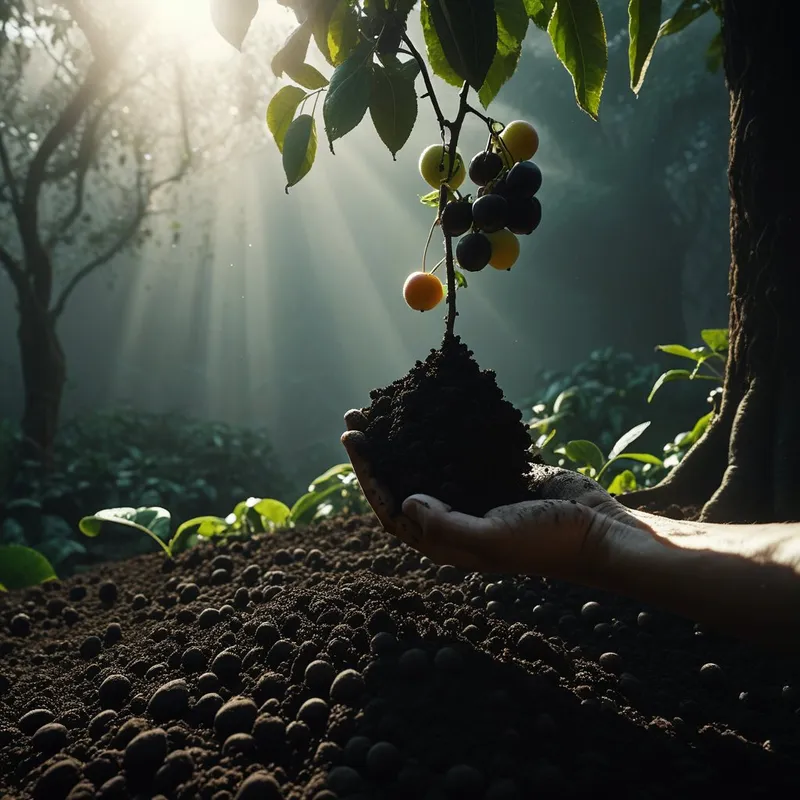
And the Presence said, “Let us make adam in our image, after our likeness.” From the dust of the adamah, the ground, It fashioned a form, and breathed into its nostrils the breath of life—nephesh. And the human became a living being. It placed this being in a garden in the east, in Eden, a place of effortless provision, where a river flowed out to [water](/myths/water “Myth from Chinese culture.”/) [the world](/myths/the-world “Myth from Tarot culture.”/). In the midst of the garden grew [the Tree of Life](/myths/the-tree-of-life “Myth from Kabbalistic culture.”/), and the Tree of the Knowledge of Good and Evil.
“You may freely eat of every tree,” said the Presence, walking in the garden in the cool of the day. “But of the Tree of the Knowledge of Good and Evil, you shall not eat, for in the day that you eat of it, you shall surely die.”
But in the garden was also a cunning creature, the nachash. It spoke to the woman, who stood beside the man. “Did the Presence truly say you shall not eat of any tree?” And the woman corrected the serpent, but the seed was planted. “You will not surely die,” hissed the serpent. “For the Presence knows that when you eat of it, your eyes will be opened, and you will be like divine beings, knowing good and evil.”
She saw the tree was good for food, a delight to the eyes, and desirable to make one wise. She took of its fruit and ate, and she gave some to the man, and he ate. And their eyes were opened. They knew they were naked. They sewed fig leaves together and made loincloths. And they hid.
They heard the sound of the Presence walking in the garden, and they hid among the trees. A voice called out, “Where are you?” The man answered, “I heard the sound of you in the garden, and I was afraid, because I was naked, and I hid.” The voice asked, “Who told you that you were naked? Have you eaten of the tree of which I commanded you not to eat?”
A cascade of blame followed—the man blamed the woman, the woman blamed the serpent. And the Presence pronounced consequences: enmity, pain in childbirth, toil upon cursed ground. And then, in an act of terrible mercy, It made garments of skin for the man and the woman, and clothed them. “See,” It said, “the human has become like one of us, knowing good and evil. Now, lest he reach out his hand and take also of the [Tree of Life](/myths/tree-of-life “Myth from Kabbalistic culture.”/), and eat, and live forever…” And the Presence sent them out from [the garden of Eden](/myths/the-garden-of-eden “Myth from Global/Universal culture.”/), and placed cherubim and a flaming sword that turned every way to guard [the way](/myths/the-way “Myth from Taoist culture.”/) to the [Tree of Life](/myths/tree-of-life “Myth from Kabbalistic culture.”/).
Cultural Origins & Context
This foundational narrative is the opening act of the Torah, the core sacred text of ancient Israel. Its final form is a product of the Babylonian Exile (6th century BCE), a period of profound trauma and theological crisis where the exiled Judean priests and scribes wove together older oral and written traditions—often identified by scholars as the P and J sources—into a cohesive origin story. It was not meant as a scientific textbook, but as a theological and ontological manifesto. Recited and studied, it served to answer the most urgent questions of a displaced people: Who are we? Why is life so hard? What is our relationship with the divine? It established a radical monotheism against the surrounding polytheistic cultures, positing a single, sovereign, transcendent Creator who acts in history and whose primary medium is ethical command and covenantal relationship, not cyclical nature.
Symbolic Architecture
The myth is a profound map of the [birth](/symbols/birth “Symbol: Birth symbolizes new beginnings, transformation, and the potential for growth and development.”/) of reflective [consciousness](/symbols/consciousness “Symbol: Consciousness represents the state of awareness and perception, encompassing thoughts, feelings, and experiences.”/). The primordial state of unity—the formless void with the hovering [Spirit](/symbols/spirit “Symbol: Spirit symbolizes the essence of life, vitality, and the spiritual journey of the individual.”/)—represents the undifferentiated unconscious. The act of creation through speech is the first act of discrimination, the [separation](/symbols/separation “Symbol: A spiritual or mythic division between realms, states of being, or consciousness, often marking a transition or loss of connection.”/) of opposites (light/dark, waters above/waters below) necessary for any [reality](/symbols/reality “Symbol: Reality signifies the state of existence and perception, often reflecting one’s understanding of truth and life experiences.”/) to be perceived.
The Garden is the pre-conscious paradise of instinct, where the human is in harmony with nature and the divine but lacks self-awareness. The human is a part of the landscape, not an observer of it.
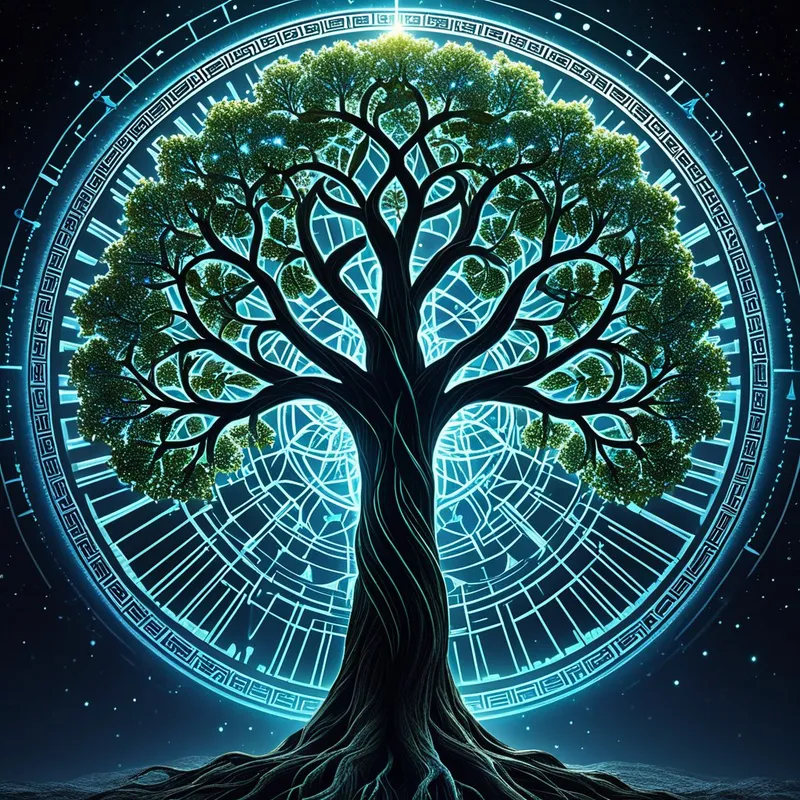
The two central trees are archetypal symbols. The [Tree of Life](/symbols/tree-of-life “Symbol: Embodies the interconnectedness of all living things and the cycle of life, death, and rebirth.”/) represents unbroken, unconscious participation in the divine wholeness. The [Tree](/symbols/tree “Symbol: In dreams, the tree often symbolizes growth, stability, and the interconnectedness of life.”/) of [Knowledge](/symbols/knowledge “Symbol: Knowledge symbolizes learning, understanding, and wisdom, embodying the acquisition of information and enlightenment.”/) represents the [capacity](/symbols/capacity “Symbol: A measure of one’s potential, limits, or ability to contain, process, or achieve something, often reflecting self-assessment or external demands.”/) for moral judgment, self-[reflection](/symbols/reflection “Symbol: Reflection signifies self-examination, awareness, and the search for truth within oneself.”/), and the painful [awareness](/symbols/awareness “Symbol: Conscious perception of self, surroundings, or internal states. Often signifies awakening, insight, or heightened sensitivity.”/) of duality—good/evil, self/other, naked/clothed. The prohibition is not a petty test, but a [boundary](/symbols/boundary “Symbol: A conceptual or physical limit defining separation, protection, or identity between entities, spaces, or states of being.”/) that defines a [relationship](/symbols/relationship “Symbol: A representation of connections we have with others in our lives, often reflecting our emotional state.”/). To cross it is to initiate the irreversible process of individuation.
The nachash is the catalyst from within the Garden itself—the [trickster](/symbols/trickster “Symbol: A boundary-crossing archetype representing chaos, transformation, and the subversion of norms through cunning and humor.”/) [aspect](/symbols/aspect “Symbol: A distinct feature, quality, or perspective of something, often representing a partial view of a larger whole.”/) of the unconscious that pushes consciousness toward its necessary, if painful, evolution. The “fall” is thus simultaneously a catastrophe and an awakening. The knowledge gained is not intellectual, but experiential: the shocking awareness of separateness, [vulnerability](/symbols/vulnerability “Symbol: A state of emotional or physical exposure, often involving risk of harm, that reveals authentic self beneath protective layers.”/) (nakedness), and [shame](/symbols/shame “Symbol: A painful emotion arising from perceived failure or violation of social norms, often involving exposure of vulnerability or wrongdoing.”/). [Death](/symbols/death “Symbol: Symbolizes transformation, endings, and new beginnings; often associated with fear of the unknown.”/) enters not as a immediate [punishment](/symbols/punishment “Symbol: A dream symbol representing consequences for actions, often tied to guilt, societal rules, or internal moral conflicts.”/), but as the logical consequence of separation from the [source](/symbols/source “Symbol: The origin point of something, often representing beginnings, nourishment, or the fundamental cause behind phenomena.”/) of [life](/symbols/life “Symbol: The symbol of ‘Life’ represents a journey of growth, interconnectedness, and existential meaning, encompassing both the joys and challenges that define human experience.”/); [mortality](/symbols/mortality “Symbol: The awareness of life’s finitude, often representing transitions, impermanence, or existential reflection in dreams.”/) is the price of a conscious, historical existence.
The Dreamer’s Resonance
When this myth stirs in the modern [psyche](/myths/psyche “Myth from Greek culture.”/), it often manifests in dreams of profound transition and moral anxiety. One may dream of being in a beautiful, safe, but strangely boring or confining place (the Garden), feeling a compulsion to break a rule they don’t fully understand. They may encounter a persuasive, ambiguous animal or figure (the serpent) offering a secret or a key. The act of transgression is followed not by immediate catastrophe, but by a chilling wave of realization—often symbolized by suddenly being exposed in public, or seeing one’s own reflection change.
This dream pattern somaticizes the psychological “fall” from a state of unconscious belonging (in a family system, a dogma, a comfortable identity) into the terrifying freedom of self-awareness. The shame and fear are the birth pangs of a new, more responsible consciousness. The dreamer is not being punished by an external god, but is experiencing the inner consequence of having taken a step toward psychological independence.

Alchemical Translation
The alchemical journey modeled here is the opus contra naturam—the work against nature, which in psychological terms is the work against unconscious, instinctual identification. [The prima materia](/myths/the-prima-materia “Myth from Alchemical culture.”/) is the undifferentiated psyche. The first separation (creatio ex nihilo) is the emergence of [the ego](/myths/the-ego “Myth from Jungian culture.”/) from the unconscious. The Garden is the albedo, the white stage of purity and potential, but also of naivete.
The eating of the fruit is the crucial [nigredo](/myths/nigredo “Myth from Alchemical culture.”/), the blackening. It is the descent into [the shadow](/myths/the-shadow “Myth from Jungian culture.”/), the confrontation with duality, guilt, and mortality. This is not a mistake to be undone, but the essential, painful dissolution required for transformation. The expulsion is the beginning of the long, hard road of the citrinitas and [rubedo](/myths/rubedo “Myth from Alchemical culture.”/)—the yellowing and reddening—which is historical, conscious life with all its toil, conflict, and capacity for love and [justice](/myths/justice “Myth from Tarot culture.”/).
The goal is not a return to the Garden, which is now guarded by the flaming sword of irreversibility. The ultimate goal, hinted at in the myth’s own symbolism, is to integrate the knowledge gained from the Tree of Knowledge with the eternal life of the Tree of Life. This is the culmination of individuation: to live a conscious, ethical, mortal life while being rooted in the timeless, creative ground of being. We are forever exiled from unconscious paradise, so that we may, through our own conscious striving, build a sacred world in time.
Associated Symbols
Explore related symbols from the CaleaDream lexicon: