God Myth Meaning & Symbolism
A story of a singular, absolute Creator who forms a world, makes a covenant with humanity, and engages in a complex, transformative relationship with His creation.
The Tale of God
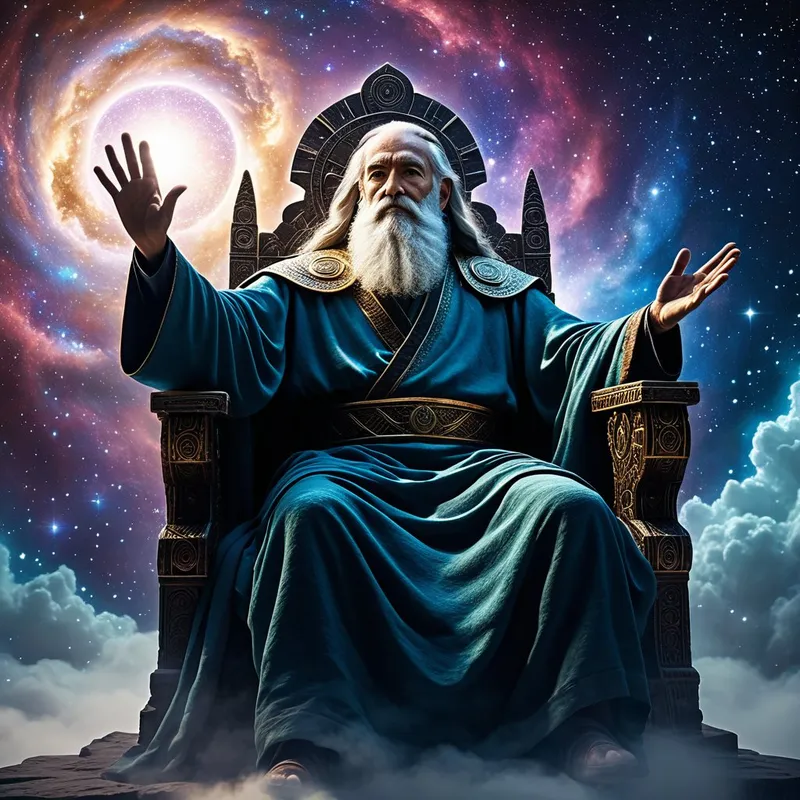
In the beginning, there was no before. There was only the One, a presence so vast it was not a thing among things, but the ground of all being. Silence, perfect and complete. Then, a word—not a sound, but an act of will that shattered eternity into possibility. Let there be light. And there was.
And the light was good. From that first fission, the cosmos tumbled forth: the vault of heaven, the cradle of earth, the teeming seas. The One spoke suns into fire and spun planets into dance. He breathed life into the dust, forming a creature in His own image—Adam—and placed him in a garden of unthinkable beauty, where rivers of honey flowed and every tree was heavy with fruit. He gave him a companion, Eve, and they walked with the sound of the One in the cool of the day. But in the garden grew the Tree of Knowing, and a voice like a whisper of wind through leaves asked, "Did He truly say...?"
The fruit was eaten. The eyes were opened. And for the first time, the creatures hid from the sound in the garden. The voice of the One now held a terrible grief. "Where are you?" The world fractured. Thorns sprouted from the soil. Childbirth became pain. They were cast out, east of Eden, to a land where they would now know the sweat of their brow and the dust of their return.
But the story was not over. The One chose a man, Abraham, under a sky dusted with more stars than sand. "Go," the voice said. "I will make of you a great nation." A covenant was cut in the flesh and the night. Abraham’s faith was tested on a barren mountain, a knife raised over his only son, until a ram cried out from the thicket. The promise endured.
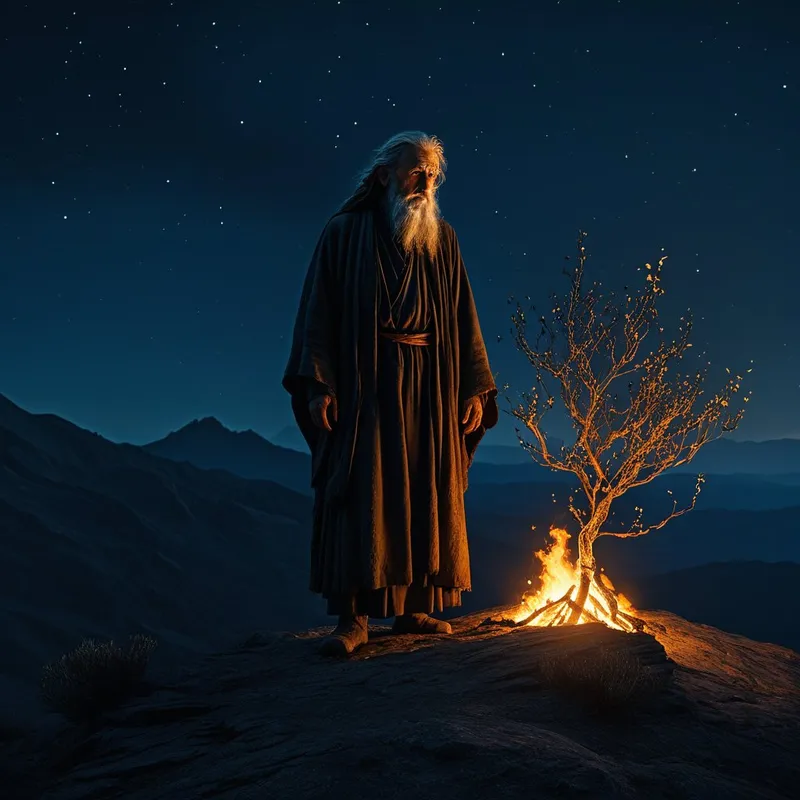
Generations later, His people groaned under the sun-baked bricks of Egypt. The One heard. He appeared in a desert thornbush that blazed with fire yet was not consumed. To a stammering exile named Moses, He revealed a name too holy to speak: YHWH, "I Am Who I Am." With a staff and ten plagues, He broke the chains of empire. On a peak shrouded in thunder and lightning, He gave a law carved not just on stone, but meant for the heart. He led them as a pillar of cloud by day and a tower of fire by night.
Yet they built golden calves. They doubted. They wandered. Prophets arose—Elijah calling down fire, Isaiah speaking of one wounded for transgressions—voices crying in the wilderness, trying to call a people back to the memory of the covenant. The relationship was a tempest of justice and mercy, a father’s wrath and a lover’s longing, written in the blood of sacrifices and the poetry of the psalms. It was a story of a Creator who refused to be done with His creation, forever calling it back from exile, forever speaking its name in the dark.
Cultural Origins & Context
This is not a myth from a single time or place, but a living tapestry woven over millennia across the arid landscapes of the Ancient Near East. Its earliest threads are found in the oral traditions of nomadic pastoralists and settled city-dwellers, competing and conversing with the grand polytheistic narratives of Mesopotamia and Canaan. It was crystallized, edited, and compiled by priestly and scribal classes in the kingdoms of Judah and Israel, particularly after the traumatic national exiles of the 8th and 6th centuries BCE. These events—the destruction of the Temple, the loss of the land—forced a profound theological crisis: how could the god of a defeated people be the one true God? The answer was forged in the fire of catastrophe: this God was not a territorial deity, but the sovereign of history itself, using even empire and exile as instruments of a mysterious purpose.
The story was passed down as sacred scripture—Tanakh, Old Testament, Qur'an—becoming the foundational narrative for Judaism, Christianity, and Islam. It functioned as law, history, poetry, and identity. It told a people who they were (a chosen covenant people), why they suffered (broken covenant), and what their destiny was (restored covenant). It was recited in temple rituals, sung in psalms, debated in synagogues, and whispered in prayers. It provided a cosmic order in a chaotic world, situating human life within a divine drama of creation, fall, and promised redemption.
Symbolic Architecture
At its core, the myth presents a radical symbolic architecture for understanding reality and the human psyche. The One represents the archetype of the absolute, the transcendent ground of being from which all consciousness and matter emanate. He is the ultimate Self, the totality of the psyche that encompasses both consciousness and the unfathomable depths of the unconscious.
The journey from the Garden to the Covenant is the psyche's journey from unconscious unity, through the necessary trauma of self-awareness (the Fall), toward a conscious and responsible relationship with the divine.
The Garden symbolizes the original, paradisiacal state of the infantile psyche—a state of unconscious identification with the source, where no distinction exists between wish and reality, self and other. The Tree of Knowing and the Serpent represent the inevitable emergence of consciousness, the catalytic force that disrupts primal unity. Eating the fruit is not a "sin" in a petty moral sense, but the primordial act of ego-formation—the painful birth of the "I" that knows itself as separate, that judges, that feels shame.
The Covenant is the central symbol of the myth's psychological genius. It represents the move from a broken, childlike relationship with the source (expulsion) to a mature, negotiated relationship based on law, promise, and ethical responsibility. The Law is not merely restriction, but the symbolic structure—the ego—necessary to contain and relate to the overwhelming power of the Self. The prophets are the voices of the Self correcting the ego’s inflation or corruption, calling it back to its foundational truth.

The Dreamer's Resonance
When this myth stirs in the modern dreamscape, it often signals a profound encounter with what Jung called the "numinous"—the overwhelming, awe-inspiring power of the archetypal Self. To dream of a blinding, transcendent light, a commanding voice from a whirlwind or a burning bush, or an immense, judging patriarchal figure is not necessarily about religion. It is the psyche announcing a critical juncture.
The somatic experience is one of awe bordering on terror: a racing heart, a sense of being scrutinized, of profound smallness. Psychologically, the dreamer is likely facing a moment where their current identity (their personal "Egypt" of habit, limitation, or oppression) is being challenged by a call from a deeper, more authentic Self (the voice saying "Go forth"). This can feel like exile—being cast out of a familiar, if confining, psychological state. The dream may present tests (a mountain, a knife, a choice) that feel divinely imposed. This is the psyche's alchemical furnace, where the old, adapted personality structure is being broken down so a new covenant, a more conscious agreement between the ego and the vast, creative power of the unconscious, can be forged.
Alchemical Translation
The alchemical process mirrored in this myth is the opus magnum—the great work of individuation. It begins with the prima materia: the formless void of undifferentiated psychic potential. The fiat lux—"Let there be light"—is the first spark of conscious awareness igniting within the unconscious.
The forty years in the desert are not punishment, but the necessary nigredo, the dark night of the soul where all former certainties (the idols of Egypt) are stripped away, leaving only the stark confrontation with the Self.
The Fall from Eden represents the essential separatio, the painful but necessary division of the conscious ego from the unconscious matrix. This is the precondition for all growth; one must leave the garden of childhood to undertake the journey. The long narrative of covenant, failure, prophecy, and renewal is the cycle of solutio (dissolution in the floods of emotion or crisis) and coagulatio (re-forming under a new law or insight), repeated until a more resilient consciousness is achieved.
The ultimate goal is not a return to the unconscious Eden, but the arrival at the Promised Land of a conjunctio oppositorum—a union of opposites. This is symbolized by the prophetic visions of a new covenant written on the heart, or a reconciled creation where the wolf dwells with the lamb. It is the state where the ego, having passed through the fire of relationship with the absolute, no longer rebels or submits in fear, but consciously participates in the creative work. The individual becomes, in a profound sense, a partner in the ongoing creation of their own world, bearing the image of the creator not through passive innocence, but through hard-won, covenant-conscious love and responsibility. The alchemical gold is this integrated Self, a personality grounded in the transcendent, capable of holding both law and spirit, justice and mercy, exile and homecoming.
Associated Symbols
Explore related symbols from the CaleaDream lexicon: