Gnowee Sun Woman Myth Meaning & Symbolism
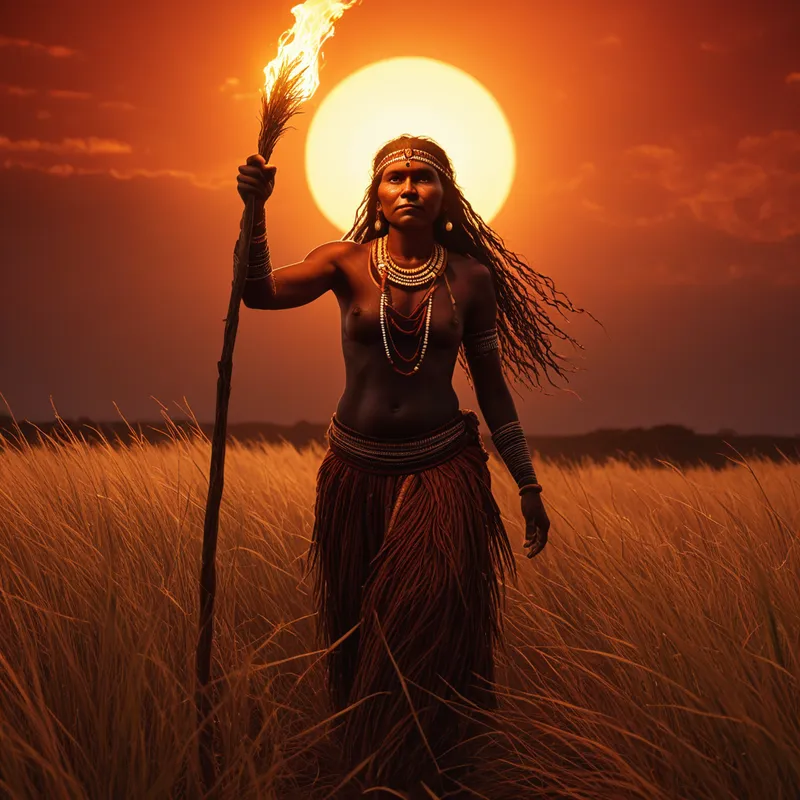
A primordial woman, searching for her lost child with a flaming torch, ascends into the sky to become the sun, lighting the world in an endless quest.
The Tale of Gnowee Sun Woman
In the time before time, when the world was soft and dark, there was a woman named Gnowee. She lived with her people on the earth, and she had a child, a small, bright spark of life that was her heart walking outside her body. One day, as the deep violet shadows of that first world grew long, her child wandered away. One moment he was there, a warm weight against her side; the next, he was gone, swallowed by the immense, featureless land.
A coldness seized Gnowee that was deeper than any night. She called out, her voice scattering against the silent hills. No answer came. So she took dry grasses and twisted them into a bundle. With a fierce breath of will and need, she sparked the first fire, lighting a torch. Its flame was a tiny, defiant sun in her hand.
She began to walk. She walked east, the torchlight pushing back the darkness, revealing stones and hollows. She peered into every shadow, called her child’s name into every valley. The land was vast and empty. She walked until the flame began to falter, and still, she found nothing but silence. So she climbed a high hill, and with a strength born of utter love and desolation, she thrust her torch into the sky, lighting a fresh, brighter one from its dying embers.
She walked on. North, then south, then west. Each day, her search grew more frantic, more vast. She climbed higher hills, seeking a vantage over the whole world. Her love was a furnace, her grief its fuel. The torches she lit grew larger, their light reaching further. She began to climb not just hills, but the very curve of the sky. Her feet left the earth, her body straining upward, the fire in her hand blazing with such intensity it consumed the old torch and became her very being.
And there she remained. Her search became the arc of the day. Each morning, she rises in the east, her torch—now her own glorious form—rekindled with desperate hope, scanning the earth below. She climbs the sky, pouring her light into every corner, leaving no crevice in shadow, searching, always searching. At the zenith of her climb, her light is fiercest, a blinding, all-revealing gaze. And as despair creeps in with the afternoon, she descends, her light softening to a sorrowful glow in the west, before she passes beneath the world to prepare her torch for the next day’s endless, loving quest. Gnowee became the sun, and her search for her lost child is the reason we have day.

Cultural Origins & Context
This is a creation narrative from the Wotjobaluk and related peoples of what is now southeastern Australia, in the state of Victoria. It belongs to the Dreamtime, or Alcheringa. These stories are not mere folklore but are the living, spiritual title deeds to the land, encoding law, ecology, and identity.
The myth of Gnowee was traditionally passed down through oral storytelling, often by Elders around campfires, with the landscape itself serving as a mnemonic map. The rising and setting sun was not an abstract astronomical event but the visible, daily enactment of this profound, emotional drama. Its societal function was multifaceted: it explained the celestial mechanics of the sun in human, relational terms, it underscored the paramount cultural value of caring for children and the profound responsibility of the community, and it modeled the depth of a mother’s love as a cosmic, shaping force. The story roots the people in their place, reminding them that the very light by which they live is born of a love as deep as their own.
Symbolic Architecture
At its core, Gnowee’s myth is about the transformation of personal, devastating loss into a universal, life-giving principle. Her search is not a failure but a sublime, creative act. The lost child represents not just a literal son, but any profound, core part of the self or a cherished connection that vanishes into the unconscious or the chaos of life. Her response is not passive grief, but active, illuminated seeking.
The ultimate sacrifice is not to give up one’s life, but to have one’s deepest personal sorrow become the eternal engine of the world’s light.
The torch is the symbol of conscious awareness, the spark of spirit that refuses to accept the darkness of oblivion. Her ascent into the sky signifies the necessary movement from an earth-bound, personal perspective to a cosmic, archetypal one. She does not find her child, but in becoming the sun, she ensures that nothing else will ever be lost in total darkness again. Her journey models the path from ego-centric pain to a transpersonal purpose.
The Dreamer's Resonance
When this myth pattern stirs in the modern psyche, it often manifests in dreams of searching. One might dream of looking for a lost object in an infinite house, chasing a fading figure through familiar-yet-alien streets, or holding a light that barely pierces an overwhelming fog. The somatic sensation is one of anxious striving, a tightness in the chest, a feeling of perpetual incompletion.
Psychologically, this signals a process of soul retrieval. Something vital—an early passion, a sense of innocence, a capacity for joy or trust—has gone missing in the darkness of one’s personal history, trauma, or adaptation. The dreaming ego, like Gnowee, is now compelled to light the torch of attention and begin the search. The endless nature of the dream-search mirrors Gnowee’s eternal quest; the resolution is not in finding the lost object in its original form, but in the transformative act of seeking itself, which gradually illuminates the entire landscape of the self.

Alchemical Translation
In the alchemy of individuation, Gnowee’s myth maps the process of transmuting lead into gold. The “lead” is the raw, heavy grief of a profound personal loss or lack. The “gold” is the radiant, enduring consciousness born from engaging with that loss consciously.
The first stage is nigredo: the blackening, the moment the child is lost—the plunge into despair, depression, or meaninglessness. Lighting the torch is the beginning of albedo: the whitening, the application of conscious effort and reflection (the light) to the dark, unconscious mass. Her climbing and searching represent citrinitas: the yellowing, the arduous work of raising the material to a higher level, gaining perspective. Finally, her ascension and permanent radiance as the sun is rubedo: the reddening, the achievement of a permanent, elevated state where the personal wound has been subsumed into a greater, life-affirming function.
Individuation does not promise the recovery of what was lost, but the sacred repurposing of the love that sought it. We do not heal to return to a former self; we heal to become a vessel for a greater light.
For the modern individual, this myth invites a reframing of one’s “endless searches”—for purpose, for healing, for wholeness. It suggests that the value lies not in a final, conclusive finding, but in the quality of light we generate and hold aloft during the search. Our most painful quests, when undertaken with love and conscious intent, can become the very thing that illuminates our path and warms our world.
Associated Symbols
Explore related symbols from the CaleaDream lexicon:
- Sun — The radiant, eternal form of Gnowee herself, representing consciousness, life-force, cyclical renewal, and a personal sorrow transformed into a universal gift.
- Fire — The elemental force of her torch and her own being, symbolizing will, passion, purification, and the illuminating spark of spirit that drives the search through darkness.
- Journey — The eternal, celestial path Gnowee walks across the sky, embodying the core narrative of a quest that is its own destination and transformation.
- Mother — The central archetype Gnowee embodies, representing unconditional love, profound sacrifice, and the creative, nurturing force that shapes reality from personal devotion.
- Light — The primary product of her search, representing awareness, hope, revelation, and the driving out of ignorance and the shadow of loss.
- Child — The lost object of the quest, symbolizing innocence, potential, a vital part of the self, or a pure connection that has slipped into the unconscious.
- Sky — The vast domain of her transformed existence, representing the transpersonal, cosmic perspective one must attain to alchemize personal pain into a higher purpose.
- Search — The eternal action at the heart of the myth, representing the active, conscious engagement with loss and the unconscious, which is itself the creative act.
- Sacrifice — Gnowee’s relinquishment of her earthly, personal life to become a celestial body, modeling the surrender of egoic attachment to serve a greater whole.
- Grief — The primal fuel for her transformation, the deep, dark emotion that, when consciously carried, provides the energy for profound creation and illumination.
- Origin — The myth is a story of origins, explaining the genesis of the sun from a deeply human, emotional reality, rooting cosmic order in relational love.
- Dream — The state from which this story emerges, the Dreamtime, and the realm where such archetypal patterns of searching and transformation continue to play out in the modern psyche.