Gnomes of Paracelsus Myth Meaning & Symbolism
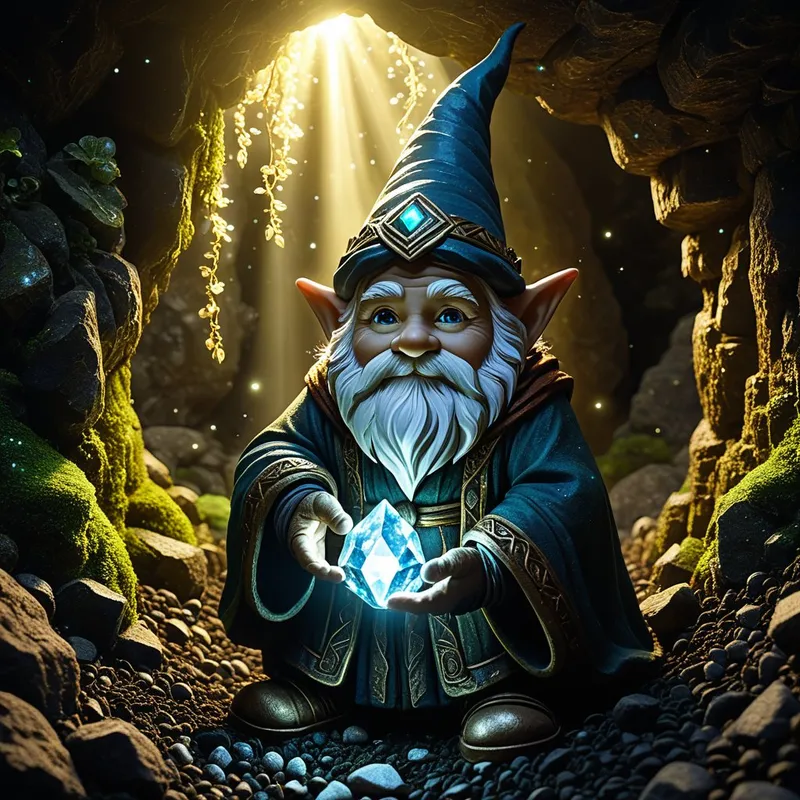
The alchemist Paracelsus names the Gnomes, spirits of the earth, revealing the hidden wisdom of the material world and the soul's deep, grounding foundation.
The Tale of Gnomes of Paracelsus
Listen, and hear a tale not of gods on high, but of spirits in the deep. In an age where the world was still a great, breathing mystery, when the boundary between stone and soul was thin as a veil, there walked a man of fire and intellect. His name was Paracelsus. He was a wanderer, a breaker of molds, his mind a crucible where the learning of the schools met the raw whisper of the world.
One night, in a chamber heavy with the scent of herbs and old parchment, Paracelsus labored. His quest was not for common gold, but for the prima materia—the first matter of all things. He sought the secret names of the world's bones. The candle guttered. The silence grew thick, a palpable thing. And in that silence, he felt not a presence, but an absence—a profound, patient stillness beneath his feet, deeper than any cellar.
He laid his hands upon the cold stone of the floor. He closed his eyes, and his vision turned inward and downward, through layers of foundation, through strata of clay and granite, into the absolute dark of the earth's belly. There, in that boundless dark, he did not see, but knew. He knew the slow, tectonic dream of the mountains. He felt the patient circulation of minerals, the secret rivers that flow not with water, but with the essence of ore and gem. And within that dream, he discerned shapes—not of men, but of the earth itself given consciousness: short, sturdy, ancient beyond counting. They were the keepers of veins of silver, the shepherds of growing crystals, the silent masons of the world's foundation.
They did not speak in words, for their language was the grinding of stone and the sigh of roots in deep soil. But to his inner ear, Paracelsus heard a name, or rather, he coined one from the very knowledge they imparted. "Gnomi," he whispered into the quiet room, the word itself feeling rough and solid on his tongue. "The knowers of the earth." In that moment, he did not discover them as one discovers a new land; he named them into being for the world of human understanding, pulling these formless spirits of the deep into the light of consciousness, giving them a home in language. The myth was born not from a battle, but from a profound act of recognition—a sage bowing to the intelligence of the abyss.

Cultural Origins & Context
This myth springs not from ancient oral tradition, but from the singular, revolutionary mind of Paracelsus in the 16th century. It is a product of the Renaissance, a time when the medieval worldview was fracturing under the pressure of exploration, science, and a revived interest in alchemy and hermetic thought. Paracelsus was a pivotal, controversial figure—a physician who rejected ancient dogma in favor of direct observation and experiment, yet one who fervently believed in an animate, ensouled universe.
His gnomes were part of his systematic classification of elemental spirits, detailed in works like Liber de Nymphis, sylphis, pygmaeis et salamandris. For Paracelsus, these beings were not mere fairy tales; they were real, as real as gravity or magnetism, representing the living intelligence inherent in the four classical elements: earth (gnomes), water (undines), air (sylphs), and fire (salamanders). The myth's societal function was twofold. For the common folk, it gave poetic form to the familiar, yet mysterious, power of the land. For the scholar and alchemist, it provided a metaphysical framework for interacting with the material world—one could not master matter without respecting its native spirit.
Symbolic Architecture
Psychologically, the Gnomes of Paracelsus represent the archetypal intelligence of the shadow and the body. They are the personification of the unconscious foundation of the psyche—all that is solid, instinctual, material, and often deemed "base" or "lowly." They dwell in the dark, not because they are evil, but because they are foundational, operating below the threshold of our bright, daytime awareness.
The gnome is the psyche’s bedrock, the silent keeper of forgotten memories, ancestral patterns, and the raw, unprocessed matter of instinct.
The act of Paracelsus naming them is the critical symbolic event. It represents the ego's (the conscious mind) courageous descent into its own depths to consciously engage with this earthy, shadowy content. The gnomes are "knowers" (gnomi), implying that profound wisdom—not intellectual, but visceral, practical, and sustaining—resides in what we ignore or trample underfoot. They symbolize the principle of grounding, the necessary connection to the physical, the mortal, and the real, without which any spiritual or intellectual pursuit becomes unrooted and manic.

The Dreamer's Resonance
When this myth stirs in the modern dreamer, it often signals a call from the depths of the somatic and instinctual psyche. To dream of gnomes, of earthy creatures, of burrowing, of cellars, caves, or suddenly fertile soil in unlikely places, is to experience the psyche's demand for grounding.
The dreamer may be going through a process where they have become overly identified with airy ideals, spiritual bypassing, or intellectual abstractions, leaving the body and its wisdom neglected. The gnome-dream is a somatic correction. It manifests as a felt sense of heaviness, density, or a pull downward. Psychologically, this is the process of re-membering—of bringing the fragmented, disembodied parts of the self back into contact with the earthy ground of being. It is the unconscious initiating a necessary descent, a nekyia, where the prized treasures (insights, stability, authentic power) are found not by rising above, but by digging into the dark, rich loam of one's own nature.
Alchemical Translation
In the alchemical opus, the first and most crucial stage is the nigredo—the blackening, the descent into the primal matter, the confrontation with the shadow. The myth of Paracelsus and the Gnomes is a perfect map for this initial, and often most feared, phase of psychic transmutation.
The modern individual's "prima materia" is their unexamined life, their complexes, their bodily tensions, and their repressed instincts. The alchemist's laboratory is their own consciousness. Paracelsus, the Sage archetype, models the attitude required: one must go into the dark (solutio and separatio into the unconscious) not with fear, but with a respectful curiosity, seeking to name what one finds. To name is not to control, but to acknowledge, to relate, to bring into the field of relationship.
Individuation begins not with soaring ambition, but with kneeling to touch the earth of one’s own soul and listening to its ancient, granular truth.
The "treasure" the gnomes guard—veins of metal, hidden crystals—symbolizes the latent potentials and innate value buried within our most basic, "earthy" nature: resilience, patience, sensuality, and the slow, sure wisdom of growth. The triumph of the myth is not an extraction, but a communion. The psychic transmutation occurs when the conscious mind (Paracelsus) stops overlooking the earth (the body, the shadow) and instead recognizes it as intelligent, sovereign, and essential to the wholeness of the Self. The gold produced is not arrogance, but groundedness—the philosopher's stone of an embodied, integrated life.
Associated Symbols
Explore related symbols from the CaleaDream lexicon: