Gleipnir Myth Meaning & Symbolism
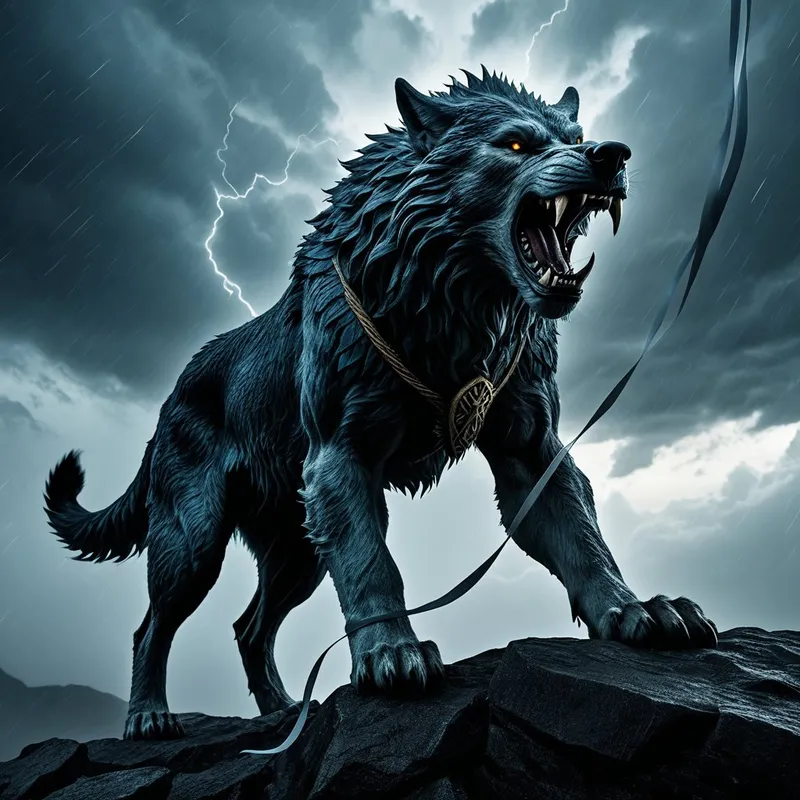
The gods forge a fetter from impossible things—a cat's footfall, a woman's beard—to bind the monstrous wolf Fenrir, a pact sealed with a god's hand.
The Tale of Gleipnir
Listen, and hear the tale of the third fetter, the one that holds the world in its balance. The air in Asgard was thick with a dread that no mead could wash away. For the wolf, Fenrir, grew not by day or by season, but by the very breath of prophecy. He was chaos given fang and fur, a shadow cast by the gods' own deeds, and his growth promised the twilight of all things.
Twice the Aesir had tried to chain him, with bonds named Lædingr and Drómi. Twice the great wolf had stretched, strained, and shattered them with a sound like mountains cracking. His laughter was a cold wind that froze the hearts of Odin and Thor. They knew brute force was a language he spoke better than they.
So they spoke in whispers and riddles. They journeyed to the realm of the dvergr, the deep-delvers in the stone-roots of the world. "Forge us a fetter," they said, "but forge it from that which does not exist." The dvergr understood the grammar of impossibility. They took the sound of a cat's footfall, which is silence. They took the beard of a woman, which is a contradiction. They took the roots of a mountain, the sinews of a bear, the breath of a fish, and the spittle of a bird. From these six impossibilities, they spun a cord smooth and soft as a silken ribbon, and they named it Gleipnir.
They brought it to the wolf on the island of Lyngvi, in the middle of the lake Ámsvartnir. "Test your strength against this trifle," they said, their voices honeyed with false cheer. Fenrir, wise to their tricks, looked upon the slender ribbon and smelled not iron, but paradox. "There is no fame in breaking so slight a band," he growled, "but I sense magic in its making. I will not let this be bound upon me unless one of you places a hand in my mouth as a pledge of good faith."
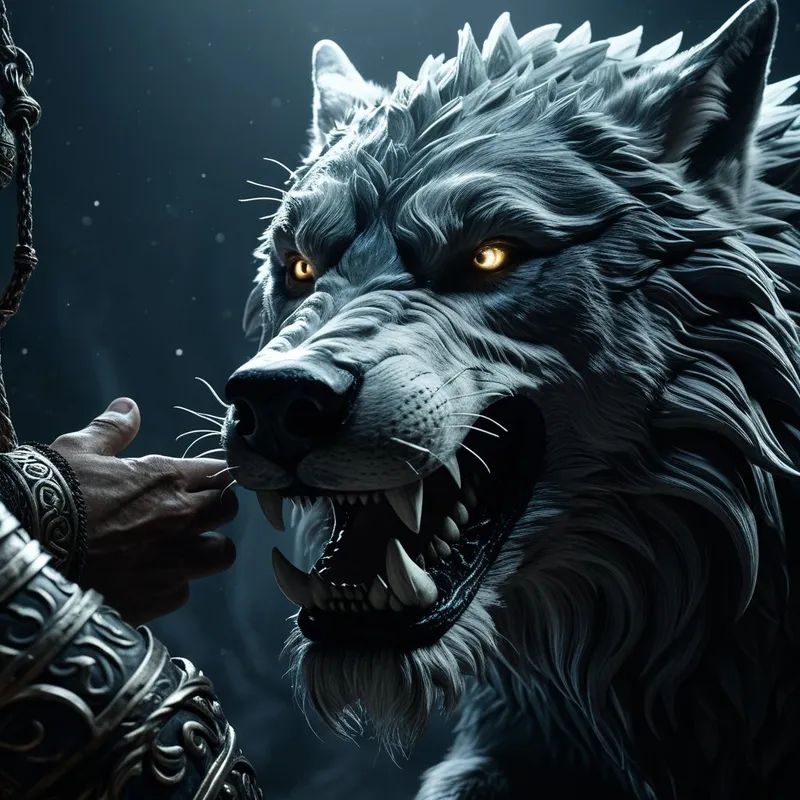
A stillness fell, colder than the lake's waters. The gods looked at one another, and their courage, so bold in the hall, wavered. Then Týr, whose word was law, stepped forward. Without a word, he placed his right hand—the hand of oath and sword-grip—between the wolf's jaws.
The ribbon was fastened. Fenrir kicked and struggled, but the more he strained, the stronger the fetter grew. The impossibilities held him fast. The gods roared with laughter, all but Týr. For as the wolf realized his eternal bondage, his great jaws snapped shut. The sound of breaking bone echoed across the silent lake. Týr stood, his honor intact, his hand gone, a sacrifice to seal the binding of chaos. They fastened Gleipnir to a great rock, Gjöll, and thrust a sword into the wolf's mouth to hold it agape, his howls a perpetual promise of the doom to come.
Cultural Origins & Context
This myth is preserved primarily in the Prose Edda of Snorri Sturluson and the earlier poetic fragments of the Poetic Edda. It was not mere entertainment but a foundational narrative for a culture intimately acquainted with harsh limits and existential threats. The Norse worldview was not one of ultimate victory over chaos, but of a temporary, hard-won order maintained through cunning, sacrifice, and bitter pact.
The story of Gleipnir would have been told in longhouses, its themes resonating with a people whose survival depended on binding the chaotic forces of nature, sea, and rival clans through law (itself a kind of fetter) and sacred oath. The myth functions as a cosmic exemplar. It explains why the world is not already torn apart—chaos is bound, but not destroyed. It validates the necessity of sacrifice (Týr's hand) for communal safety and the grim reality that even rightful actions can have maiming consequences. The teller of this tale was imparting a profound lesson: true strength often lies not in the hammer, but in the subtle, unbreakable thread of cunning and sworn word.
Symbolic Architecture
Gleipnir is the ultimate symbol of the paradoxical container. It is not stronger than the wolf; it is of an entirely different order. It represents the mind's capacity to bind formless, instinctual, destructive energy (Fenrir) not by opposing it directly, but by employing meta-level rules—the "impossible" materials of consciousness itself: silence, contradiction, essence.
The binding of chaos is not an act of conquest, but of translation. The raw, howling instinct must be fastened to the rock of conscious reality, where it can be witnessed, even if it cannot be tamed.
The six impossible ingredients are crucial. They represent non-material resources: the sound of a cat's footfall (stealth, subtlety), the beard of a woman (an overturned assumption), the roots of a mountain (stability from the unseen), the sinews of a bear (strength of wild nature), the breath of a fish (adaptation in a foreign element), and the spittle of a bird (freedom distilled). Together, they form a psychology. Týr's sacrifice is the linchpin. It symbolizes the terrible cost of integrity—the part of the Self (the guiding, law-making function) that must be willingly offered to gain control over one's own inner chaos. The oath is sealed with a piece of the oath-giver's very being.

The Dreamer's Resonance
When this myth stirs in the modern dreamer, it often signals a confrontation with a "Fenrir" complex—a growing, devouring force within the psyche. This could be a rage so vast it feels world-ending, a compulsive desire, or a foundational fear breaking its earlier chains. The dreamer may feel a monstrous growth inside them that "shatters" previous coping mechanisms (the broken fetters Lædingr and Drómi).
The appearance of a binding motif in dreams—a silken cord, a deceptively weak-looking constraint, a solemn pact—suggests the unconscious is attempting the Gleipnir solution. The psyche is searching for the paradoxical, non-linear way to contain what direct force cannot. The somatic experience can be one of immense tension—the strain of the bound thing and the grim relief of its restraint. A dream of losing a hand, particularly the right, may point to the Týr moment: a conscious sacrifice of a capacity (perhaps a way of acting in the world, a prized skill, an old identity) being made to secure a greater, if more painful, stability.

Alchemical Translation
For the individual on the path of individuation, the Gleipnir myth models a critical stage of psychic transmutation: the binding of the shadow.
The first, brute attempts to suppress our destructive or "unacceptable" impulses (the iron fetters) always fail, often strengthening the repressed complex. The alchemical work begins when we approach the shadow not with opposition, but with the "cunning of the dvergr." We must fashion our Gleipnir from the impossible things of self-awareness: the silent observation of our impulses (the cat's footfall), the acceptance of our inner contradictions (the woman's beard), and the connection to our deepest, stabilizing foundations (the mountain's roots).
Individuation requires forging a bond from what seems like nothing, creating a conscious relationship with the unconscious where once there was only fear and projection.
This binding is not annihilation. Fenrir remains, howling, a sword in his jaws—the painful truth of our nature held in awareness. The sacrifice of Týr's hand is the pivotal, conscious act. We must willingly sacrifice a degree of our innocent, untested "rightness" or our one-handed way of grasping the world. We lose a certain kind of control to gain a more profound form of integrity. The bound wolf, integrated but not assimilated, becomes a source of tremendous latent power, awaiting its destined role in our personal Ragnarok—the final, transformative crisis that leads to renewal. We bind our chaos not to deny it, but to harness its world-breaking power for the eventual rebirth of the Self.
Associated Symbols
Explore related symbols from the CaleaDream lexicon:
- Chain
- Tight
- Tie
- Trap
- Clip
- Binding/Fetters (Gleipnir)
- Knotted String
- Harness
- Entangling Vines
- Clamp
- Wrist Chain
- Lanyard
- Platinum Chains
- Paperclip
- Stapler
- Paperclip Chain
- Whirling Binder Clip
- Rubber Band Ball
- Chains
- Frayed Rope
- Snare Trap
- Nettle Fiber Cord
- Braided Rope
- Sinew String
- Loomed Fiber Rope
- Braided Leather
- Rawhide Rope
- Plant Fiber Rope
- Shimenawa Rope
- Sticky Texture
- Binding
- Knot