Gjallarhorn Myth Meaning & Symbolism
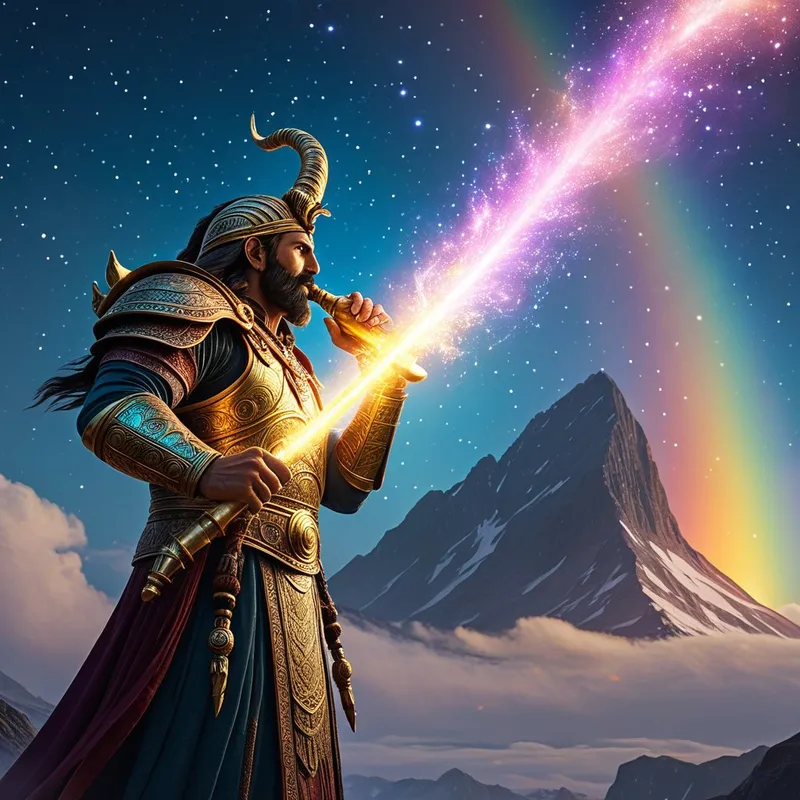
The horn of the god Heimdallr, hidden beneath the World Tree, whose sound will shatter the silence of the cosmos and herald the final battle of Ragnarök.
The Tale of Gjallarhorn
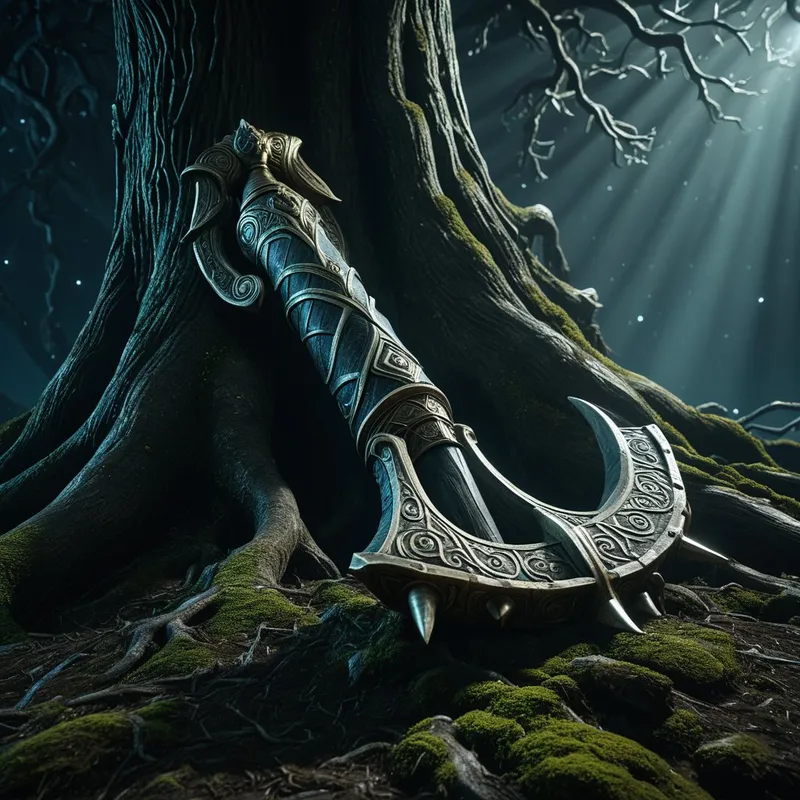
Listen. There is a silence at the root of the world, deeper than the sleep of mountains. It is the silence of the well Mímisbrunnr, where dark waters whisper with the memory of all things that were and the shadow of all things to come. And in that silence, cradled in the grip of the Yggdrasil’s mightiest root, lies a thing of power: Gjallarhorn, the Horn That Resounds.
Its keeper is Heimdallr, the whitest of the Æsir. He needs no sleep. His eyes see for a hundred leagues, by day or by night; his ears hear the grass growing on the earth and the wool growing on the sheep. He stands on the edge of things, where the shimmering bridge Bifröst arcs from the realm of gods to the world of men. His gaze is forever turned outward, across the misty plains of Midgard, toward the shadowed forests where chaos gathers.
He does not sound the horn. Not yet. Its voice is kept for the day when the bonds of the world begin to fray. He waits, a sentinel against the creeping frost, listening for the first, faint scratch of the Fenrisúlfr’s chain giving way, for the distant groan of the ship Naglfar being built. He waits for the moment the sun and moon are swallowed, and the stars fall from the sky like embers.
When that day dawns—a day with no true dawn—Heimdallr will turn from his post. He will stride to the very root of the Tree, where the waters of wisdom and fate commingle. He will take up Gjallarhorn. He will draw a breath that is not air, but the gathered tension of all the ages of watchfulness. And he will blow.
The sound will not be a call to battle. It will be the battle’s beginning. It will be the shattering of silence itself. It will ring through all the nine worlds, a note so profound it will vibrate in the marrow of mountains and in the dreams of the unborn. It will wake the gods from their halls and the einherjar from their benches. It will be the first and last alarm, the signal that the time of waiting is over. The time of ending has begun. And Heimdallr, having sounded the note that unravels the cosmos, will then take up his sword to meet his destined end, his watch finally complete.
Cultural Origins & Context
The myth of Gjallarhorn reaches us primarily through the Prose Edda of Snorri Sturluson and fragments of older Poetic Edda verse. It is not a standalone adventure tale but a crucial piece of eschatological machinery—the Norse vision of the end of the cosmic cycle, Ragnarök. This was not a myth of hope or salvation, but of fatalistic clarity.
In the Viking Age worldview, existence was cyclical and precarious, bounded by entropy and held together by oaths, wisdom, and vigilance. The myth was likely recited by skalds and elders not to terrify, but to orient. It answered the profound human question: "How does it all end?" By placing the horn in the care of the ever-watchful Heimdallr, the myth reinforced core societal values: the sacred duty of the watchman (a role vital for any community), the acceptance of inescapable destiny (ørlög), and the idea that even the gods are subject to a cosmic order whose final note had already been written. The horn’s sound was the ultimate alarm, transforming passive dread into active, purposeful confrontation with one’s fate.
Symbolic Architecture
Gjallarhorn is not merely a weapon or a tool. It is the embodiment of the Threshold. It exists in a state of potent latency, "hidden beneath the Tree," representing all that is known but not yet activated, all endings that are inevitable but have not yet begun.
The horn is the moment between the in-breath and the cry. It is the silence that contains the sound that will shatter it.
Psychologically, Heimdallr represents the conscious faculty of awareness—the part of the psyche that stands at the border between the ego (Asgard) and the vast, unknown outer world of the unconscious (Midgard and beyond). His senses are hyper-acute because true vigilance requires perceiving the subtle, the nascent, the barely-there. The horn, then, is the psychic instrument that translates a perceived inner or outer threat—a growing shadow, a broken oath, a fundamental dissonance—into an undeniable, conscious signal. It is the function that ends denial. It sounds when the psyche can no longer maintain a fractured status quo, heralding an internal Ragnarök—a necessary, destructive crisis that precedes renewal.

The Dreamer's Resonance
When the motif of Gjallarhorn echoes in modern dreams, it rarely appears as a literal Norse artifact. Its presence is felt in the quality of the sound or the act of signaling. One may dream of a deafening alarm bell that cannot be silenced, a phone ringing with urgent, world-shattering news, or the act of screaming a warning that emerges as a silent, powerful light.
Somatically, this can correlate with a state of high anxiety, a "feeling in one's bones" that a major life change is imminent—the end of a relationship, career, or identity. The dream psyche is sounding the horn. It is the psychological process of catastrophization made manifest, where the unconscious forces a conscious recognition of a brewing crisis. The dreamer is in the role of Heimdallr, being compelled to finally acknowledge what they have long seen and heard on the horizon of their awareness. The terror of the dream is the terror of the inevitable being made present.

Alchemical Translation
The individuation process, the journey toward psychic wholeness, requires its own Ragnaröks. Outworn personas, destructive complexes, and childish dependencies must meet their destined end. The alchemical translation of this myth lies in the courage to sound your own horn.
The most profound act of self-care can be the conscious decision to initiate the ending, rather than waiting passively for the collapse.
First, one must cultivate the Heimdallr faculty: a committed, vigilant self-observation. This is the "watchman at the bridge" of consciousness, noting the creeping frost of resentment, the gathering storm of unmet potential, the subtle gnawing of the wolf of despair on its chain. Then, instead of fearing the horn’s note, one must learn to wield it. To consciously choose to end a toxic situation, to speak a devastating truth, to let an old self die, is to put the Gjallarhorn to your lips and blow. You are summoning your entire psyche—all your inner gods and warriors—to a final, necessary battle against what binds you.
The sound of the horn is not annihilation, but brutal, honest communication. It says, "This ends now." The destruction that follows is not a failure, but the forging fire of the cycle. For the Norse, after Ragnarök, a new, green world rises from the sea. So too, after the internal horn-call, a more authentic, integrated self can emerge from the waters of the unconscious, ready to inhabit a world where the long watch has finally, mercifully, ended.
Associated Symbols
Explore related symbols from the CaleaDream lexicon: