
Giselle Myth Meaning & Symbolism
A peasant maiden dies of a broken heart and joins the spectral Wilis, finding the power to forgive her betrayer and transcend vengeance.
The Tale of Giselle
Listen, and let the curtain of mist part. In a village nestled where the forest meets the field, there lived a maiden named Giselle. Her heart was a bird, her feet its wings, and her joy was the simple, spinning dance of life. She loved a handsome villager she knew as Loys, whose eyes held a promise that made the sun seem dim. But Loys was a phantom name, a skin worn by Albrecht, a nobleman slumming in a pastoral dream, his engagement to another a secret coiled in his silken doublet.
The world was ripe and golden until the hunt arrived—the blast of horns, the glitter of courtiers. Among them, Albrecht’s true betrothed, Bathilde. The riddle unraveled in the village square. A rival, Hilarion, tore the disguise away. The truth was a physical blow. Giselle’s bird-heart broke against the cage of reality. The joyous dance became a frantic, shuddering spiral—the Danse de la Folie. She grasped Albrecht’s sword, its cold weight a final, terrible truth, before her spirit fled her body, leaving only a shell cradled by her grieving mother.
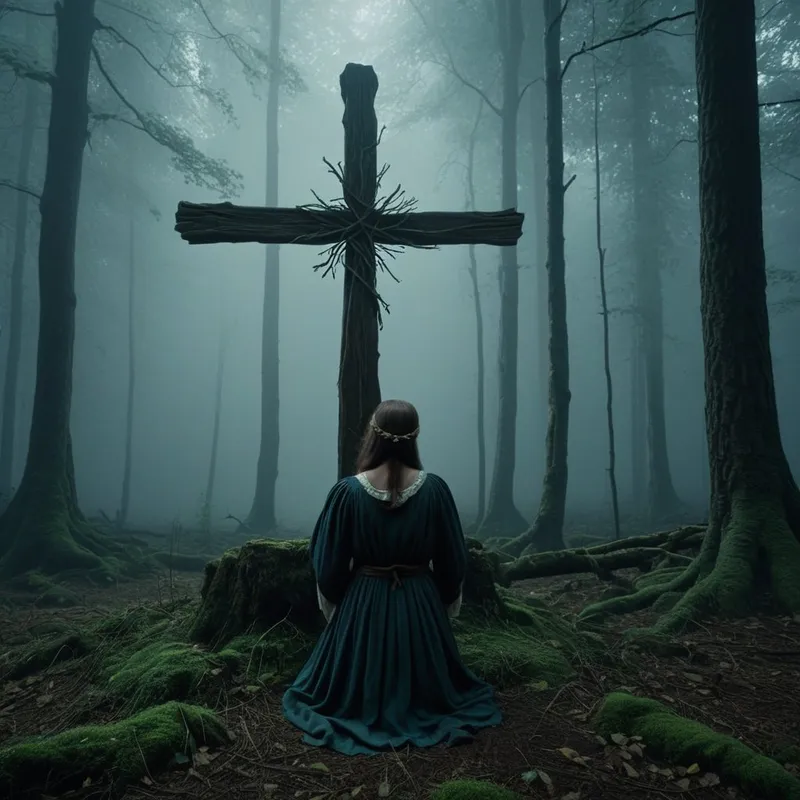
This is where the first tale ends, and the second, deeper one begins. Giselle was laid to rest in the forest, beneath a cross woven from whispers. But this forest was a borderland. When the moon crowned midnight, the glade belonged to Myrtha and her legion, the Wilis. Clad in tulle and vengeance, they were the collective fury of betrayed love. Giselle, a bride of death, was initiated. Her innocence was shrouded in their ghostly grace, her sorrow weaponized.
Into this spectral court stumbled two intruders: Hilarion, driven by guilt, and Albrecht, by grief. The Wilis’ justice was swift and cruel. With their cold, mesmerizing dance, they encircled Hilarion and drove him to drown in the marsh’s black embrace. Albrecht was next, seized by the inexorable rhythm, dancing toward his exhaustion and doom.
But then, a miracle of the soul. From within the chorus of vengeance, Giselle emerged. Not to join the dance of death, but to interrupt it. She placed herself between Albrecht and Myrtha’s will. She danced with him, not against him, her movements now a shield, a sustenance, a forgiveness made visible. She guided him to the sanctuary of her cross. As dawn’s first light pierced the trees, the power of the Wilis faded. Their forms dissolved into the rising mist. Albrecht, alive, was left alone in the glade, clutching at the empty air where Giselle’s spirit had bestowed a mercy he did not earn, and a love that transcended even death. She did not return to him. She was simply… released.
Cultural Origins & Context
The myth of Giselle was not exhumed from ancient soil but consciously forged in the Romantic crucible of 19th-century Europe. Its premiere in Paris in 1841 was a product of specific cultural alchemy: the libretto by Théophile Gautier (inspired by Heinrich Heine’s prose on Slavic folklore), the score by Adolphe Adam, and choreography by Jean Coralli and Jules Perrot. It was passed down not by oral bards, but by the exacting lineage of ballet masters, choreographic notation, and the embodied memory of dancers.
Its societal function was multifaceted. For the burgeoning bourgeois audience, it offered a sublime escape into a world of supernatural poetry and heightened emotion, a perfect vessel for the Romantic obsession with the Gothic, the pastoral, and the tragic maiden. For the art form itself, Giselle represented a pinnacle of the ballet blanc, establishing the ballerina as an otherworldly, almost divine figure. The myth served as a perfect vehicle to showcase the new technical ideal: the illusion of weightlessness, the fragility and ethereal strength of the female dancer, making the supernatural physically believable. It became, and remains, a rite of passage for the prima ballerina, a role that tests not only technical prowess but the ability to incarnate a profound psychological journey from human passion to ghostly compassion.
Symbolic Architecture
At its core, Giselle is a myth of the Anima in its dual aspect: the destroyed human lover and the transcendent spiritual guide. Giselle’s arc maps the transformation of personal, embodied love into impersonal, redemptive grace.
The broken heart is not an end, but a initiation. It is the shattering of the vessel of personal desire, through which the spirit may pass into a broader economy of compassion.
Albrecht represents the ego entangled in deception and privilege. His disguise as Loys is the persona—the mask worn for selfish gratification. His exposure is the necessary humiliation of the ego, the collapse of the false self. The forest of the Wilis is the unconscious, specifically the realm of the wronged feminine. Myrtha is the archetype of the vengeful anima, the accumulated, unprocessed rage of all betrayed love. She is a necessary force, the psychic law that seeks to balance the scales through destruction.
Giselle’s ultimate choice is the myth’s central alchemy. She moves from being a subject of the collective wrath (a Wili) to becoming an agent of individual mercy. She does not deny the betrayal or its pain; instead, she transcends the compulsive, collective response to it. Her forgiveness is not a condoning of the act, but a liberation from the cycle of vengeance that would otherwise chain her spirit to the betrayer forever.

The Dreamer's Resonance
When this myth stirs in the modern dreamer, it often signals a profound process of emotional integration following a betrayal or heartbreak. To dream of being Giselle is to feel the somatic memory of the “mad scene”—a sense of identity unraveling, of a foundational truth being ripped away, leaving the psyche in a shuddering, disoriented state. The body in the dream may feel weightless yet heavy, capable of frantic motion yet utterly drained.
The appearance of the Wilis in a dream—a chorus of identical, relentless, graceful yet cold feminine figures—points to the activation of a complex. This is not just one’s personal hurt, but the awakening of a deeper, ancestral layer of pain related to abandonment, betrayal, or the suppression of the feminine. The dreamer may feel pursued by these feelings, danced to exhaustion by their own unresolved grief and anger.
The dream’s resolution, if it follows the myth, is not reunion but release. It is the dream-ego finding, within the chorus of its own pain, a singular voice of compassion—for oneself and, paradoxically, for the one who caused the wound. This is not a logical act but a symbolic one, indicating the psyche’s movement from being a victim of its complexes toward becoming the conscious mediator of them.

Alchemical Translation
The individuation process modeled by Giselle is the transmutation of a love-complex into a spiritual function. The first stage, nigredo, is the blackening: the shock of betrayal, the death of trust, the “mad scene” of the ego’s dissolution. Giselle’s physical death is the symbolic death of the old naive identity that believed in the perfect, untested love.
Her initiation into the Wilis is the albedo, the whitening. Here, the raw, black pain is purified into a cold, focused, and collective form—the silver vengeance of the ghostly brides. This is a necessary stage; the pain must be acknowledged and given a form, rather than repressed. However, to remain here is to become Myrtha, a ruler of a kingdom of death, forever bound to the wound.
The ultimate alchemy is not in escaping the wound, but in using its shattered edges as a lens through which a broader light is perceived.
Giselle’s final act embodies the rubedo, the reddening or culmination. She takes the purified substance of her pain (her Wili nature) and, through an act of conscious will, applies it not for destruction but for preservation. She saves Albrecht not out of renewed personal love, but out of a compassion that sees his humanity—his weakness, his remorse—beyond his crime. In doing so, she saves herself from becoming eternally identified with the archetype of the vengeful spirit. She differentiates. She becomes an individual within the collective unconscious.
For the modern soul, the myth instructs that the path through profound betrayal is not around the heartbreak, but through its very center. One must first join the “Wilis” of one’s own justified anger, feel its full force. But the journey cannot end there. The final, most difficult step is to find, within that cold fury, the ember of a forgiveness that is not forgetfulness, but freedom—releasing the other, and in doing so, releasing the self from the tomb of the past to greet the dawn, alone, whole, and finally light.
Associated Symbols
Explore related symbols from the CaleaDream lexicon: