Ginkgo biloba Myth Meaning & Symbolism
A primordial tree, sole survivor of cosmic fire, becomes a living fossil holding the memory of time and the promise of union between opposites.
The Tale of Ginkgo biloba
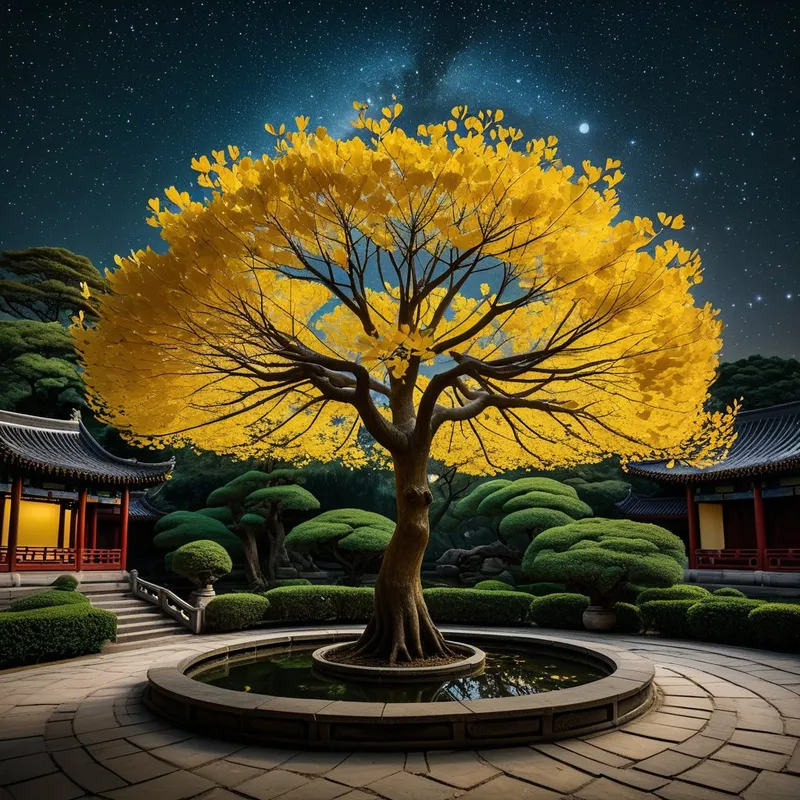
In the time before time, when the Hundun had just begun to settle, the world was a garden of celestial wonders. Among them stood the first forest, where trees whispered with the voices of the elements. The most splendid of all was the Yuánshǐ Yínxìng, the Primordial Ginkgo. Its trunk was silver like the moon’s path, and its leaves were fans of purest jade, each one a perfect balance of two halves—a symbol of the Yīn and Yáng in harmonious embrace. It was the tree of memory, its rings holding the unspoken history of the cosmos.
But chaos is never fully tamed. From the southern reaches, a cataclysm stirred. The Zhū Què, the Vermilion Bird of the South, embodiment of the fire element, grew restless in its celestial quadrant. In a rage, it unleashed a river of heavenly fire that swept across the land. The inferno consumed the first forest. The pines roared into ash, the cedars became pillars of flame, and the air itself wept smoke. The Primordial Ginkgo felt the searing breath of the fire. Its jade leaves blackened and curled. The sap in its veins boiled.
Yet, deep within its heartwood, a different memory stirred—not of growth, but of the profound stillness that existed before growth. It remembered the deep, cool dark of the earth, the patient silence of stone. As the fire licked its bark, the Ginkgo did not fight. It turned inward. It let its outer form be scorched, while its essence retreated into a seed of pure potential buried in its core. The great tree was reduced to a skeletal monument, a charcoal sentinel in a wasted land.
The fire passed. The rains came, wept by the Qīng Lóng. For a thousand years, the scarred husk stood, a tombstone for a lost world. The other gods believed the Ginkgo’s story was over. But in the silent, patient heart of the earth, the seed remembered. It remembered the shape of the leaf, the balance of the lobes, the taste of the rain. With a slowness that defied time, a single, tender green shoot pushed through the ash at the base of the monolith. It unfurled not a jade leaf, but a leaf of the most resilient gold.
This new tree was no longer the untested splendor of the Primordial. It was the Huózhuó Huàshí. Its golden leaves were a testament to the fire it had endured. It bore no flowers in the conventional sense, but produced strange, fleshy seeds that carried the faint, enduring scent of life persisting through decay. It became the sole inheritor of that first garden, a living bridge across an abyss of extinction. It did not speak of the fire with bitterness, but wore its golden leaves as a quiet, luminous chronicle. It had become the keeper of time, the tree that remembered so that the world would not have to forget.
Cultural Origins & Context
The Ginkgo, while possessing a rich symbolic life in China, does not originate from a single, codified mythological epic like the tales of the Yellow Emperor. Its mythos is ecological and philosophical, woven into the fabric of Daoist thought and later, Buddhist temple gardens. The "myth" is less a narrative of gods and heroes and more a story told by the tree itself through its sheer, improbable existence.
It was observed by ancient scholars and monks as a tree of incredible longevity and resilience, often planted in temple courtyards. Its unique, fan-shaped, bilobed leaf became a natural symbol for Yīn-Yáng duality. Its status as a "living fossil"—a species that survived unchanged while all its contemporaries perished—cemented its legendary status. The story of surviving a cosmic fire is a poetic extrapolation, a narrative cloak for the biological truth witnessed over millennia. It was passed down not by bards, but by botanist-sages, gardeners, and poets who saw in its endurance a profound lesson for human life. Its societal function was as a living memento mori and memento vitae—a reminder of fragility and an emblem of unyielding persistence.
Symbolic Architecture
The Ginkgo is a master symbol of paradoxical union. Its entire being is an argument against simple binaries.
The tree does not choose between fire and earth, memory and oblivion, life and death. It becomes the vessel in which these opposites are forced into a lasting, golden truce.
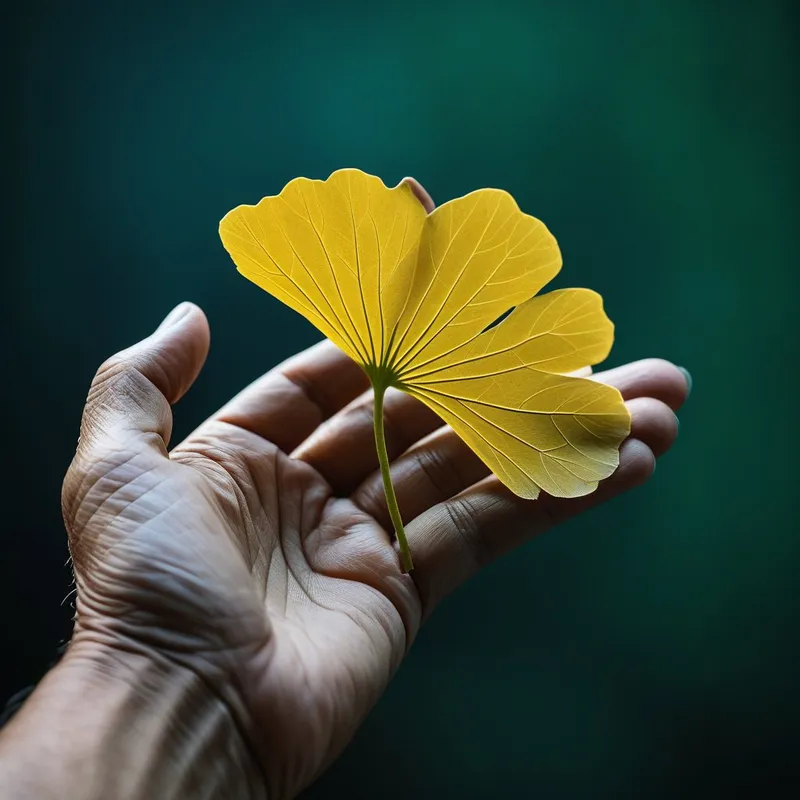
Its bilobed leaf is the most immediate symbol. It is not one leaf split, but two distinct halves joined at a central stem—a perfect visual for the Yīn-Yáng principle. It represents the psyche’s inherent duality: conscious and unconscious, masculine and feminine attributes, logic and intuition. The golden color of its autumn foliage is alchemical. It is not the green of naive growth, but the gold of tested, tempered spirit—the color of value forged in the fires of experience. The foul-smelling seed within a beautiful golden shell is another profound paradox, speaking of the necessary, fertile decay (the putrefactio of alchemy) at the heart of renewal.
Psychologically, the Ginkgo represents the Self as a living fossil. It is that core of our being which survives all personal cataclysms—trauma, loss, transformation—not by remaining untouched, but by retreating into a seed of essential identity, waiting to re-sprout in a new, more resilient form. It is the archetype of endurance through adaptation, not resistance.
The Dreamer's Resonance
When the Ginkgo appears in a modern dream, it is often a sign that the psyche is processing deep time and ancestral memory. It is not a tree of quick growth, but of glacial, patient integration.
To dream of a golden Ginkgo tree in full autumn splendor may indicate the dreamer is in a phase of harvesting wisdom from a long, difficult period. The suffering has passed, and what remains is a luminous, condensed understanding. A lonely, leafless Ginkgo in a winter landscape often points to a felt sense of being a "living fossil" oneself—feeling archaic, out of step with the times, yet possessing a deep, unshakeable inner structure. The dream may be asking the dreamer to honor this deep-rootedness.
Dreams featuring the distinctive bilobed leaf, perhaps floating in water or held in the hand, frequently surface when the dreamer is grappling with a core duality or conflict in their life. The leaf is a somatic symbol, an image handed to the conscious mind by the unconscious, suggesting that the solution lies not in choosing one side, but in finding the central stem that connects and balances both. The often-reported smell of the rotting seeds in a dream can be a challenging but crucial symbol, indicating the necessity of engaging with something repulsive, forgotten, or "rotten" in one’s personal history to release its fertile potential.
Alchemical Translation
The myth of the Ginkgo models the alchemical process of psychic individuation with stunning clarity. The initial state is the Primordial Ginkgo—the naive, unconscious wholeness of childhood or an undeveloped personality. It is beautiful but untested.
The cosmic fire is the inevitable nigredo, the descent into the darkness of suffering, depression, crisis, or profound disillusionment. It is the necessary destruction of the old, naive form.
The tree’s apparent death and retreat into the seed symbolize the mortificatio stage. The ego, or the old self-concept, is scorched away. This is a period of introversion, depression, or feeling spiritually barren. One becomes a "living fossil," carrying life in potential only. The crucial work here is not action, but memory—holding onto the essential core of who one is beneath the trauma.
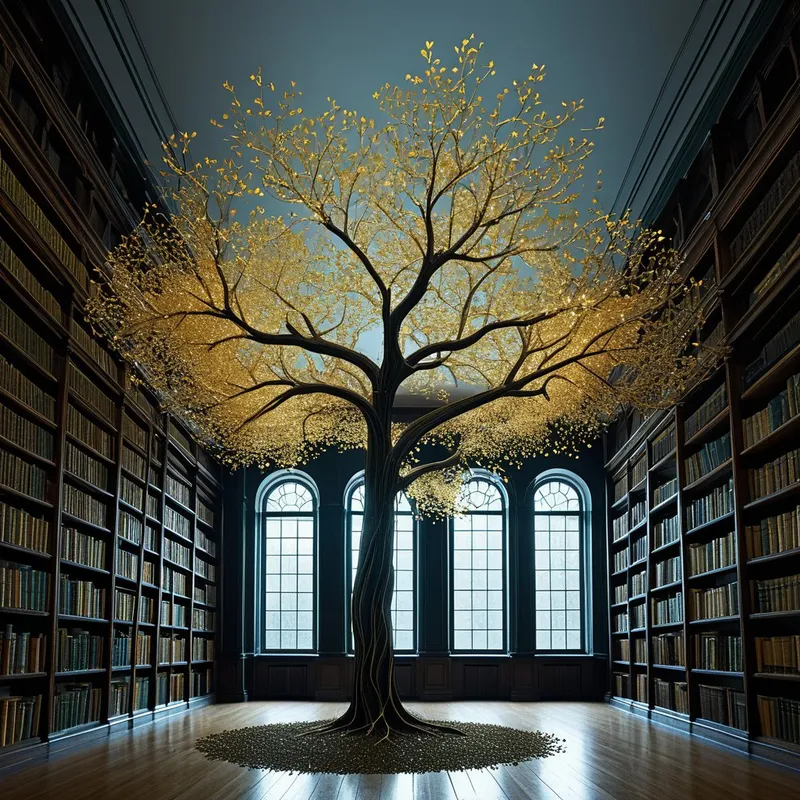
The re-sprouting is the albedo, the whitening, the first dawning of a new consciousness. But the Ginkgo does not return to green. It achieves the citrinitas, the yellowing, and ultimately the rubedo, the red-gold of completion. Its new golden leaves represent the hard-won philosophical gold—a perspective tempered by fire. The enduring, foul-smelling seed is the final, integrated truth: that wholeness includes the acceptance of one’s own "rot," one’s shadow, one’s mortality, as a source of fertility.
For the modern individual, the Ginkgo’s lesson is that our deepest transformations are not about becoming something entirely new, but about becoming more resilient, more integrated versions of our primordial blueprint. We survive our personal cataclysms by allowing the fire to strip us to our essential seed, and then having the patience—spanning years, even decades—to grow back, not to innocence, but to a wise, golden, and enduring complexity. We become the sage that has witnessed the fire and chosen to remember it as light.
Associated Symbols
Explore related symbols from the CaleaDream lexicon: