Geri and Freki Myth Meaning & Symbolism
The two wolves who feast beside Odin, embodying the ravenous instinct and fierce loyalty that accompany divine consciousness and sovereignty.
The Tale of Geri and Freki
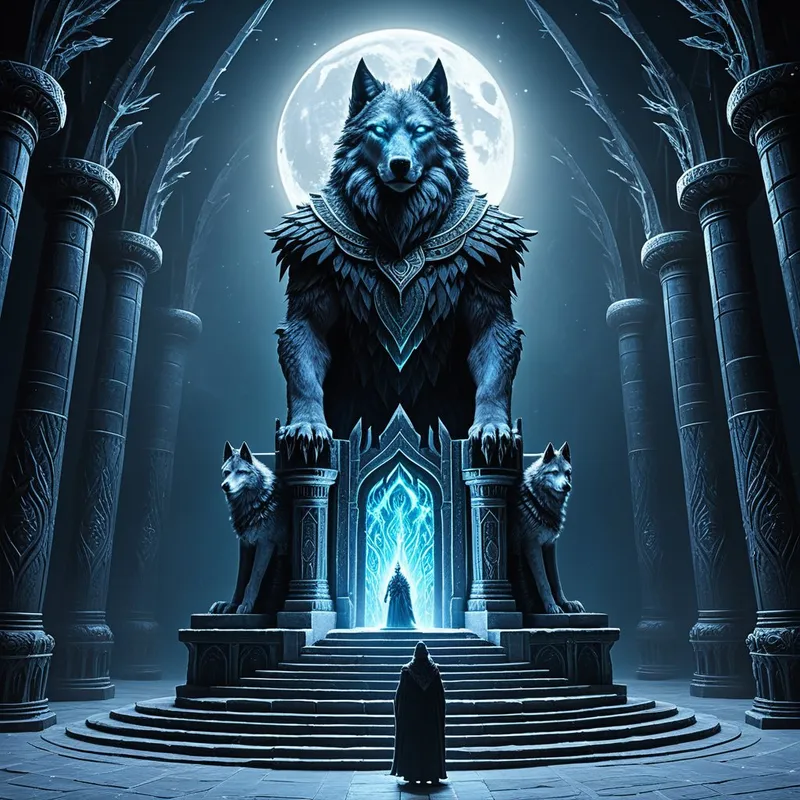
Hear now, and listen well, by the crackle of the long-fire and the whisper of the wind in the Yggdrasil's branches. In the high hall of Asgard, where the rafters are spears and the roof is shields, sits the All-Father. Odin the One-Eyed, his gaze seeing all that was, is, and shall be. His throne, Hliðskjálf, is not a seat of rest, but a seat of seeing. And he is never alone.
From the shadows at the foot of the dais, a low growl rumbles, not of threat, but of presence. Two shapes resolve from the gloom, massive and silent as falling snow. Geri, the Ravenous One, his pelt the deep, consuming black of the space between stars. Freki, the Greedy One, fur like the first hard frost that bites the earth. They are extensions of his will, his hunger given form. They pad forward on paws that make no sound on the strewn rushes, coming to rest on either side of the high seat. Their amber eyes, twin flames in the dim hall, watch the same distant horizons as their master.
A feast is laid in the hall of Valhalla. The Einherjar roar with laughter and clash their cups, devouring the flesh of the great boar Sæhrímnir, drinking deep the mead that flows from the udder of the goat Heiðrún. The scent of roasting meat is thick enough to taste.
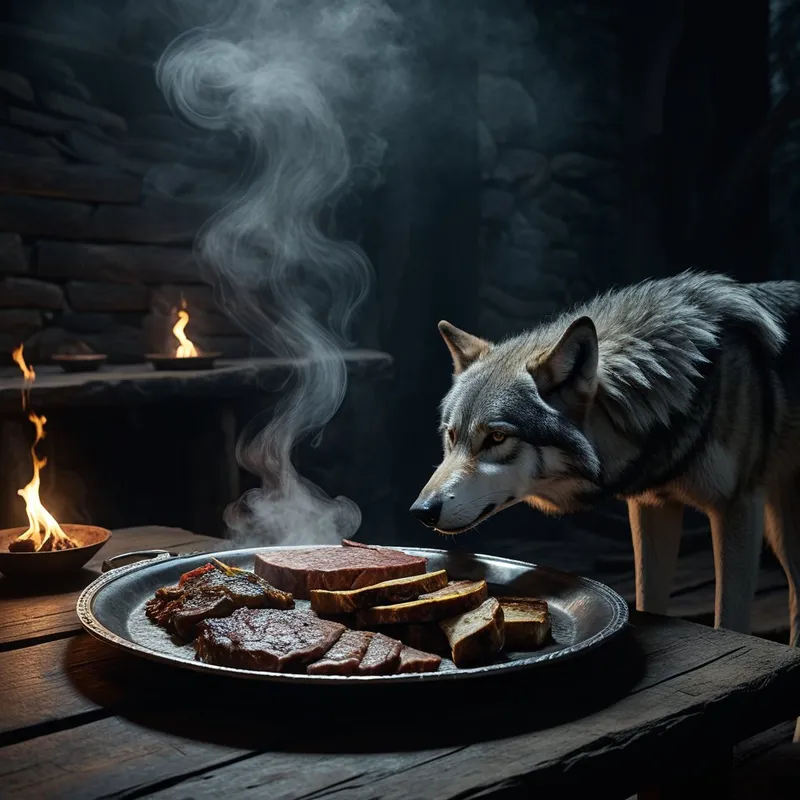
But at the high table, Odin does not eat. He sits, his single eye seeing the threads of fate spun by the Norns. Before him is a platter, heaped with the finest cuts. The steam rises, a fragrant offering. Geri and Freki sit at attention, their nostrils flaring, yet utterly still. They do not drool. They do not whine. Their hunger is a vast, patient silence.
For the All-Father's sustenance is not of this meat. His is the wine of poetry, the bread of knowledge. He gives the feast to his companions, to the embodiments of his own relentless drive. With a gesture as slight as a thought, he grants them the bounty. And they fall to, not with the mindless frenzy of beasts, but with the terrible, efficient purpose of forces of nature. They consume all, leaving not a scrap, for their hunger is as infinite as their master's quest for wisdom. They are fed, and in their feeding, they complete the circle of his sovereignty. They are the jaws of his power, ever-hungry, ever-loyal, feasting so that he may see beyond the need to feast.
Cultural Origins & Context
The primary sources for Geri and Freki are sparse yet potent, found in the poetry of the Poetic Edda and the later prose Prose Edda by Snorri Sturluson. In the poem Grímnismál, Odin, disguised as Grímnir, declares: "Geri and Freki the war-famed, the greedy Hroptatýr feeds; on wine alone the weapon-glorious Odin ever lives." This is not a detailed narrative but a symbolic fixture in the divine portrait of the god.
This myth was not a bedtime story for children, but a piece of the complex theological and cosmological mosaic understood by skalds, warriors, and those who contemplated the harsh realities of their world. The image of the god who forgoes physical sustenance for his wolves speaks to a culture intimately familiar with sacrifice, allocation of resources, and the chain of being. Odin’s wisdom and power come at a cost—a cost often borne by others (his eye, his hanging on Yggdrasil). Geri and Freki represent another facet of that cost: the raw, instinctual force that must be acknowledged and directed, not denied. They were likely invoked in understanding the nature of kingship and leadership—a ruler must have at his command both the refined mind (Odin) and the potent, executing force (the wolves).
Symbolic Architecture
Geri and Freki are not mere pets; they are psychopomps of a particular kind, guiding not souls to the afterlife, but primal energy into the service of consciousness. They symbolize the untamed instincts—hunger, ambition, aggression, territoriality—that are part of the sovereign self.
The ruler who denies his wolves starves his own throne. True sovereignty is not the absence of hunger, but the conscious direction of its ferocity.
Their duality—often interpreted as a pair, perhaps representing complementary forces like strategic aggression (Geri) and possessive defense (Freki)—signifies that these instincts are not a monolithic "beast" but a complex system. They are Odin's fylgjur (fetch spirits) in the most profound sense, his attendant spirits that are both part of him and distinct. Crucially, Odin feeds them from his own plate. He does not banish them, nor does he let them run wild. He integrates them. He sacrifices his own physical nourishment (a metaphor for simplistic, mundane consumption) so that his instincts are sated and loyal, freeing him to pursue the metaphysical nourishment of wisdom. The wolves get the meat; Odin gets the mead of poetry. This is a profound model of psychological integration: the conscious ego (Odin) acknowledging and providing for the shadow (the wolves), thereby transforming raw instinct into loyal power.
The Dreamer's Resonance
When the imagery of Geri and Freki pads into the modern dreamscape, it often signals a critical moment of confrontation with one's own "hungers." These are not necessarily base or shameful. To dream of two wolves, especially ones that are watchful, waiting, or accompanying a central, authoritative figure (which may be the dreamer themselves), points to a somatic recognition of powerful drives coming to the fore of the psyche.
The dreamer may be on the cusp of a leadership role, a creative project, or a necessary battle for personal boundaries. The wolves represent the immense energy required—the hunger for success (Freki's greed) and the ravenous focus needed to achieve it (Geri's voracity). The psychological process is one of mobilization. The dream asks: Are you feeding these forces, or are you trying to ignore them? Are they restless and threatening because they are starved, or are they sitting loyally at your side because you have acknowledged their power? A dream where the wolves are aggressive may indicate unintegrated shadow energy running amok. A dream where they are calm and attentive suggests the dreamer is learning to channel their primal drives with conscious authority.

Alchemical Translation
The alchemical process modeled here is the transmutation of the prima materia of instinct into the gold of conscious will. In the vessel of the self, the base metals are our raw, often conflicting, appetites and aggressions. The myth provides the formula.
First, Correction: Recognize the wolves as part of your own court. Do not project them onto others as enemies or fears. They are your Geri and your Freki. Second, Sacrifice: The conscious ego must give up the simplistic idea of "having it all" for itself. It must willingly offer the "meat" of its petty indulgences, its scattered attention, and its unexamined impulses to feed these concentrated powers. This is the sacrifice of childish consumption for adult responsibility.
Individuation is the feast where the Self, as sovereign, presides. It partakes of the divine mead, while its loyal instincts, well-fed and purposeful, guard the boundaries of its becoming.
Finally, Coagulation: The integrated result is not a tamed beast, but a formidable alliance. The wolf-energy, now loyal and directed, becomes the protective, executing force of the individuated psyche. The individual gains the courage of Geri and the tenacity of Freki, not as uncontrolled reactions, but as faculties of a sovereign Self. One no longer is hungry and aggressive; one commands Hunger and Aggression, who sit at one's side, feasting on the challenges of life, freeing the center of consciousness to engage in the higher work of insight, creativity, and wise rule over one's own inner kingdom. This is the ultimate translation: from being devoured by one's instincts to having them as devoted companions on the high seat of one's own destiny.
Associated Symbols
Explore related symbols from the CaleaDream lexicon: