Gerald Gardner Myth Meaning & Symbolism
The story of a man who, in a world stripped of magic, remembered the Old Ways and gave them a new name, forging a path back to the sacred.
The Tale of Gerald Gardner
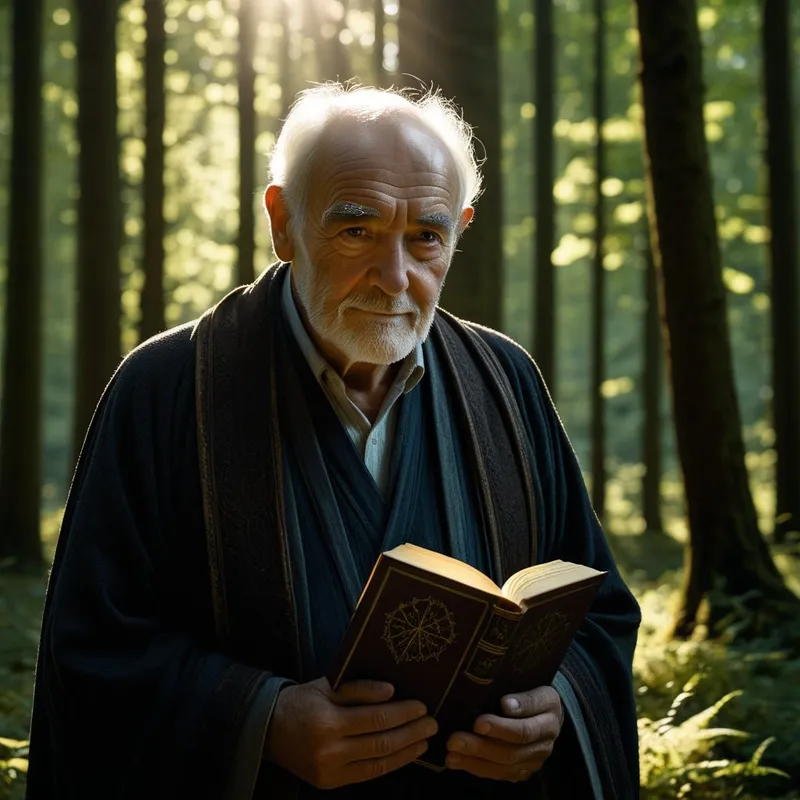
Listen, and hear a tale not of ancient stone circles, but of a man who walked between worlds. In a time when the world was grey—a time of factories, of smoke, and of a great forgetting—there lived a man named Gerald. His bones had known the jungles of the East, his eyes had seen many strange rites, but his soul carried a hollow ache, a longing for a magic his world declared dead.
He returned to the green heart of England, to the New Forest, where the old oaks whispered secrets the modern ear could not hear. It was here, in the deep shadow of impending war, that the veil thinned. He was led, by fate or by cunning, to a coven. They were the People of the Old Ways, keepers of a flame that had flickered in hidden hearths for centuries. Under a moon swollen with portent, they initiated him. They spoke of the Lady and the Lord, of the turning Wheel of the Year, of power drawn not from domination, but from the sacred pulse of life itself.
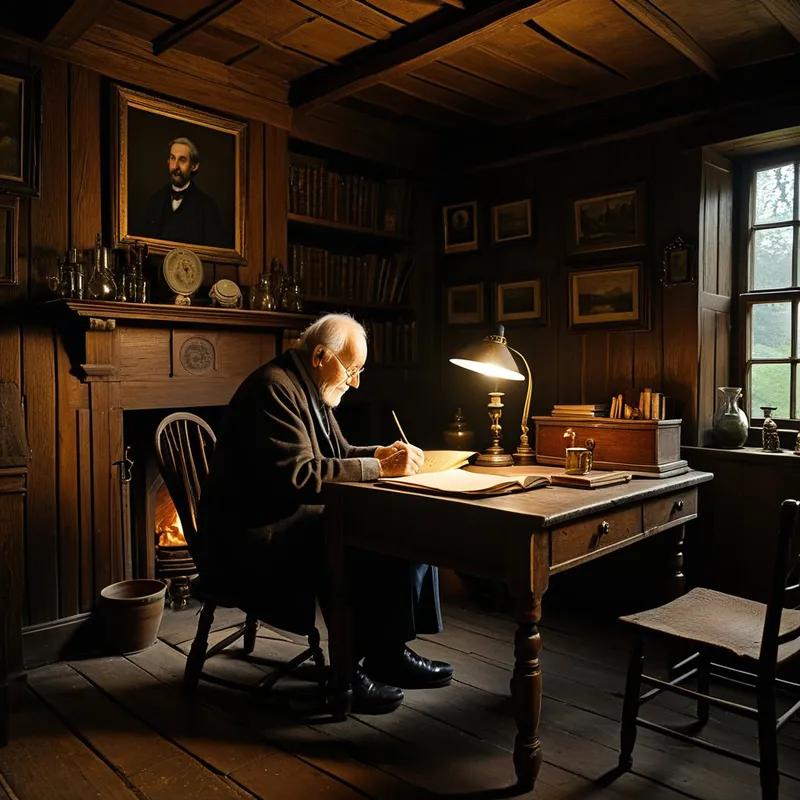
But a shadow fell. The great war came and went, leaving a deeper spiritual winter in its wake. Gerald saw the old knowledge fading, its last guardians growing old. A fire was kindled in him—not just to practice, but to preserve. He became a vessel and a scribe. In his cottage, by lamplight, he began to weave. He wove threads from the old coven’s teachings with strands from his own vast learning—folklore, ceremonial magic, the writings of Dion Fortune and Aleister Crowley. He crafted a tapestry fit for a new age.
He wrote a novel, a veil of fiction to shield a truth. He penned rituals, gave structure to ecstasy, and named the nameless. He called it Wica, and later, Wicca. He did not claim to invent it, but to give it a voice that could be heard above the din of the modern world. He built a temple in the Isle of Man, a museum of magic, a beacon. He initiated others, most notably a fiery priestess named Doreen Valiente, who helped him refine the wild poetry of the rites.
He was mocked by the newspapers, dismissed by scholars, suspected by neighbors. Yet, he stood firm, a stout, bespectacled man smiling enigmatically, holding open a door that many did not even know existed. When he passed from this world, he left behind not a dying secret, but a living, breathing path—a spark that would become a wildfire, spreading across oceans, calling the children of the disenchanted world back to the dance under the moon.
Cultural Origins & Context
This is a uniquely modern foundation myth. Unlike ancient tales passed down through millennia of oral tradition, the narrative of Gerald Gardner emerged in the mid-20th century, primarily from Gardner’s own writings, the corroborating accounts of early initiates like Doreen Valiente, and the subsequent community that formed around them. Its primary function was etiological—to explain the origin and legitimacy of Wicca as a contemporary religious practice.
Gardner positioned himself not as a prophet, but as a revealer and a synthesizer. He claimed to have been initiated into a surviving remnant of the European witch-cult, a theory popularized by Margaret Murray. While the historical veracity of this specific coven is debated by scholars, its narrative power is undeniable. It served a critical cultural purpose: it provided a lineage, a sense of ancient roots, and a break from the dominant Christian narrative that had vilified witchcraft. The myth was passed down through published books (Witchcraft Today, The Meaning of Witchcraft), through the initiatory lineage of covens, and later through the burgeoning Pagan press. It functioned as a charter myth, granting identity, authenticity, and a sense of sacred history to a rapidly growing spiritual movement born in the atomic age.
Symbolic Architecture
Psychologically, Gardner represents the Magician archetype in its most grounded form. He is the translator of the numinous.
The Magician’s task is not to create something from nothing, but to recognize the latent pattern in the chaos and speak its name into being.
His journey symbolizes the individual’s confrontation with the anima mundi—the world soul—in an era that has declared it obsolete. The “great forgetting” is the collective repression of the mystical, intuitive, and embodied aspects of the psyche. Gardner’s initiation is the symbolic moment of reconnection with the personal and collective unconscious, the anima as the Goddess. His subsequent work—the writing, the synthesizing, the building—represents the crucial process of bringing that unconscious content into conscious, communicable form. He built a temenos, a sacred container (the Book of Shadows, the ritual circle, the tradition itself) to hold the powerful and often chaotic energies of the deep psyche safely.
The controversy and mockery he faced embody the resistance of the entrenched, rationalistic ego-consciousness to the re-emergence of this repressed material. His persistent, public smile in the face of it is the symbol of the Magician’s confidence in the reality of the unseen world he serves.
The Dreamer's Resonance
When this mythic pattern stirs in the modern dreamer, it signals a profound interior process: the call to remember and legitimize one’s own innate, perhaps hidden, spiritual knowing. To dream of finding an old, handwritten book in a forest; of being secretly taught by a group of elders; of struggling to translate a powerful vision into a form others can understand—these are somatic echoes of the Gardner narrative.
Psychologically, the dreamer is integrating their personal shadow material that holds spiritual potency. The “old coven” in the dream often represents aspects of the self or ancestral wisdom that have been in hiding. The act of “writing the book” or “creating the ritual” in the dream reflects the ego’s effort to structure and make conscious this influx from the unconscious. There is often a somatic sense of urgency, of a duty to preserve something precious before it is lost. This dream pattern manifests during life transitions where one is moving from a private, intuitive understanding of the self toward a more embodied, expressed, and perhaps public identity aligned with that inner truth.
Alchemical Translation
The alchemical process modeled here is the coniunctio oppositorum—the sacred marriage—on a cultural and personal scale. Gardner’s work was an act of psychic transmutation, taking the prima materia of fragmented folklore, occult philosophy, personal mystical experience, and historical speculation, and subjecting it to the alchemical fire of his own consciousness.
Individuation requires the courage to become a heretic to the prevailing consciousness of one’s age, in service to a deeper, more holistic truth.
For the modern individual, the myth maps the journey of individuation through the lens of spiritual synthesis. The first stage (nigredo) is the “grey world”—the sense of disenchantment, spiritual alienation, and longing. The initiation in the forest is the albedo, a cleansing and illuminating encounter with the soul. The long labor of writing, arguing, and building—facing both inner doubt and outer ridicule—is the citrinitas, the yellowing, the often-frustrating work of integration. The final stage (rubedo), the reddening, is not Gardner’s personal perfection, but the creation of a living, generative system—the tradition itself—that outlives him and facilitates the transformation of others.
The ultimate alchemical gold produced is not a static dogma, but a method. It is the gift of the ritual circle, the Wheel of the Year, the tool of “working in the between.” It provides a vessel for others to perform their own opus, their own sacred marriage of self and soul, humanity and nature, consciousness and mystery. The myth of Gerald Gardner, therefore, is an invitation: to become the magician of one’s own life, to gather the scattered fragments of one’s deepest truth, and to dare to give it a name and a form in the world.
Associated Symbols
Explore related symbols from the CaleaDream lexicon: