Geometric Tilework Myth Meaning & Symbolism
A tale of a master artisan who, guided by a celestial pattern, builds a portal to the divine, only to find the infinite within the finite human heart.
The Tale of Geometric Tilework
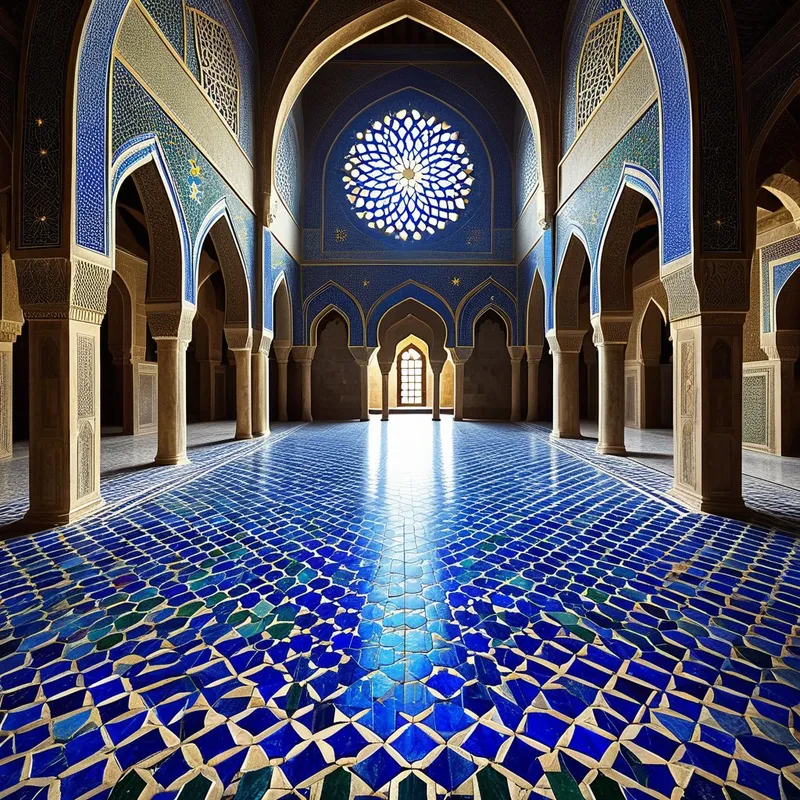
In the time when the world was a whisper between the desert’s breath and the sky’s vast eye, there lived an artisan named Abd al-Sani. His hands were maps of his labor, his eyes pools of a deep, unquenched thirst. He built palaces for sultans, mosques that touched the clouds, yet his soul remained a barren courtyard. For he sought not to build walls, but to capture a echo—the echo of the Primordial Pattern from which all things were spun.
One night, under a moon so sharp it could cut glass, a dream came. Not of forms, but of pure relation. A single, luminous point expanded into a circle. The circle birthed intersecting lines, which multiplied into stars, which blossomed into a field of infinite, interlocking harmony. It was a silent music, a frozen flame of intellect. He awoke with the scent of wet clay and ozone in his nostrils, his fingers tracing phantom angles on his woolen blanket.
Driven, he withdrew to his workshop, a cell of dust and determination. He forsook the curves of vine and flower, seeking only the truth of the compass and the straightedge. He began with a hexagon, then inscribed a star within it. From each point, another line extended, birthing another shape, in a cascade of necessary consequence. Days bled into nights, measured only by the growing mosaic on his wall. He was not placing tiles; he was following a path, unravelling a secret thread in the fabric of al-Dunya.
The local Imam came, frowning at the absence of calligraphy. "Where is the Name of the Compassionate?" he asked. Abd al-Sani, his eyes never leaving the growing pattern, replied, "I am learning to write the alphabet of His grammar." The townsfolk whispered he had gone mad, conversing with angles instead of men.
The crisis came when the pattern reached the edges of his wall. The logic of the design demanded it continue, but the physical world refused. The infinite pattern met the finite boundary. In a fever of despair, Abd al-Sani worked faster, his tiles becoming smaller, more intricate, trying to compress eternity into a last, shrinking corner. He collapsed as the final tile was set, the pattern complete yet visibly, painfully trapped.
In his exhaustion, he dreamed again. He was a single point within his own mosaic. And from that point, he saw the pattern not as a wall, but as a gateway. Every line was a path, every intersection a choice, every polygon a chamber in a palace without end. The boundary was not a wall, but a horizon. He awoke not to despair, but to a profound stillness. He looked at his wall and did not see a captured pattern. He saw a single, perfect note of a song that echoed forever in both directions. He had not built a cage for the infinite. He had built a mirror. And in its precise, boundless reflection, he found the center he sought was not in the tile, but in the quiet, understanding heart of the one who beheld it.
Cultural Origins & Context
This is not a myth written in a single book, but one inscribed across the very skin of civilization, from al-Andalus to Khurasan. It emerged from the confluence of a theological imperative and a scholarly renaissance. The aniconic tendency in Islamic sacred spaces, avoiding depiction of the divine, turned artistic genius toward the abstract. This was not a prohibition, but an invitation to explore the architecture of reality itself.
The "tale" was passed down not by bards, but by master artisans (ustadh) to their apprentices in dusty workshops, embedded in the rigorous disciplines of geometry (‘ilm al-handasa) and the sacred art of proportion. Its societal function was multifaceted: it was a meditation aid on the complexity and unity of Allah, a demonstration of worldly power and divine favor for patrons, and a living testament to the Islamic sciences' pursuit of universal truth. The tilework on a mosque wall was both a public scripture and a silent, ongoing philosophical discourse.
Symbolic Architecture
The myth’s core symbol is the Non-Terminating Pattern. It represents the transcendent order of the cosmos, the hidden mathematical substrate of creation that is rational, beautiful, and endless.
The straightedge is the law; the compass is the spirit. Where they intersect, the world is born.
The artisan, Abd al-Sani, is the human intellect and soul (nafs) in its yearning state. His initial desire to "capture" the pattern is the ego's attempt to possess and contain the divine, to reduce the infinite to a trophy. The wall represents the limiting conditions of material existence and the mortal mind. The crisis at the boundary is the essential human confrontation with finitude, mortality, and the ultimate unknowability of the Absolute.
The resolution—seeing the pattern as a gateway from within—symbolizes the pivotal shift from outward observation to inner participation. It is the moment of ma’rifah, where the seeker understands he is not separate from the pattern he studies. The finite wall becomes the starting point for an inward, limitless journey.
The Dreamer's Resonance
When geometric tilework appears in modern dreams, it rarely feels decorative. It feels operative. To dream of perfect, glowing tessellations suggests the psyche is actively engaged in a process of integration—sorting, ordering, and finding hidden relationships between disparate fragments of the self or one's life experience.
To dream of building such a pattern indicates a conscious, perhaps arduous, effort to construct a coherent worldview or personal philosophy from first principles. The somatic sensation is often one of focused precision, a calm intensity.
Conversely, to dream of the pattern cracking, dissolving, or becoming impossibly complex speaks to a confrontation with life's inherent chaos. It is the psyche's representation of a system—be it a relationship, career, or belief structure—reaching its logical limit, its "wall." The dream may evoke feelings of entrapment, intellectual overload, or awe at a complexity beyond grasp. This is the shadow of the myth: the terror of the infinite before it is recognized as home.
Alchemical Translation
The myth models the alchemical opus of individuation perfectly. The nigredo, or initial blackening, is Abd al-Sani's profound dissatisfaction, his "barren courtyard." The raw, chaotic matter of the soul is the unshaped clay.
The albedo, the whitening, is the purification through discipline—the rigorous application of compass and straightedge. This is the conscious work of analysis, therapy, or spiritual practice, imposing temporary order to see the underlying structure.
The crisis at the boundary is the crucial rubedo, the reddening. It is the fiery confrontation with the transcendent function—the psychic entity that bridges the conscious and unconscious. The ego's project fails spectacularly.
The final realization is the citrinitas, the yellowing, or illumination. The pattern is internalized. The seeker no longer looks at the law but understands he exists within and as an expression of it. The psychic material is transmuted.
The infinite pattern is the Self, the complete, boundless totality of the psyche. The wall is the ego. The myth teaches that the ego cannot encompass the Self, but it can become a perfect, finite aperture through which the light of the Self can shine in an intelligible form. The goal is not to become infinite, but to become a flawless, conscious reflection of infinity—a single, perfect tile in the grand, everlasting mosaic.
Associated Symbols
Explore related symbols from the CaleaDream lexicon: