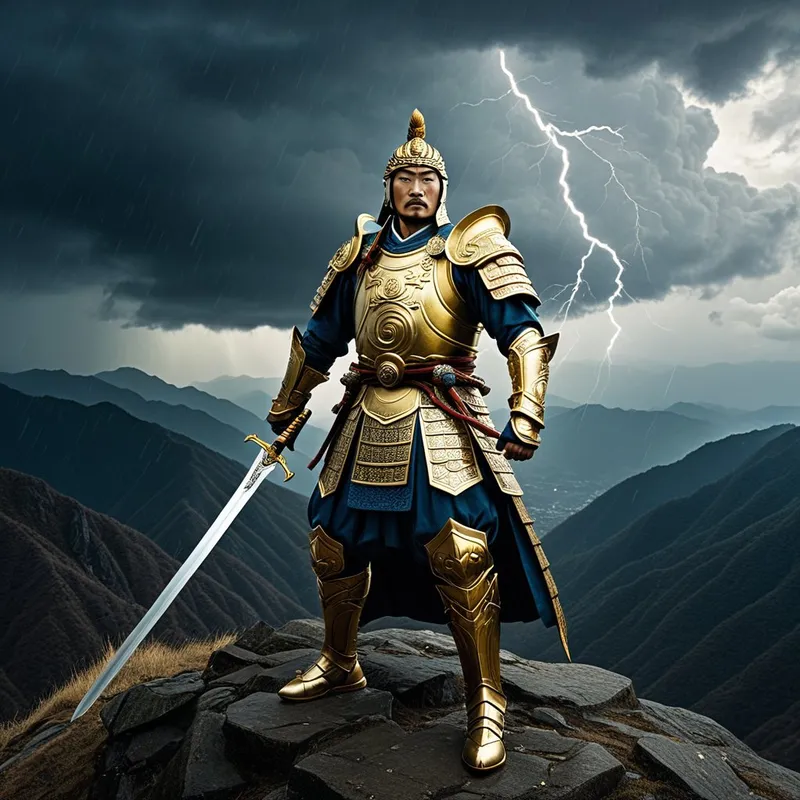
General Kim Yu-sin Myth Meaning & Symbolism
The legendary tale of a Silla prince who sacrificed personal glory to unify the Korean peninsula, becoming a symbol of destiny and transcendent purpose.
The Tale of General Kim Yu-sin
Listen, and hear the tale that the wind still whispers through the pine forests of Silla. It begins not with a birth, but with a prophecy. Under a sky streaked with the ominous light of a comet, a child was born to the royal house of Gyeongju. They named him Kim Yu-sin, and the shamans spoke in hushed tones of a destiny written in the stars—a destiny that would shake the very bones of the earth.
He grew like a bamboo stalk: straight, strong, and hollow only to sing with the wind of purpose. As a youth, he gathered a band of Hwarang, the Flower Knights, under the sacred code of loyalty, courage, and justice. They were not mere soldiers; they were poets of war, their spirits tempered in the mountain streams and their resolve hardened by the teachings of Won Gwang. Yu-sin was their bright, guiding star.
But destiny is a river with treacherous currents. The peninsula was a cauldron of war, divided into the Three Kingdoms: Silla, Baekje, and the mighty Goguryeo. Silla was besieged, its survival hanging by a thread. The king, in desperation, turned to his brilliant general. The task was impossible: unite the fractured lands. Yu-sin accepted, but the weight bowed his shoulders. He knew the cost would be measured not in gold, but in blood and broken oaths.
The conflict reached its zenith at the Battle of Hwangsanbeol. Baekje’s forces, led by the fiercely loyal general Gye Baek, stood defiant. The air was thick with the smell of damp earth and fear. Silla’s advance faltered; morale crumbled like dry clay. In that moment of impending ruin, General Kim Yu-sin made his sacrifice. He took his most cherished possession—a sword bestowed upon him, said to be blessed by the spirits of the moon and stars—and he swore a terrible vow. He pledged his own life and afterlife to the gods of mountain and stream for victory.
He drew the sword and thrust it into the earth. “If we are destined to prevail,” he cried, his voice cutting through the din, “let this blade break the sky itself!” And as if in answer, the heavens convulsed. A peal of thunder, not from clouds, but from the very fabric of fate, rolled across the battlefield. The sword did not break, but shone with a cold, relentless light. Heartened by this divine portent, or perhaps by the sheer magnitude of their general’s faith, the Silla troops found a reservoir of courage they did not know they possessed. They surged forward, and the tide turned.
Victory was achieved, but it was a bittersweet draught. Yu-sin had won the kingdom, but he had mortgaged his soul to the spirits of war. The final unification under King Munmu was his life’s work fulfilled, yet legends say he was often seen gazing westward at sunset, his eyes holding the quiet sorrow of a man who has conversed with gods and found the conversation costly. He became the sword that forged a nation, and in the forging, was himself remade.

Cultural Origins & Context
The story of General Kim Yu-sin occupies a unique space between documented history and national mythos. It is rooted in the Samguk Sagi and the Samguk Yusa, texts that blend chronicle with folklore. He was a historical figure, a paramount military leader in 7th century Silla, but his narrative was quickly woven into the cultural fabric by bards, scholars, and later, by the Muism practitioners who saw in his actions a dialogue with the animistic world.
The tale was not merely a record of events; it was a societal instrument. Told within the Hwarang tradition, it served as the ultimate exemplar of their five secular commandments: loyalty to the king, filial piety, trust among friends, courage in battle, and a commitment to justice. It provided a template for the ideal Silla citizen—one who subsumes personal ambition and even personal spiritual welfare for the collective destiny of the nation. In a culture deeply influenced by Confucian hierarchy and Buddhist concepts of karma and sacrifice, Yu-sin’s story reconciled the warrior’s path with spiritual consequence, offering a model of righteous action that transcended individual life.
Symbolic Architecture
At its heart, the myth of Kim Yu-sin is a profound drama of the individuation process enacted on a national scale. The General represents the conscious ego, gifted and capable, but facing an impossible task—the integration of the disparate, warring parts of the psyche (the Three Kingdoms).
His sacred sword is the symbol of his will, his intellect, and his connection to the transcendent (the Self). It is his tool for ordering chaos. The pivotal moment—the vow and the thrusting of the sword into the earth—is the critical act of sacrifice.
The hero does not conquer by force alone, but by offering up his most prized possession—his own sovereign self—to a power greater than his will.
He sacrifices his personal trajectory, his potential for a peaceful legacy, and his spiritual autonomy to the demands of the greater whole. This is not a martyrdom of weakness, but a conscious, agonizing choice of surrender to a transpersonal destiny. The thunder that answers is the voice of the unconscious, the Self, acknowledging the pact. Victory is achieved not by the ego’s might, but by the ego’s submission to a pattern larger than itself. The sorrow that lingers in Yu-sin is the knowledge of this bargain; the integrated Self is achieved, but the naive, self-contained ego that began the journey is gone forever.

The Dreamer's Resonance
When this myth stirs in the modern dreamer, it often manifests as a profound somatic pressure—a feeling of being tasked with an overwhelming, yet crucial, responsibility. You may dream of trying to hold together collapsing structures, of leading a group through an impossible storm, or of standing before a council of silent, judging figures (the inner “kingdom”) awaiting your decision.
The psychological process at work is the confrontation with a life-stage or crisis that demands a sacrifice of a cherished identity. Perhaps it is the ambitious professional who must sacrifice career for family, the artist who must give up a beloved style to find their true voice, or the individual who must relinquish personal grievance to heal a familial or communal rift. The dreamer is at their own Hwangsanbeol. The “sword” in the dream—the symbol of their skill, pride, or control—feels useless. The myth signals that the way forward is not through doubling down on effort, but through a sacred surrender. It is the process of offering up your old “sword,” your old way of being, to the earth of your own deeper soul, and trusting that a different kind of power will answer.

Alchemical Translation
The alchemical journey mirrored in this myth is the Nigredo giving way to the Albedo, but through the fire of conscious sacrifice (Rubedo). The base material—the divided, conflicted psyche—is subjected to the intense heat of an impossible task.
The first operation is identification with the role: the ego, as the “General,” takes up the mandate of unification. The second, crucial operation is the sacrifice of the tool. This is the alchemical “mortification.” The ego’s prized instrument (the sword of intellect, will, or a specific talent) is deliberately “buried” or offered up. This act of humility is what allows the transcendent function—the lightning from the heavens—to operate.
Individuation is not a conquest led by the ego, but a unification brokered by its surrender.
The final, integrated state is the united kingdom. It is a psyche where warring complexes (ambition vs. duty, self vs. other, tradition vs. progress) are brought under a single, functioning sovereignty. However, the myth wisely includes the General’s lingering melancholy. The alchemical gold, the philosopher’s stone of a unified Self, carries the memory of what was lost in its creation. The modern individual undergoing this process does not emerge simply “happy.” They emerge sovereign, carrying the solemn wisdom and integrated power of one who has made a pact with their own depths and fulfilled a destiny written not just for them, but through them. They become, like Kim Yu-sin, a living bridge between the earthly struggle and the celestial pattern.
Associated Symbols
Explore related symbols from the CaleaDream lexicon: